Showing posts with label #Emmaus. Show all posts

Saturday, 30 January 2016

Camino Day 15: Burgos - Hornillos (07/10/15)

A much easier day’s walking after the hard slog the previous day. We woke up at 6.30 am in the wonderful Emaús albergue and at 6.45 beautiful children’s choral music began from speakers set into the walls beside our bunk beds, which gradually rose in volume. I felt encouraged to rise above the problems and issues of life that can drag me down and instead, lift up our eyes and focus on God. The opening line of morning liturgy in the Book of Common Prayer for Ordinary Radicals says:

“O Lord, let my soul rise up to meet you

As the day rises to meet the sun”

The ethereal choral music certainly helped me rise physically and spiritually to face the day’s walking ahead!
Matthew & David outside the Emaus albergue
We had a communal breakfast together and said our goodbyes – we hoped to see some of our fellow pilgrims again, but David and the Polish brother and sister were walking faster and further than us, so we knew it was unlikely we would see them again as they planned to walk to Hontanas, whilst we were only going as far as Hornillos (21.0km). We slipped out quietly so as not to disturb those praying in the chapel and said our final goodbyes to Marie – Noelle, promising to pray for her as she requested.
Plaza Mayor
We cut down to the river and we could have followed the south bank westwards towards Santa Maria de Las Huelgas, but David wanted to find an ATM and anyway, I was keen to re-join the traditional Camino route in the medieval city centre. We had entered the old city through Arco San Juan and I wanted to symbolically exit the city through Arco San Martin. To do this we therefore crossed the rio Arlanzón on the Puente San Pablo, passed the statue of El Cid and walked across Plaza Mayor. It was lovely to see children walking to school, satchels on their backs, with their parents. This is one of the things I love about the Spanish cities I have seen; unlike British historic city centres, that seem to have lost their souls as families have moved out to the suburbs, families in Spain still seem to live their lives in the centres of cities like Burgos.
Arco San Martin
We found an ATM and then climbed up onto calle Fernán Gonzales, passing the rear of the cathedral where street sweepers were already at work, before exiting the old city through the 13th century Arco San Martin with it’s horseshoe shaped Mozarab gateway flanked by two towers. A descent down the hill on which the medieval city is built, brought us again across the Puente Malatos over the Arlanzón that we had crossed three days earlier when visiting Santa Maria de las Huelgas.
I was keen to see the 12th century gateway of the Hospital del Rey on the way out of the city, but I didn’t trust the John Brierley guidebook map of Burgos after our previous experiences of trying to find Las Huelgas and the Emaús albergue, so I asked a passing pedestrian. I was right to be sceptical; the map showed the Hospital del Rey as being just across the bridge behind the Hospital Miliatar. In fact it was on the other side of Parque El Parral. (It was however correctly located on the Burgos – Hornillos map). We reached the hospital passing another small hermitage gateway on the way.
Plateresque gateway of Hospital del Rey
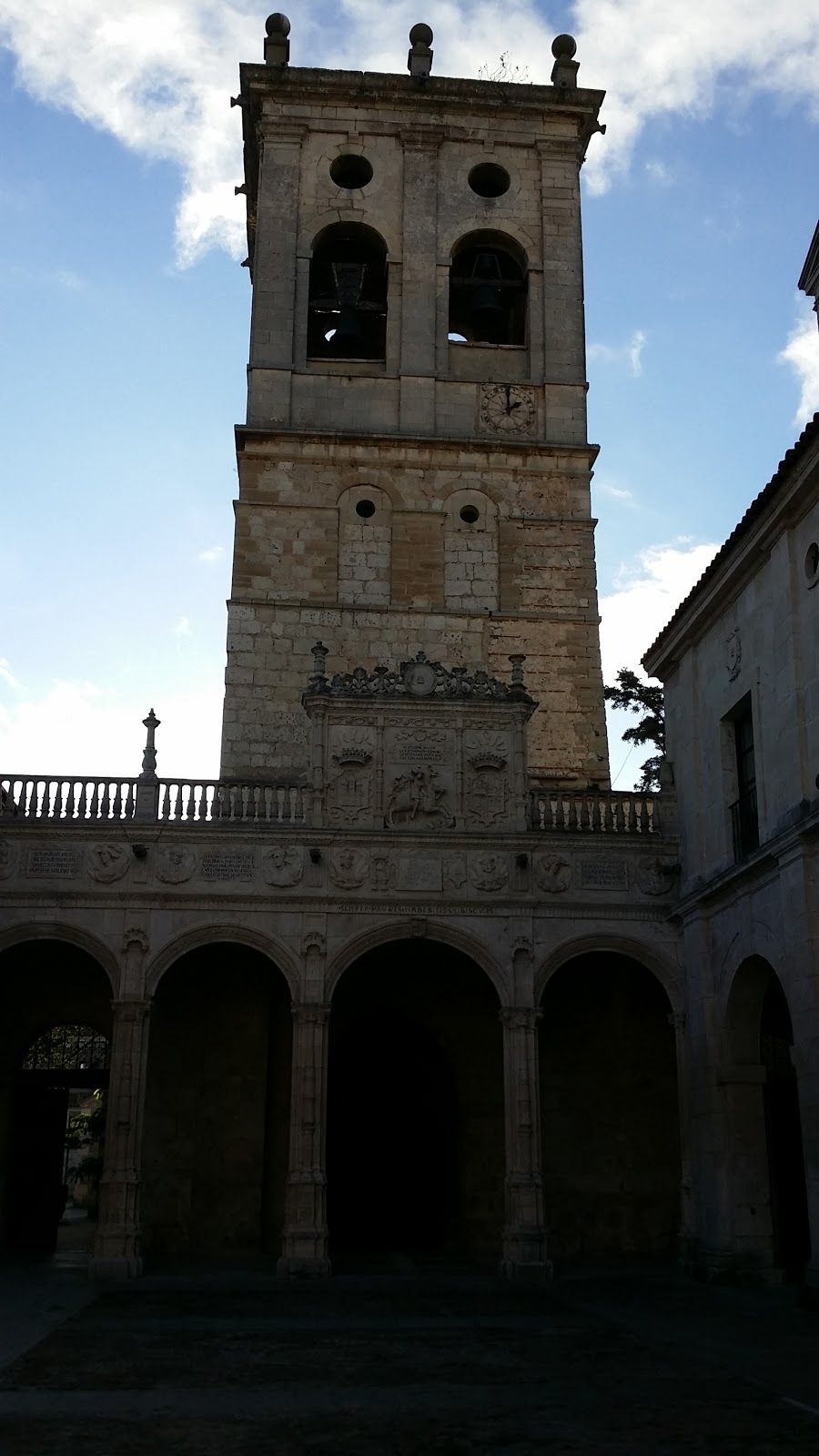
The Hospital del Rey was one of the most important pilgrim hospitals on the Camino route and was founded in 1195 by King Alfonso VIII at the same time that he founded the convent of Santa Maria de las Huelgas. A few Romanesque ruins of the hospital survive, but most of what we see today dates from the 16th century and has now been incorporated into the Law Faculty of Burgos University. A fine Plateresque Puerto de Romeros (Pilgrim’s Gate) pierces the wall of the hospital and leads through to a courtyard with the equally fine Pórtico de la iglesia. According to A Practical Guide for Pilgrims by Lozano, the Renaissance wooden church door has exceptional wood carvings featuring three generations of a family making a pilgrimage to Santiago but I missed that detail!
The rising sun was setting alight the pinnacles of the Puerto de Romeros and making it look very special indeed, but I was aware that Matthew and David were not keen to loiter and were waiting impatiently, so I quickly took some photographs of the gateways and hospital ruins, nipped into the reception desk of the Law Faculty to get a stamp on my credencial and then we moved on!
We walked on through the suburbs of Burgos before finally entering open countryside. The weather was warm and sunny and the rain had gone. I was feeling a little weary and Matthew said his legs felt very tired. However we pressed on and we again found the fields full of dead sunflowers; many of them starting to fall over or rot. This mystified me – why plant field after field of sunflowers if they are not going to be harvested and left to start decaying? Were they harvested after we had departed? I saw hundreds of such fields of unharvested sunflowers on our walk. Maybe someone reading this blog can explain why?
Ruins of Hospital del Rey
In a picnic area near Villalbilla we stopped for a snack and together said Morning Prayer before passing under a railway line and negotiating the muddy and confusing building site where the intersection of the A-231 and N-120 was being re-designed. The extensive construction site was hard to negotiate and temporary Camino signs were confusing and hard to follow.
Fields of Dead Sunflowers
At Tarjados we bumped into the Polish brother and sister again who were just leaving a café as we arrived. We stopped for second breakfast; potato tortilla with chicken washed down with vino tinto and a café con leche for a caffeine boost.
Puente de Arzobispo
Just after Tarjados is the impressive Puente de Arzobispo (the Bridge of the Archbishop) across the rio Urbel. The Archbishop of Burgos used to have his palace at Tarjados (now the Vincentian Convent). Presumably he funded the building of the bridge? Apparently this valley between Tarjados and Rabé de Las Calzadas was once notoriously swampy and gave rise to a popular rhyme:

De Rabé a Tarjados,

no te faltarán trabajos;

de Tarjados a Rabé,

¡libera nos, Domine!”


“From Rabé to Tarjados,

you’ll have your work cut out for you;

from Tarjados to Rabé,

spare us Lord!”

With the bridge and a chat with some pilgrims from New Zealand along the way, the walk to Rabé seemed more pleasant for us!
Rabe de las Calzadas
We reached Rabé de Las Calzadas, where I hoped to see the church, however it was locked and three local women were scrubbing graffiti off the church wall outside the gate – clearly even small Spanish villages are plagued with the universal scourge of graffiti “artists” who in a similar way to stray dogs like to mark their territory!
Matthew looking intrepid before the Meseta escarpment!
After Rabé, the Meseta began – it’s initial escarpment rising up in a line before us after leaving the village. In some ways it reminded me of similar escarpments in the English South Downs. The Meseta itself is a high (610 -760m) plateau that covers about 50% of the Iberia Peninsula. As I said earlier in this blog, I was concerned about walking across it as I had heard such mixed reports about it; some people said it was wonderful with expansive horizons and wide vistas, but a lot of people seemed to find it mind numbingly boring and empty. I wondered what I would think myself as we began to ascend the 950m Alto Meseta?
Hermitage at Rabe with detail of doorway carvings

The initial ascent onto the escarpment was pleasant and Matthew and I took the opportunity to do Midday Prayer together as we climbed. At the summit of Cuesta de Matamulos (another mule killer slope!) however, we were surprised to suddenly come upon Matt who was sitting admiring the view with a few pilgrims he had met including Annika from Birmingham.
Meeting Matt surprised us as we were not expecting to meet up with him until we reached Hornillos. Matt of course was delighted to meet us and being the highly gregarious and talkative person that he is, immediately began to pepper us with conversation, questions and anecdotes about his pilgrimage thus far! As I lay on the grass resting I felt a sense of culture shock come over me; Matthew, David and I had spent five days travelling together and three days walking on the Camino and had fallen into a comfortable rhythm of talking interspersed with periods of silence quiet reflection. As often seems to happen when I walk on the Camino, I find that the longer I walk, the less I feel the need to talk and enjoy the periods of solitude and silence. Now suddenly, I felt bombarded by Matt’s conversation and almost unable to cope with it! My silence began to draw Matt’s attention, which only made me feel worse as he began to ask questions like “What’s wrong with you Michael?”, “Why are you so quiet?”, “Are you in a bad mood?”
Over the next few days I would struggle with Matt’s constant stream of conversation as we walked and I began to feel guilty for wanting to wander off by myself or just tell him to shut up for a few minutes! Matt is a lovely guy and his chatter was friendly and well-meaning. So why was I having trouble coping with it? Was I being selfish for wanting peace and quiet and the Camino? These were inner questions I struggled with as I walked.
The answer however came to me as I read Henri Nouwen’s The Way of the Heart – The Spirituality of the Desert Fathers and Mothers (www.harperone.com). I usually bring a small devotional book on the Camino to read at bedtime as I lie in my albergue bunk and this is the book I had brought this time. However, I didn’t get to read it until near the end of the trip and was therefore surprised to find that it was divided into three sections: Solitude, Silence and Prayer. As I read the chapter on silence, I was startled to hear Nouwen say that “First silence makes us pilgrims. Secondly silence guards the fire within. Thirdly, silence teaches us to speak” Nouwen then went on to quote Abba Tithoes who said that “Pilgrimage means that a man should control his tongue” and said that “To be on pilgrimage is to be silent (pergrinato est tacere)” In short, says Nouwen “words can give us the feeling of having stopped too long at one of the little villages that we pass on our journey, of having been motivated more by curiosity than service”.
The other positive feature of silence that Nouwen discussed was that Silence is the discipline by which the inner fire of God is tended and kept alive”. To illustrate this Nouwen quoted Diadochus of Photiki who said that “When the door of the steambath is continually left open, the heat inside rapidly escapes through it: likewise the soul, in it’s desire to say many things, dissipates it’s remembrance of God through the door of speech, even though everything it says may be good”.
From reading Nouwen’s book, I came to realise that God was actually speaking to me through Matt’s constant chatter. When I had started walking the Camino in September 2014, I had gradually realised that God was drawing me to the value of solitude; I had spent more and more time walking and sitting by myself, just enjoying the peace of God’s presence. This time I realised that God was speaking to me about the value of silence. It wasn’t about Matt talking too much or about me feeling selfish, it was about me learning to talk less and build up the steam of God’s presence and love in my heart, so that I have something to offer people when God brings them to me and to help me realise that silence, as Nouwen said, can become “a portable cell taken with us from the solitary place into the midst of our ministry”. This is countercultural stuff in a verbose world that never shuts up and is full of a constant stream of chatter (much of it inane) on radio, television and social media, but something I need to learn if I am to have anything to offer of value to those around me.
Descending Cuesta Matamulas with
Hornillos in distance
Nevertheless, as the four of us set off down the mule killer slope towards Hornillos, I deliberately hung back and let Matt go on ahead with Matthew and David so I could enjoy the peace of the Meseta!
Calle Real, Hornillos
At Hornillos we checked into the Meeting Place Albergue. The other albergues were filling up fast and we were unable to get into the albergue with the swimming pool! The Meeting Place was however pleasant and modern and we had no complaints about the facilities.
Medieval jettied buildings
After showering and resting David, Matthew and myself had a walk around the small town (more of a large village actually) which had clearly seen more prosperous days, but still had an attractive down-at-heel ambience. The main street was lined with medieval buildings – some of them dilapidated timber-framed structures with jettied protruding second storeys. There was once a Benedictine Monastery in the village and I wondered if one of the buildings on the Main Street was part of this or had been a Pilgrim Hospital as it had carvings of a chalice and St. Peter’s Keys and a Cross of Santiago over it’s doorways? Nearby, I was startled to see a more modern house with a stone medieval sarcophagus acting as the lintel over the front door!

Beyond the edge of town, David, Matthew and I also stumbled upon some medieval ruins which may have been the remains of the Hospital of San Lázaro – one of many leprosaria that were once strung along the Camino? The surrounding area seemed to full of storerooms built into the hillside and presumably used by the locals to keep produce cool in summer before the days of refrigeration?
Sarcophagus doorway
In the centre of the village was a small plaza with a Parish Church and the picturesque Hen Fountain or Fuente del Gallo. Annika was sitting on the steps of the municipal albergue doctoring her feet, which looked in a very sorry state with numerous blisters.
Fuente del Gallo
It didn’t take long to look around town and then Matt joined us and we had some lunch in a nearby café and shared communion together with some of the left over bread and wine. Afterwards Matt and David returned to the albergue and Matthew and I walked over to the beautiful parish church and sat for a long time. We enjoyed the soaring gothic architecture (surprisingly grand for such a small place and clearly hinting at a more important past) and enjoyed the peace; reading the Psalms of Ascents together and meditating on them.
We returned to the albergue in time for the communal meal of chicken paella and got talking to an American from California who works in an Emergency Control Room despatching the police, fire and ambulances in response to 911 calls. As David has spent a career working for the Fire Service in Cork, there was much comparing of notes between the way things are done in California and Ireland!


We finished the evening by sitting on the bench outside the albergue under a starry meseta sky saying Evening Prayer together before the chill got too much and we scuttled back inside.
Paella

Friday, 8 January 2016

Camino Day 14: San Juan De Ortega - Burgos Part II (06/10/15)

It was after 2pm by the time we finally left Cartuja de Miraflores and we were feeling very tired and hungry. I was particularly concerned about Matthew, who had been very patient while I looked round the monastery, but now looked very pale and exhausted and was suffering with the pain in his knee. As we walked back down the hill towards Burgos, he looked ready to collapse, so I insisted that he sucked the entire contents of a tube of glucose energy gel that I gave him. I remembered having my slump on the way to San Millán, so I knew what it could feel like!
We walked back to where we had left the path beside the rio Arlanzón (this took about 20 minutes and then continued until we reached a large wide boulevard called Timoteo Arnaiz. Unfortunately, to add to our hunger, tiredness and weakness, we now had to face again the inaccuracy of the urban maps in John Brierley’s guidebook. I was keen that we stay at the Casa de Peregrinos Emaús Albergue; a Parish albergue that I liked the sound of in the guidebook because it said that it had a shared meal with Christian prayer and a pilgrim blessing. It was situated on the south side of the river, on the opposite side from the medieval city centre. The map of Burgos in the guidebook showed clearly that all we had to do was walk down Timoteo Arnaiz and turn right onto calle de San Pedro de Cardeña. The Albergue was shown as being situated at the corner of the calle and calle Molinillo and the accompanying blurb said that it was at 31 calle de San Pedro de Cardeña.
We trudged in a very weary manner along the above streets. They turned out to be longer than they looked on the map and the area was rather scruffy and had that ugly urban look that many city suburbs have, which did not enhance our mood. I kept a concerned eye on Matthew who looked thoroughly exhausted and fed up.
We finally reached the site marked on the map as the location of the albergue, but instead, were confused and rather irritated to find a bar! We looked up and down the street, but could see no albergue or church. Exhausted, we decided to go into the bar to see if they served pintxos and regroup! Luckily, the bar was still serving a good variety of pintxos and I immediately ordered a large selection accompanied by three glasses of rioja whilst Matthew went off to the bathroom for what seemed a very long time (he later told me that he was so tired that he was nearly in tears and so thought he had better go in the bathroom for a while. He had felt like giving up, but as I said to him later, he didn’t – perserverance makes a real pilgrim and he showed it that day and I was proud of my friend). When he returned, he told me that he didn’t feel like eating but David and I told him we didn’t care whether he felt like it or not and ordered him to eat to regain his strength. By the time we had all eaten several pintxos, had some wine and then coffees (and a hot chocolate for Matthew), we all began to feel a bit better at least!
We now discussed what we were going to do. Should we give up attempting to find the Emaús albergue and walk on into the city centre? We showed the barman the map, but he looked at it in astonishment and couldn’t make it out and just shrugged. He didn’t seem to have heard of the Emaús albergue. I returned to the table and then had the bright idea that since in the guidebook it said that the albergue was situated behind the church of San José Obrero, maybe he had heard of the church, if not the albergue? I tried again – “Por favour – iglesia San José Obrero?” Ah! This time recognition from the barman and he drew directions on a piece of paper. It turned out that the albergue was not on calle de San Pedro de Cardeña at all, but in a street that ran parallel behind it and was not even marked on the map! Note to John Brierley, Camino Guides and Findhorn Press – please improve your urban maps!!
We walked round to the church in less than two minutes and found a door at the side with a notice that said that pilgrims could only stay there if they had not already stayed at another albergue in Burgos. Matt had arrived in Burgos the day before and although he had also seen the sign earlier in the day, he had tried to bluff his way in and stay there, but was turned away when he presented his credencial and the stamp from the previous night was spotted – I don’t know why he even tried it!? He texted us and told us that he was now staying at Hostal Evolucion in the city centre instead.
We rang the bell and were greeted by the Hospitalero, a very friendly French woman called Marie-Noelle who explained that the rules of the Emaús albergue were different than in most albergues. Firstly we had to keep the noise down as there was a continuous adoration of the eucharist taking place in the chapel downstairs inside the building. The worshippers were also praying for the pilgrims who stayed in the albergue. Secondly there was a mass and pilgrim blessing at 6.30pm and the albergue locked its doors at 8pm (most albergues stay open until 10pm) because there was a communal meal and prayer time after the mass. “These are the rules – we try to create a place of rest for pilgrims, do you still want to stay?” We said we were quite happy to do so – it sounded great to us!
Inside, the albergue was very well appointed and the nicest that I have stayed in – better even than the Check In Rioja albergue in Logroño! Marie-Noelle explained that the building had been a Jesuit Seminary which had closed and become dilapidated. The parish priest now in residence had the visionary idea of raising money to restore the seminary building, create an albergue inside part of it and create a chapel to provide mass for the locals. At the time the priest had been told that he was mad, would never raise enough money, would bankrupt himself and that pilgrims would not want to stay in this part of the city. However, he preserved and eventually, the work was completed to an extraordinary level of quality and detail.

The Jesuit Seminary staircase

Leaving our boots on the ground floor, Marie-Noelle took us up the wide sweeping staircase of the old seminary with it’s stained glass windows, to the second floor where the albergue had been created. On one side of the staircase landing were the bedrooms and bathrooms, furnished with bunks and lockers in Scandinavian style light wood. The showers were good quality and we even discovered the following morning that there were speakers set into the walls to wake us up with gentle choral music! On the other side of the landing there was a lovely cosy lounge area also clad with timber, steps to a small balcony library, an open plan dining area and a well-appointed kitchen.
Several other pilgrims were already staying at the albergue – an Italian called David from Turin, a Danish lady who lived in Sweden, a German lady and a brother and sister from Poland. All spoke good English and we chatted to them and enjoyed their company.

We gratefully showered and washed our clothes (including re-washing the damp ones we had not manged to dry at San Juan de Ortega. Although the tumble drier wasn’t working, there was a balcony and we hung our clothes to dry there instead.
Walking along the rio Arlanzon into Burgos
Matthew was feeling more energised now that he had digested his pintxos and showered and so we texted Matt and agreed to meet him in the city centre after I had shown Matthew the cathedral. Marie-Noelle informed us that entrance to the cathedral was free on that day.
Matt with the churros con chocolate
The walk into town took about twenty minutes and we spent an hour walking around the cathedral before bumping into Matt near the chapels around the high altar. We were slightly limited for time, because we wanted to be back at the albergue for the mass and pilgrim blessing, so we left the cathedral and went to the Favour Chocolate café in Plaza Santa Maria – opposite the main entrance of the cathedral. The café was decorated in early twentieth century gentile splendour and we indulged in churros con chocolate – very large, long fingers of fried dough, sprinkled with sugar for dipping in really superb thick viscous chocolate caliente. Excellente! Mega calorie intake! We felt however that we could afford to indulge after all our walking! We were rather shocked to see that the menu suggested that one serving should consist of seven churros to eat for each person, but we managed to reduce this and ask for one serving of churros only to share with our three hot chocolates!
Matt had been walking for a few days by himself since Ben had left him at Najera to go to Brazil and had not seen either of us for about two weeks, so he was extremely talkative in a way that Matthew and I found rather shocking after David and ourselves had lived fairly quietly together for the last few days. In the café Matt started a random stream of consciousness that he specialises in at times, sharing with us his knowledge of Spain gleaned over the previous two weeks, telling us about the various pilgrims he was walking with and even explaining the “correct” pronunciation of Najera to me ;-) We love him dearly and were glad to see him, but in a way, we were also glad to leave him talking to the tourists at the next table whilst we headed back to the Emaús albergue!


Marie-Noelle with German pilgrim
We returned just in time for the mass. The chapel was full of locals from the area surrounding the church, which I liked as I felt it had an authentic feel and lacked the “touristy” feel of some of the churches I have been in on the Camino. A local signalled at Matthew and made room for him on a pew and I sat at the back with David from Turin. The three of us observed the Mass, whilst most of the pilgrims went forward and took the Eucharist. Afterwards all of us went forward for a pilgrim blessing from the priest.
Marie- Noelle then escorted us back upstairs, where we set the dining table and had a simple but filling meal, whilst sharing our stories and laughing and chatting together. Marie-Noelle explained how, each morning, she bought food for the evening meal using money donated by pilgrims who had stayed the previous night.
Matthew, Marie- Noelle, David, Me, David from Turin,
with the Polish, German and Danish pilgrims
After our meal we washed the dishes together, set the table for breakfast and then shared a time of communal prayer together. We were given a little booklet as a gift and read Luke chapter 24, verses 13-35 together before praying the pilgrim blessing. It was a wonderful time of fellowship; a time of peace and unity despite being from so many nationalities and the whole visit to the albergue was such a restful experience – a credit to Marie- Noelle who welcomes pilgrims day after day and yet seems unflagging in her gracious welcome and hospitality to pilgrims.
Luke 24: 23-35
Now that same day two of them were going to a village called Emmaus, about seven miles from Jerusalem. They were talking with each other about everything that had happened. As they talked and discussed these things with each other, Jesus himself came up and walked along with them; He asked them, ‘What are you discussing together as you walk along?’ They stood still, their faces downcast. One of them, named Cleopas, asked him, and ‘Are you the only one visiting Jerusalem who does not know the things that have happened there in these days?’ ‘What things?’ he asked. ‘About Jesus of Nazareth,’ they replied. ‘He was a prophet, powerful in word and deed before God and all the people. The chief priests and our rulers handed him over to be sentenced to death, and they crucified him; but we had hoped that he was the one who was going to redeem Israel. And what is more, it is the third day since all this took place. In addition, some of our women amazed us. They went to the tomb early this morning but didn’t find his body. They came and told us that they had seen a vision of angels, who said he was alive. Then some of our companions went to the tomb and found it just as the women had said, but they did not see Jesus.’ He said to them, ‘How foolish you are, and how slow to believe all that the prophets have spoken! Did not the Messiah have to suffer these things and then enter his glory?’ And beginning with Moses and all the Prophets, he explained to them what was said in all the Scriptures concerning himself. As they approached the village to which they were going, Jesus continued on as if he were going further. But they urged him strongly, ‘Stay with us, for it is nearly evening; the day is almost over.’ So he went in to stay with them. When he was at the table with them, he took bread, gave thanks, broke it and began to give it to them. Then their eyes were opened and they recognised him, and he disappeared from their sight. They asked each other, ‘Were not our hearts burning within us while he talked with us on the road and opened the Scriptures to us?’ They got up and returned at once to Jerusalem. There they found the Eleven and those with them, assembled together and saying, ‘It is true! The Lord has risen and has appeared to Simon.’ Then the two told what had happened on the way, and how Jesus was recognised by them when he broke the bread.
Bendición del Peregrino

Lord, bless the pilgrim’s feet…Bless his suffering, the result of many kilometres.

Bless these feet which have borne the weight of the day; bless every step of this way and bless all the ways and steps of his life. Lord, bless his history.

Lord, bless his rucksack. Bless the weight he carries on his shoulders, bless everything he has left at home before leaving and suffering; bless his family, his work, his relationships…May your blessing, Lord, lighten the weight of the day.

Lord, bless his eyes. You made them for contemplation. All along the way, may his eyes become familiar with the beauty of creation, the beauty of each pilgrim, the beauty of each gesture of affection and of service. Open his eyes, that one day they may meet you and recognise you!

Lord, bless his heart. That all along the road YOU may be his special guest. Like the disciples of Emmaus, I say to you: “Stay with me, Lord and YOU shall be my greatest blessing”.

Amen!

Thursday, 27 August 2015

The Sacrament of the Ordinary


One of my favourite painters is Caravaggio; whenever I am in Dublin, I always try and find time to sit for a few minutes in the National Gallery of Ireland and contemplate The Taking of Christ - an experience made all the more moving by seeing Caravaggio's self-portrait on the far right of the crowd; his face illuminated by a lantern, desperately straining to try and see Christ in the gathering darkness. He was a man so tortured and restless in real life and I am sure this is no artistic coincidence; his way of saying how he sincerely longed for God and yet felt so distant; a prisoner of his anger, pride and dissolute lifestyle. He was a man who painted with heavenly talent during the day, but squandered it at night in drunken brawls and vendettas that led to him murdering a man and going down to an early grave himself.

The Taking of Christ
I have spent an enjoyable time on holiday in recent years examining paintings like his Bacchus in the Uffizi in Florence. Is Caravaggio’s Sicilian friend Mario Minniti just modelling the god of wine or does the painting hint at something much deeper – the Eucharist; as a goblet of rich red wine is held out towards the viewer above the over-ripe fruit; symbol of the transience of life?

Bacchus
In June 2014 whilst on holiday in Rome, I bemused my children by visiting as many of his paintings as I could manage! Astonishing paintings like those in the Cerasi Chapel in Santa Maria del Popolo; The Crucifixion of St. Peter, where the weight of Peter’s cross is felt as his executioners hoist him aloft or The Conversion of St. Paul where the almost tangible solidity of the horse is contrasted by the heavenly light that has fallen on the spead-eagled St. Paul as his moment of conversion is internalised and he is caught up in ecstasy to the eternal sphere.

Crucifixion of St. Peter
What is it I like so much about Caravaggio's paintings? One reason is their almost photographic realism - the art critic and TV presenter, Andrew Graham Dixon in his excellent book, Caravaggio - A Life Sacred and Profane has pointed out that if Caravaggio was alive today, he would probably be a film director because of the radical use of light in his paintings, which are like freeze frame moments - his paintings are always full of latent action.

Conversion of St. Paul
But the other reason I am attracted to Caravaggio's paintings is their realism. As Graham - Dixon points out, you only have to compare the fanciful paintings of Caravaggio's rival Annibale Carracci - paintings like his Assumption of the Virgin in the same Cerasi Chapel, with it's contrived postures, characters who not placed in space and time, and who are adorned with lurid colours to see how radical Caravaggio was in the way he grounded his paintings in normal life. The sheet covering Bacchus' couch is grimy and revealing the ticking underneath; the feet of the executioner lifting St. Peter's cross are dirty; the imperfections in the flank of St. Paul's horse are lovingly recorded so that you feel you can almost feel it twitching beneath your hand.

Caravaggio did not dress up the characters in his paintings with a holy aura; with halos and rich clothes; he made them into ordinary people from the everyday Rome of the 16th Century that he lived in. He made the biblical stories take place in taverns among the poor and the working class. This scandalised the Church of his day who didnt want to see Jesus portrayed as a humble peasant mixing with the dubious dregs of society, but as a but a glorious and triumphant God suitable for Princes and Cardinals! But I am with Caravaggio, for the Kingdom of God is open to all and blessed are the poor, the hungry the persecuted and those who mourn.


Caracci's Assumption of the Virgin
 Which brings me to my favourite of Caravaggio's paintings; The Supper at Emmaus, painted in 1601, which hangs in the National Gallery in London. I have been thinking a lot recently about what we might call the Sacrament of the Ordinary. A sacrament is an outward sign of an invisible grace as I have said previously in this blog. For example, the seemingly ordinary bread and the wine that believers take at Communion is an outward symbol of the salvation and new life that was won for us on the cross by Christ. As the Christian writer Richard Foster points out "to speak of life as sacramental means that everything visible in some way points to the invisible - the constant upholding reality of eternal grace. The wind, a bird in flight or glass of water - the Spirit. A good meal - God's provision. The embrace of a loved one - God's love to us." And Foster goes on to say that “the fact that God became a man affirms every aspect of human experience as potentially holy ground".

The Supper at Emmaus
Caravaggio deliberately grounded his paintings in the everyday life of the world around him because he understood the sanctity of the ordinary; that whispers of God's glory, love and presence could be found in everyday life. 

The incident portrayed in The Supper at Emmaus comes from Luke’s Gospel Chapter 24, verses 13 – 35. In these verses we are told that two of Jesus’ followers were walking about seven miles from Jerusalem to the village of Emmaus on the Sunday morning after Jesus’ crucifixion. They were downcast and were talking about Jesus’ death two days before and a rumour that Jesus had risen from the dead, when suddenly the resurrected Jesus appears and walks alongside them, but they are kept from recognising him due to some change in his appearance or because of their depressed state. Jesus asks them what they are talking about and then goes on to explain from Scripture “beginning with Moses and all the prophets” how his coming death and resurrection was foretold.

When they reached Emmaus, Jesus makes to continue on, but the disciples urge him to stay with them as it is nearly evening. They have a meal together and then Luke tells us that Jesus

“took bread, gave thanks, broke it and began to give it to them. Then their eyes were opened and they recognised him and he disappeared from their sight. They asked each other “Were not our hearts burning within while he talked with us on the road and opened the Scriptures to us”. (Luke 24:30-32).

In his painting Caravaggio has captured in freeze-frame that split-second moment as Jesus breaks the bread and the disciples have their eyes opened. One disciple is just in the process of pushing himself out of his chair in shock, the other disciple has his arms stretched out in utter amazement; his left hand seems to reach out of the membrane of the canvas to touch us.

But what is really interesting about the painting is the seeming ordinariness of the scene – even the muted colours are “ordinary” – muted greens and reds; none of Annibale Carracci’s gaudiness here! Caravaggio places the Supper at Emmaus in an ordinary 16th Century tavern of the type he drank in frequently in Rome. Apparently to the viewer it’s just a pub scene; the Innkeeper who has just brought the food to the table doesn’t seem to see anything special about Jesus (who is unusually portrayed as beardless to symbolise his resurrected body). The disciples just seem poor down-at-heel working folk wearing worn old clothes (one with a hole in his jacket’s elbow).

But he who has eyes let him see, for look more closely and in the seeming ordinariness, those who are prepared to believe will find God’s glory. For what do we see on the table but bread and a jug of wine, whispers of the Eucharist as in the Bacchus painting? There again is the basket of over ripe fruit, this time teetering on the edge of the table, a device often used in the period to hint at mortality. But look at the shadow cast by the fruit and we see a fish’s tail. The fish was an early Christian symbol. To emphasise mortality further the dead scrawny chicken lies with it’s shrivelled feet. However, these feet are echoed by the hand of Christ raised in a life-giving benediction and the shadow on the wall behind him makes a halo above Christ’s head. In the midst of the ordinariness of everyday life, Christ is still very much present if we choose to see him

One of the things that fascinates me about the Camino is that there are often long sections of just trudging along where nothing seems to happen and which seem very mundane and ordinary; a long straight section beside a noisy motorway maybe, or a walk through an ugly industrial or urban landscape. But I have come to realise that life itself is the same; very often there are long ordinary stretches of going to work day after day or taking the kids to school or cutting the grass and doing housework. There are no mountain top experiences or special revelations, though they come too eventually to refresh us just as a beautiful section or event on the Camino eventually occurs. And yet in the midst of seeming "ordinariness" God can still speak. In fact, that is precisely where he often speaks if we are listening. He comes and meets us as we just pod along.

Foster comments that in the bible “God showed up in the most ordinary and common way possible, from the ground up, in an out of the way place, with only a few common folk summoned to witness his arrival". The discovery of God he says "lies in the daily and the ordinary, not in the spectacular and the heroic. If we cannot find God in the routines of home and shop, then we will not find him at all". I pray that you and I will have eyes to see Jesus when he meets us in the guise of the ordinary, whether walking the Camino on one of the boring stretches or just on the everyday pilgrimage of life.

By the way, did you notice that the disciple on the right is a pilgrim? Look more closely; he is proudly wearing a scallop shell on his breast – he must have been to Santiago!