Showing posts with label #AlfonsoVIII. Show all posts

Saturday, 30 January 2016

Camino Day 15: Burgos - Hornillos (07/10/15)

A much easier day’s walking after the hard slog the previous day. We woke up at 6.30 am in the wonderful Emaús albergue and at 6.45 beautiful children’s choral music began from speakers set into the walls beside our bunk beds, which gradually rose in volume. I felt encouraged to rise above the problems and issues of life that can drag me down and instead, lift up our eyes and focus on God. The opening line of morning liturgy in the Book of Common Prayer for Ordinary Radicals says:

“O Lord, let my soul rise up to meet you

As the day rises to meet the sun”

The ethereal choral music certainly helped me rise physically and spiritually to face the day’s walking ahead!
Matthew & David outside the Emaus albergue
We had a communal breakfast together and said our goodbyes – we hoped to see some of our fellow pilgrims again, but David and the Polish brother and sister were walking faster and further than us, so we knew it was unlikely we would see them again as they planned to walk to Hontanas, whilst we were only going as far as Hornillos (21.0km). We slipped out quietly so as not to disturb those praying in the chapel and said our final goodbyes to Marie – Noelle, promising to pray for her as she requested.
Plaza Mayor
We cut down to the river and we could have followed the south bank westwards towards Santa Maria de Las Huelgas, but David wanted to find an ATM and anyway, I was keen to re-join the traditional Camino route in the medieval city centre. We had entered the old city through Arco San Juan and I wanted to symbolically exit the city through Arco San Martin. To do this we therefore crossed the rio Arlanzón on the Puente San Pablo, passed the statue of El Cid and walked across Plaza Mayor. It was lovely to see children walking to school, satchels on their backs, with their parents. This is one of the things I love about the Spanish cities I have seen; unlike British historic city centres, that seem to have lost their souls as families have moved out to the suburbs, families in Spain still seem to live their lives in the centres of cities like Burgos.
Arco San Martin
We found an ATM and then climbed up onto calle Fernán Gonzales, passing the rear of the cathedral where street sweepers were already at work, before exiting the old city through the 13th century Arco San Martin with it’s horseshoe shaped Mozarab gateway flanked by two towers. A descent down the hill on which the medieval city is built, brought us again across the Puente Malatos over the Arlanzón that we had crossed three days earlier when visiting Santa Maria de las Huelgas.
I was keen to see the 12th century gateway of the Hospital del Rey on the way out of the city, but I didn’t trust the John Brierley guidebook map of Burgos after our previous experiences of trying to find Las Huelgas and the Emaús albergue, so I asked a passing pedestrian. I was right to be sceptical; the map showed the Hospital del Rey as being just across the bridge behind the Hospital Miliatar. In fact it was on the other side of Parque El Parral. (It was however correctly located on the Burgos – Hornillos map). We reached the hospital passing another small hermitage gateway on the way.
Plateresque gateway of Hospital del Rey
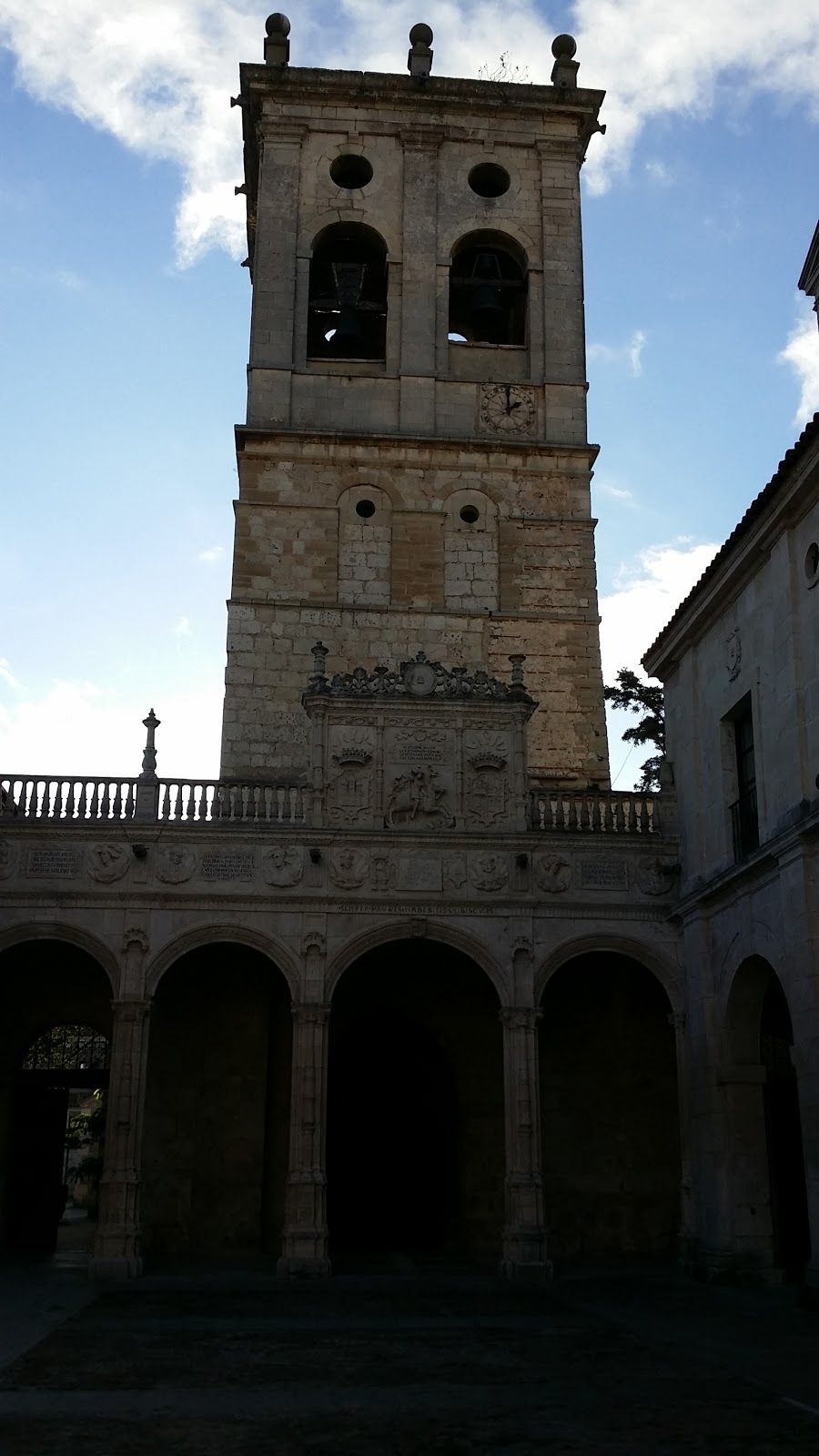
The Hospital del Rey was one of the most important pilgrim hospitals on the Camino route and was founded in 1195 by King Alfonso VIII at the same time that he founded the convent of Santa Maria de las Huelgas. A few Romanesque ruins of the hospital survive, but most of what we see today dates from the 16th century and has now been incorporated into the Law Faculty of Burgos University. A fine Plateresque Puerto de Romeros (Pilgrim’s Gate) pierces the wall of the hospital and leads through to a courtyard with the equally fine Pórtico de la iglesia. According to A Practical Guide for Pilgrims by Lozano, the Renaissance wooden church door has exceptional wood carvings featuring three generations of a family making a pilgrimage to Santiago but I missed that detail!
The rising sun was setting alight the pinnacles of the Puerto de Romeros and making it look very special indeed, but I was aware that Matthew and David were not keen to loiter and were waiting impatiently, so I quickly took some photographs of the gateways and hospital ruins, nipped into the reception desk of the Law Faculty to get a stamp on my credencial and then we moved on!
We walked on through the suburbs of Burgos before finally entering open countryside. The weather was warm and sunny and the rain had gone. I was feeling a little weary and Matthew said his legs felt very tired. However we pressed on and we again found the fields full of dead sunflowers; many of them starting to fall over or rot. This mystified me – why plant field after field of sunflowers if they are not going to be harvested and left to start decaying? Were they harvested after we had departed? I saw hundreds of such fields of unharvested sunflowers on our walk. Maybe someone reading this blog can explain why?
Ruins of Hospital del Rey
In a picnic area near Villalbilla we stopped for a snack and together said Morning Prayer before passing under a railway line and negotiating the muddy and confusing building site where the intersection of the A-231 and N-120 was being re-designed. The extensive construction site was hard to negotiate and temporary Camino signs were confusing and hard to follow.
Fields of Dead Sunflowers
At Tarjados we bumped into the Polish brother and sister again who were just leaving a café as we arrived. We stopped for second breakfast; potato tortilla with chicken washed down with vino tinto and a café con leche for a caffeine boost.
Puente de Arzobispo
Just after Tarjados is the impressive Puente de Arzobispo (the Bridge of the Archbishop) across the rio Urbel. The Archbishop of Burgos used to have his palace at Tarjados (now the Vincentian Convent). Presumably he funded the building of the bridge? Apparently this valley between Tarjados and Rabé de Las Calzadas was once notoriously swampy and gave rise to a popular rhyme:

De Rabé a Tarjados,

no te faltarán trabajos;

de Tarjados a Rabé,

¡libera nos, Domine!”


“From Rabé to Tarjados,

you’ll have your work cut out for you;

from Tarjados to Rabé,

spare us Lord!”

With the bridge and a chat with some pilgrims from New Zealand along the way, the walk to Rabé seemed more pleasant for us!
Rabe de las Calzadas
We reached Rabé de Las Calzadas, where I hoped to see the church, however it was locked and three local women were scrubbing graffiti off the church wall outside the gate – clearly even small Spanish villages are plagued with the universal scourge of graffiti “artists” who in a similar way to stray dogs like to mark their territory!
Matthew looking intrepid before the Meseta escarpment!
After Rabé, the Meseta began – it’s initial escarpment rising up in a line before us after leaving the village. In some ways it reminded me of similar escarpments in the English South Downs. The Meseta itself is a high (610 -760m) plateau that covers about 50% of the Iberia Peninsula. As I said earlier in this blog, I was concerned about walking across it as I had heard such mixed reports about it; some people said it was wonderful with expansive horizons and wide vistas, but a lot of people seemed to find it mind numbingly boring and empty. I wondered what I would think myself as we began to ascend the 950m Alto Meseta?
Hermitage at Rabe with detail of doorway carvings

The initial ascent onto the escarpment was pleasant and Matthew and I took the opportunity to do Midday Prayer together as we climbed. At the summit of Cuesta de Matamulos (another mule killer slope!) however, we were surprised to suddenly come upon Matt who was sitting admiring the view with a few pilgrims he had met including Annika from Birmingham.
Meeting Matt surprised us as we were not expecting to meet up with him until we reached Hornillos. Matt of course was delighted to meet us and being the highly gregarious and talkative person that he is, immediately began to pepper us with conversation, questions and anecdotes about his pilgrimage thus far! As I lay on the grass resting I felt a sense of culture shock come over me; Matthew, David and I had spent five days travelling together and three days walking on the Camino and had fallen into a comfortable rhythm of talking interspersed with periods of silence quiet reflection. As often seems to happen when I walk on the Camino, I find that the longer I walk, the less I feel the need to talk and enjoy the periods of solitude and silence. Now suddenly, I felt bombarded by Matt’s conversation and almost unable to cope with it! My silence began to draw Matt’s attention, which only made me feel worse as he began to ask questions like “What’s wrong with you Michael?”, “Why are you so quiet?”, “Are you in a bad mood?”
Over the next few days I would struggle with Matt’s constant stream of conversation as we walked and I began to feel guilty for wanting to wander off by myself or just tell him to shut up for a few minutes! Matt is a lovely guy and his chatter was friendly and well-meaning. So why was I having trouble coping with it? Was I being selfish for wanting peace and quiet and the Camino? These were inner questions I struggled with as I walked.
The answer however came to me as I read Henri Nouwen’s The Way of the Heart – The Spirituality of the Desert Fathers and Mothers (www.harperone.com). I usually bring a small devotional book on the Camino to read at bedtime as I lie in my albergue bunk and this is the book I had brought this time. However, I didn’t get to read it until near the end of the trip and was therefore surprised to find that it was divided into three sections: Solitude, Silence and Prayer. As I read the chapter on silence, I was startled to hear Nouwen say that “First silence makes us pilgrims. Secondly silence guards the fire within. Thirdly, silence teaches us to speak” Nouwen then went on to quote Abba Tithoes who said that “Pilgrimage means that a man should control his tongue” and said that “To be on pilgrimage is to be silent (pergrinato est tacere)” In short, says Nouwen “words can give us the feeling of having stopped too long at one of the little villages that we pass on our journey, of having been motivated more by curiosity than service”.
The other positive feature of silence that Nouwen discussed was that Silence is the discipline by which the inner fire of God is tended and kept alive”. To illustrate this Nouwen quoted Diadochus of Photiki who said that “When the door of the steambath is continually left open, the heat inside rapidly escapes through it: likewise the soul, in it’s desire to say many things, dissipates it’s remembrance of God through the door of speech, even though everything it says may be good”.
From reading Nouwen’s book, I came to realise that God was actually speaking to me through Matt’s constant chatter. When I had started walking the Camino in September 2014, I had gradually realised that God was drawing me to the value of solitude; I had spent more and more time walking and sitting by myself, just enjoying the peace of God’s presence. This time I realised that God was speaking to me about the value of silence. It wasn’t about Matt talking too much or about me feeling selfish, it was about me learning to talk less and build up the steam of God’s presence and love in my heart, so that I have something to offer people when God brings them to me and to help me realise that silence, as Nouwen said, can become “a portable cell taken with us from the solitary place into the midst of our ministry”. This is countercultural stuff in a verbose world that never shuts up and is full of a constant stream of chatter (much of it inane) on radio, television and social media, but something I need to learn if I am to have anything to offer of value to those around me.
Descending Cuesta Matamulas with
Hornillos in distance
Nevertheless, as the four of us set off down the mule killer slope towards Hornillos, I deliberately hung back and let Matt go on ahead with Matthew and David so I could enjoy the peace of the Meseta!
Calle Real, Hornillos
At Hornillos we checked into the Meeting Place Albergue. The other albergues were filling up fast and we were unable to get into the albergue with the swimming pool! The Meeting Place was however pleasant and modern and we had no complaints about the facilities.
Medieval jettied buildings
After showering and resting David, Matthew and myself had a walk around the small town (more of a large village actually) which had clearly seen more prosperous days, but still had an attractive down-at-heel ambience. The main street was lined with medieval buildings – some of them dilapidated timber-framed structures with jettied protruding second storeys. There was once a Benedictine Monastery in the village and I wondered if one of the buildings on the Main Street was part of this or had been a Pilgrim Hospital as it had carvings of a chalice and St. Peter’s Keys and a Cross of Santiago over it’s doorways? Nearby, I was startled to see a more modern house with a stone medieval sarcophagus acting as the lintel over the front door!

Beyond the edge of town, David, Matthew and I also stumbled upon some medieval ruins which may have been the remains of the Hospital of San Lázaro – one of many leprosaria that were once strung along the Camino? The surrounding area seemed to full of storerooms built into the hillside and presumably used by the locals to keep produce cool in summer before the days of refrigeration?
Sarcophagus doorway
In the centre of the village was a small plaza with a Parish Church and the picturesque Hen Fountain or Fuente del Gallo. Annika was sitting on the steps of the municipal albergue doctoring her feet, which looked in a very sorry state with numerous blisters.
Fuente del Gallo
It didn’t take long to look around town and then Matt joined us and we had some lunch in a nearby café and shared communion together with some of the left over bread and wine. Afterwards Matt and David returned to the albergue and Matthew and I walked over to the beautiful parish church and sat for a long time. We enjoyed the soaring gothic architecture (surprisingly grand for such a small place and clearly hinting at a more important past) and enjoyed the peace; reading the Psalms of Ascents together and meditating on them.
We returned to the albergue in time for the communal meal of chicken paella and got talking to an American from California who works in an Emergency Control Room despatching the police, fire and ambulances in response to 911 calls. As David has spent a career working for the Fire Service in Cork, there was much comparing of notes between the way things are done in California and Ireland!


We finished the evening by sitting on the bench outside the albergue under a starry meseta sky saying Evening Prayer together before the chill got too much and we scuttled back inside.
Paella

Saturday, 19 December 2015

Santa Maria la Real de Huelgas, Burgos (04/10/15)


Sunday morning dawned damp and grey, but our spirits were high and we were glad to be back in Burgos. Originally, when I was planning our trip, I had hoped that we could get from Dublin back to Belorado in one day to continue the Camino where we had finished last time, however the Aer Lingus flight arrived in Bilbao one hour too late for us to be able to get to Burgos in time to catch the last bus to Belorado. This meant we had to stay overnight in Burgos and then take the bus the next day. In addition, because it was a Sunday, the bus service to Belorado was reduced and the first bus would not be until 14.00. No matter – things work out for the best; we had already had the blessing of the Festival of El Cid and I had a plan for spending the morning in Burgos in an interesting manner!

Santa Maria la Real de Huelgas
I was keen to see the Cistercian Abbey of Santa María de Real de Huelgas – the abbey which was the royal mausoleum of the kings of Castille lies about 1 km from the cathedral on the south western outskirts of Burgos city centre. I discovered that on Sunday mornings it opened for tours at 10.00am. Having already seen the royal mausoleum of the kings of Navarre at Najera, this important place linked to the history of the Camino was a must-see site for me, and if we visited it on Sunday morning, then it would save us having to hang around half the morning until 10.00am when we walked nearby again on Day Three of our trip.
David & Matthew at Arco San Juan

We gladly left the nicotine infused atmosphere of our hostel room behind and wandered back into the old city centre through the Arco San Juan, past the Cathedral, finding a place for a breakfast of tortilla potata and café con leche in a stylish bar frequented by locals on Lain Calvo.
Walking into Burgos
Afterwards, we left our bags in the lockers at Burgos bus station (stopping to admire the rather humourous toilet signs which I hadn’t noticed back in March!) and then made our way along the pleasant tree-lined walk beside the rio Arlanzón, fallen chestnuts crunching underfoot, before we crossed over the river on the Puente Malatos – the same bridge medieval pilgrims would have crossed the river when saying a final goodbye to Burgos. The gentle walk to Santa María from the bus station took us about thirty minutes.
Bus Station toilets!

Burgos Cathedral
Santa María de Real de Huelgas was signposted down a long street beside Parc El Parral. We noticed for what would not be the last time on this trip, that the abbey did not seem to be located anywhere near where it was marked on the map of Burgos in John Brierley's Camino de Santiago guidebook. We have found the guidebook excellent many ways and the maps of the actual Camino route seem to be spot on, but we have come to realise that the urban maps are not necessarily to be trusted and the place that you are looking for can be some distance to where it is, apparently arbitrarily, marked on the map!
The tree-lined path beside the rio Arlanzon
We reached the abbey enclosure, which though presumably once in open countryside, now appears to be surrounded by pleasant enough 19th Century suburbs. The rather long name of the abbey basically means “The Royal Abbey of Saint Mary on the grazing area for cattle that are not used to work the land” because although “huelgas” means “labour strike” in modern Spanish, it referred to cattle that were de huelgo or idle that is non- working, in medieval times. The abbey is still a possession of the Spanish Crown today.
Las Huelgas Inner Courtyard
Alfonso VIII (1156 – 1214) founded it in 1187 at the request of his wife, Queen Eleanor Plantagenet. In 1199 it was formally handed over to the Cistercian Order as a convent with the clause that it would become the royal pantheon for Alfonso and his successors.

Ferdinand III (1219), his son Alfonso X, Prince Edward (later Edward I of England) (1255), Alfonso XI (1331) Henry II (1356) and John I (1379) were all crowned and knighted here. It is also interesting to note that the abbey of Cañas that David and I visited in March eventually came under the jurisdiction of the abbey and the abbess of Santa María eventually came to exercise ecclesiastical, civil and criminal jurisdiction over its estates which ran to about sixty four villages. Very unusually for a woman, it is also said that for a time the Abbess could even hear Confession and administer the Sacraments.

At the same time that Alfonso VIII founded the abbey, he also established the King’s Hospital nearby for pilgrims walking the Way of St. James, but I shall return to that in a later blog when we are walking out of Burgos.

We made our way into the abbey enclosure through a gateway (which apparently was the birthplace in 1334 for a later Castillian king with the sinister name of Pedro I “the Cruel”). This led into the Inner Court – a large courtyard where the ticket office was situated and which was surprisingly full of tourists. It seemed that Sunday mornings were a favoured time to do a spot of heritage tourism in Spain! Entrance to the abbey was by timed guided tour only and we had happily arrived at just the right moment to join one and also get our credencials stamped.

The tour was conducted in Spanish (as I would expect) but unfortunately, unlike the tour David and I did of San Millán de Yuso, there were no useful information boards in other languages, so I had to guess what I was looking at and then read up on it later in the guidebook.

I was also extremely miffed to discover that tourists were not allowed to take photographs inside the abbey buildings, apparently out of respect for the nuns who still live there (certain parts of the abbey were off limits to vsitors). This was a great blow as there were so many interesting things to photograph. However, when I got home, I found the excellent website www.paradoxplace.com written by Adrian Fletcher which I highly recommend. Adrian has a wealth of interesting pictures which he took himself inside Santa Maria in 2006 and when I emailed him, he kindly gave me permission to use any that I wanted in my blog and stated that when he visited the abbey, photographs inside were allowed. Maybe the nuns were less holy back then??
Side Colonnade of Church

The tour began in the side colonnade of the abbey church and we were led by the north transept to the high altar. Five chapels opened onto the crossing, an arrangement which apparently is typical of Cistercian churches and was based on the original founding abbey church at Cîteaux and put me in mind of the similar layout of the chapels in the ruins of Fountains Abbey in Yorkshire, which I have visited many times and which has seven chapels. Of particular note was a gilded iron pulpit which can be swung in front of the gateway into the nave, so that it can be seen by seen by the nuns worshipping in the choir at the west end of the church.
Hinged pulpit
©Adrian Fletcher

The tour now led into the north aisle of the church. Known as St. Catherine’s aisle or the Gospel aisle, this area has been enclosed and contains sixteen royal tombs, all of them consisting of rectangular stone coffins with sloping lids that rest on eagle or lion shaped supports. Some of the tombs were elaborately decorated. A much later raised timber floor gives some of the tombs a slightly sunken appearance as if the tide has risen around them and is lapping at the stone lions.

Most prominent amongst the tombs is that of Don Alfonso de la Cerda (died 1333) in the centre of the room, which is covered in a pattern of octagons containing the lions and castles of Castille and Leon, the spaces between are filled with fleurs-de-lis, as Don Alfonso’s mother was daughter of King (St.) Louis IX of France. The tomb however, did not always stand in the middle of the room, but was once placed in front of that of Don Alfonso’s father, Don Fernando de la Cerda. This second tomb is set into a niche in the wall in the corner of the room. Over it is an elaborate gothic arch with decorated mouldings of bunches of grapes, vine leaves and more lions and castles. Inside the arch a carving of the crucifixion is displayed with a painting of Jerusalem in the background. Don Fernando himself was the son and heir of Alfonso X and died in 1275 aged only 21 years old.
Tomb of Alfonso de la Cerda
©Adrian Fletcher

These two tombs together have an important historical significance. When Napoleon invaded Spain his troops opened and looted the royal tombs, however because Don Alfonso’s tomb was placed at the time in front of his father’s, Don Fernando’s tomb was not opened until modern times and the artefacts from inside it are now on display in the abbey in the Museum of Fabrics which we saw later on the tour.

We moved on into the nave of the church, where on a stone plinth, is displayed the double tomb of Alfonso VIII and his Queen, Eleanor of England. I had been particularly interested to see this tomb as it has important links with British history. Alfonso’s side of the tomb is covered with reliefs of castles spanned by trefoil arches and Eleanor’s with the pointed shield and three heraldic lions of the Plantagenets.
The royal tomb of Alfonso VIII & Eleanor of England

©Adrian Fletcher

Eleanor was the daughter of the English king Henry II and therefore the sister of kings Richard I (the Lionheart) and John (famous for signing Magna Carta and appearing in the tales of Robin Hood). She married Alfonso when she was 12 years old in 1174, but because of the international uproar caused by the murder of the Archbishop of Canterbury, Thomas Becket, in which Henry II was implicated, the wedding was delayed for six months. Eleanor’s mother was Eleanor, Duchess of Aquitaine and this Duchy was famous for it’s cultured court of literature, troubadours and sages and Eleanor like her mother brought similar cultural sophistication to the court at Burgos. Alfonso and Eleanor apparently got on well and reportedly at Alfonso’s death in 1214, she was so distraught with grief that she was unable to preside over his funeral in the abbey church and died only twenty eight days later.

The connection of the abbey with British history does not end there however, as it was Alfonso and Eleanor’s great-granddaughter, known to history as Eleanor of Castille (I hope you are keeping up with all these Eleanors!!?) who was married to the future English king Edward I, in Las Huelgas on 1st November 1254. By all accounts Edward (when he wasn’t trying to conquer Wales and Scotland!) and Eleanor had a very happy marriage, travelled everywhere together and unusually amongst medieval English kings, Edward appears to have had no mistresses or children outside wedlock.

This second royal Anglo-Spanish marriage interests me personally. As a Podiatry student, I travelled to England to I train in the large market town of Northampton, where I spent three very happy years and met my own wife. Just outside the town at Hardingstone, is one of three surviving medieval Eleanor Crosses. Another, the best preserved of the three stands in the Northamptonshire village of Geddington, near the home of some friends of mine. The background to the crosses is that in 1290, aged 49 and after 36 years of marriage, Eleanor of Castille died at Harby in Nottinghamshire. Her body was taken to Lincoln, seven miles away and embalmed. Her viscera was buried in Lincoln cathedral where a tomb stands to this day (her heart was also buried at Blackfriars Dominican Priory in London alongside her son Alfonso). A great funeral procession then wound its way in great state from Lincoln to Westminister Abbey in London. The journey took twelve days and where the coffin stopped each night, Edward ordered elaborate stone “Eleanor Crosses” to be erected, the most famous of which was Charing Cross in London. The crosses were probably intended to encourage passers-by to pray for the Queen’s soul and survive as a testimony to Edward and Eleanor’s love, which started here at Las Huelgas.
Northampton Eleanor Cross
© Steve Daniels
http://s0.geograph.org.uk/geophotos/03/11/34/3113402_852a817d.jpg

But I digress! Returning to the tour, we moved on to St. Ferdinand’s cloister and I was very interested to note that the barrel vaults still have extensive areas of surviving Mudéjar plasterwork. The term Mudéjar comes from the Arabic Mudajjan meaning “tamed” or “domesticated” and refers to Muslims or Moors from the Muslim Caliphate of Al-Andalus or its successor states who remained in Spain after the Christian Kingdoms reconquered these areas and did not convert to Christianity. They are distinguished from Moriscos who were Muslims who converted and Mozarabs who were Christians who lived under Muslim rule in Al-Andalus (we saw Mozarab architecture back at the monastery of San Millán de Suso). Initially granted protected religious and cultural freedoms, the Mudéjar, Moriscos and Jews were progressively expelled from Spain as the atmosphere of tolerance evaporated with the rise of the Spanish Inquisition. The Mudéjar plasterwork on the cloister vaults dates from between 1240 – 1260 and includes Persian peacocks, vegetative patterns and Kufic inscriptions. Originally it would have been painted and must have made a very striking impression when first created.
St. Ferdinand's Cloister
©Adrian Fletcher


In the cloister, the door to the Sacristy also has panels of walnut and boxwood in interlacing octagons and star shapes and is probably 11th or 12th century carpentry from an Andalusian mosque pulpit or Mimbar and contains a Kufic inscription “perfect blessing”. This must have been brought back as a trophy from a military campaign and like the plasterwork illustrates the confrontation between Islam and the Christian kingdoms of Northern Spain that took place on the Iberian peninsula over many centuries.
The Chapter House
©Adrian Fletcher

We moved on to the Chapter House and then the second cloister known as Las Claustrillas – “little cloister”. This is a beautiful area and is probably the only part of the abbey to be built (1180 – 1190) before Alfonso VIII died. The four sides of the courtyard each have twelve Romanesque arches and the centre contains an elegantly understated garden with a fountain, box hedging and four topiary tree delineated by gravel areas.
Las Claustrillas
Matthew has a very tiny area of his brain allocated to history (with much larger areas for Birds of Prey and Rugby!) with the result that whilst I was in my element sucking the historical marrow from the Las Huelgas bones, he was beginning to lose the will to live by the time we reached the cloister and gave me a look, that from my experience, could in theory portend some form of violence if the tour did not come to an end fairly shortly! His mood was not enhanced by the fact that the tour was in Spanish and whereas I was enjoying working out historical connections from the occasional word that I grasped, Matthew bycontrast was becoming very frustrated.
Matthew - "When are we finally leaving this flipping abbey?"
Luckily for my health and general well-being the tour was nearly finished! There were however two other areas in the abbey to visit which I found very special. The first was the Chapel of St. James. Walking out into the kitchen garden we entered the chapel which sits as a separate building. Inside, the east end has an extraordinary Mudéjar high ceiling panel which rose up above our heads through more elaborate plasterwork containing epigraphic inscriptions, interlaced figures and castles, to a polychrome area (red predominated) decorated with a multitude of stars. I was entranced by the unexpected richness of the decoration.
Mudéjar plasterwork in Chapel of St. James
©Adrian Fletcher

The chapel itself also contains the statue of a seated St. James brandishing a sword on a movable arm. According to tradition, during a ceremony in the chapel, kings were touched on the shoulder with this statue to “knight” them.
Mudéjar ceiling
©Adrian Fletcher

Finally we entered the Museum of Medieval Fabrics which is situated in the abbey’s old granary. Opened in 1987, the museum has dimmed lighting and temperature / humidity controlled cabinets, shaped in a similar fashion to the tombs we had seen earlier. These cabinets contain fabrics and artefacts taken from tombs in the abbey. I was literally astonished to see clothes, fabrics and even cushions dating from the 1200’s – I didn’t think it was possible for fabrics to survive intact from so long ago, but according to the guide who spoke to David in English, the reason they had been preserved so well is that the royal bodies had been embalmed and mummified (like Eleanor of Castille’s) before being placed in the stone coffins wrapped in layers of fabric and the tombs were therefore dry, aiding the preservation. The colours, designs and shape of the fabrics were amazingly well preserved.
Las Huelgas Kitchen Garden & Orchard

Particularly special were the artefacts taken from Don Fernando de la Cerda’s tomb – his birrette or cylindrical cap with lions and castles picked out in tiny pearls with bands of gold at the top and bottom, his pellote or fur lined surcoat, with large slits for the shoulders and made from gold cloth, his spectacular ring, sword belt, sword and spurs. Nearby was the bejewelled gold Cross of Navas de Tolosa, said to be have been carried into battle against the Moors by Don Alfonso de la Cerda. I felt I had stepped into the world of Narnia inhabited by bejewelled medieval kings dressed in fine robes riding on fine steeds. But these were real surviving relics from the medieval age, nit some modern re-imagined reconstruction in a novel! How rare to get a glimpse into the colour, fabric and clothing of a medieval European Court. I was struck by the sophistication and vibrant colour of what we saw, which contrasts with the sometimes primitive impression of the medieval world that we sometimes get when we visit the skeleton of some draughty semi-ruined castle. I also mused about the wonderful things that must have been looted by Napoleon’s soldiers and lost forever if Don Fernando’s tomb was anything to go by? What treasures must have been in Alfonso VIII and Eleanor Plantagenet’s tomb for example?

A final extraordinary treat for me was viweing the Navas De Tolosa Standard in it’s own case. This is believed to have belonged to the tent of Sultan Al-Nasir who was defeated by Alfonso VIII at the battle of Navas de Tolosa in 1212. The tapestry measure 3.30m x 2.20m and is woven in brightly coloured silks and silver thread. To quote the Las Huelgas Guidebook

“The central compositional motif is an eight-pointed sta rinside a wreath of stars and circles, which is in turn framed by a broad square bearing Kufic inscriptions with interlaced stars at the corners. The upper part of the tapestry comprises three superimposed strips. The broadest one contains a quote from the Koran. The bottom of the standard contains eight circles with Kufic inscriptions: “Only God is God and Muhammad his prophet”, “The eternal empire”, “perpetual happiness”, “perpetual saviour”, “perpetual salvation” etc.”

Talking of Kufic inscriptions I couldn’t help wondering if the Mudéjar craftsmen were having a secret laugh at one Princess’s expense as on the pillow of Doña Berenguela is the Kufic inscription “There is no other divinity but Allah” – a strange thing to find in the tomb of a medieval Christian princess! Maybe the artistic designs of Kufic inscriptions were popular in the Royal Court and a blind eye was turned to what they might mean!

Whilst I was pondering these interesting things I became aware that David and Matthew had long departed and going back out into the Inner Court, I found David talking to a Canadian pilgrim and Matthew looking in a pensive mood of total despair due to a surfeit of Alfonsos and Eleanors! Collecting David, I marshalled Matthew towards a nearby café and we revived him with chocolate caliente; that wonderful thick, viscous hot chocolate that the Spanish and Italians specialise in and which my children call “Chocolate soup” ever since a holiday in Florence.

Thus fortified, we made our way back into Burgos, had some Rioja and pintxos (hardly necessary after the chocolate, but what the heck!) and then returned to the bus station ready for the trip to Belorado.