Showing posts with label #ElCid. Show all posts

Saturday, 30 January 2016

Camino Day 15: Burgos - Hornillos (07/10/15)

A much easier day’s walking after the hard slog the previous day. We woke up at 6.30 am in the wonderful Emaús albergue and at 6.45 beautiful children’s choral music began from speakers set into the walls beside our bunk beds, which gradually rose in volume. I felt encouraged to rise above the problems and issues of life that can drag me down and instead, lift up our eyes and focus on God. The opening line of morning liturgy in the Book of Common Prayer for Ordinary Radicals says:

“O Lord, let my soul rise up to meet you

As the day rises to meet the sun”

The ethereal choral music certainly helped me rise physically and spiritually to face the day’s walking ahead!
Matthew & David outside the Emaus albergue
We had a communal breakfast together and said our goodbyes – we hoped to see some of our fellow pilgrims again, but David and the Polish brother and sister were walking faster and further than us, so we knew it was unlikely we would see them again as they planned to walk to Hontanas, whilst we were only going as far as Hornillos (21.0km). We slipped out quietly so as not to disturb those praying in the chapel and said our final goodbyes to Marie – Noelle, promising to pray for her as she requested.
Plaza Mayor
We cut down to the river and we could have followed the south bank westwards towards Santa Maria de Las Huelgas, but David wanted to find an ATM and anyway, I was keen to re-join the traditional Camino route in the medieval city centre. We had entered the old city through Arco San Juan and I wanted to symbolically exit the city through Arco San Martin. To do this we therefore crossed the rio Arlanzón on the Puente San Pablo, passed the statue of El Cid and walked across Plaza Mayor. It was lovely to see children walking to school, satchels on their backs, with their parents. This is one of the things I love about the Spanish cities I have seen; unlike British historic city centres, that seem to have lost their souls as families have moved out to the suburbs, families in Spain still seem to live their lives in the centres of cities like Burgos.
Arco San Martin
We found an ATM and then climbed up onto calle Fernán Gonzales, passing the rear of the cathedral where street sweepers were already at work, before exiting the old city through the 13th century Arco San Martin with it’s horseshoe shaped Mozarab gateway flanked by two towers. A descent down the hill on which the medieval city is built, brought us again across the Puente Malatos over the Arlanzón that we had crossed three days earlier when visiting Santa Maria de las Huelgas.
I was keen to see the 12th century gateway of the Hospital del Rey on the way out of the city, but I didn’t trust the John Brierley guidebook map of Burgos after our previous experiences of trying to find Las Huelgas and the Emaús albergue, so I asked a passing pedestrian. I was right to be sceptical; the map showed the Hospital del Rey as being just across the bridge behind the Hospital Miliatar. In fact it was on the other side of Parque El Parral. (It was however correctly located on the Burgos – Hornillos map). We reached the hospital passing another small hermitage gateway on the way.
Plateresque gateway of Hospital del Rey
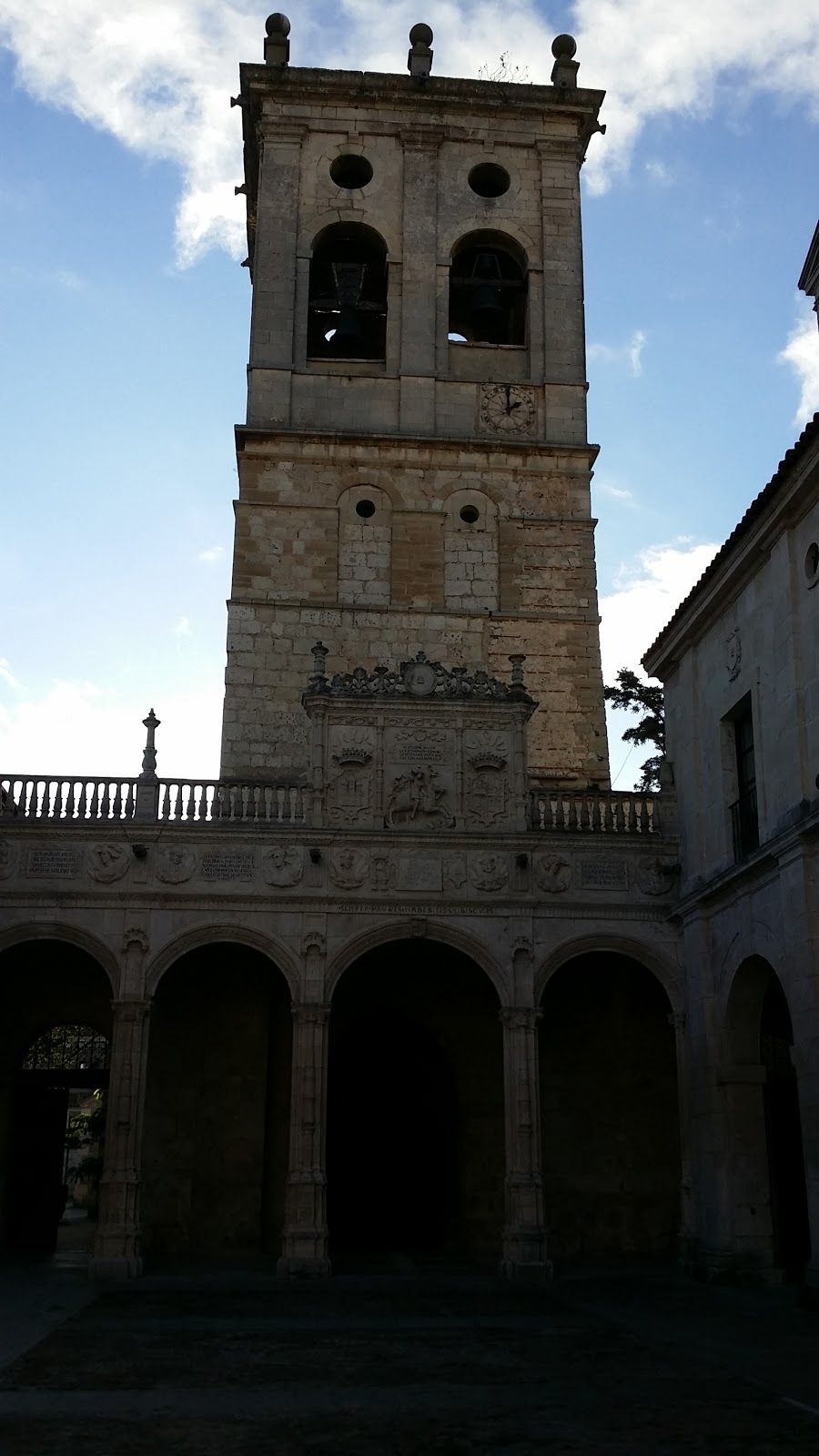
The Hospital del Rey was one of the most important pilgrim hospitals on the Camino route and was founded in 1195 by King Alfonso VIII at the same time that he founded the convent of Santa Maria de las Huelgas. A few Romanesque ruins of the hospital survive, but most of what we see today dates from the 16th century and has now been incorporated into the Law Faculty of Burgos University. A fine Plateresque Puerto de Romeros (Pilgrim’s Gate) pierces the wall of the hospital and leads through to a courtyard with the equally fine Pórtico de la iglesia. According to A Practical Guide for Pilgrims by Lozano, the Renaissance wooden church door has exceptional wood carvings featuring three generations of a family making a pilgrimage to Santiago but I missed that detail!
The rising sun was setting alight the pinnacles of the Puerto de Romeros and making it look very special indeed, but I was aware that Matthew and David were not keen to loiter and were waiting impatiently, so I quickly took some photographs of the gateways and hospital ruins, nipped into the reception desk of the Law Faculty to get a stamp on my credencial and then we moved on!
We walked on through the suburbs of Burgos before finally entering open countryside. The weather was warm and sunny and the rain had gone. I was feeling a little weary and Matthew said his legs felt very tired. However we pressed on and we again found the fields full of dead sunflowers; many of them starting to fall over or rot. This mystified me – why plant field after field of sunflowers if they are not going to be harvested and left to start decaying? Were they harvested after we had departed? I saw hundreds of such fields of unharvested sunflowers on our walk. Maybe someone reading this blog can explain why?
Ruins of Hospital del Rey
In a picnic area near Villalbilla we stopped for a snack and together said Morning Prayer before passing under a railway line and negotiating the muddy and confusing building site where the intersection of the A-231 and N-120 was being re-designed. The extensive construction site was hard to negotiate and temporary Camino signs were confusing and hard to follow.
Fields of Dead Sunflowers
At Tarjados we bumped into the Polish brother and sister again who were just leaving a café as we arrived. We stopped for second breakfast; potato tortilla with chicken washed down with vino tinto and a café con leche for a caffeine boost.
Puente de Arzobispo
Just after Tarjados is the impressive Puente de Arzobispo (the Bridge of the Archbishop) across the rio Urbel. The Archbishop of Burgos used to have his palace at Tarjados (now the Vincentian Convent). Presumably he funded the building of the bridge? Apparently this valley between Tarjados and Rabé de Las Calzadas was once notoriously swampy and gave rise to a popular rhyme:

De Rabé a Tarjados,

no te faltarán trabajos;

de Tarjados a Rabé,

¡libera nos, Domine!”


“From Rabé to Tarjados,

you’ll have your work cut out for you;

from Tarjados to Rabé,

spare us Lord!”

With the bridge and a chat with some pilgrims from New Zealand along the way, the walk to Rabé seemed more pleasant for us!
Rabe de las Calzadas
We reached Rabé de Las Calzadas, where I hoped to see the church, however it was locked and three local women were scrubbing graffiti off the church wall outside the gate – clearly even small Spanish villages are plagued with the universal scourge of graffiti “artists” who in a similar way to stray dogs like to mark their territory!
Matthew looking intrepid before the Meseta escarpment!
After Rabé, the Meseta began – it’s initial escarpment rising up in a line before us after leaving the village. In some ways it reminded me of similar escarpments in the English South Downs. The Meseta itself is a high (610 -760m) plateau that covers about 50% of the Iberia Peninsula. As I said earlier in this blog, I was concerned about walking across it as I had heard such mixed reports about it; some people said it was wonderful with expansive horizons and wide vistas, but a lot of people seemed to find it mind numbingly boring and empty. I wondered what I would think myself as we began to ascend the 950m Alto Meseta?
Hermitage at Rabe with detail of doorway carvings

The initial ascent onto the escarpment was pleasant and Matthew and I took the opportunity to do Midday Prayer together as we climbed. At the summit of Cuesta de Matamulos (another mule killer slope!) however, we were surprised to suddenly come upon Matt who was sitting admiring the view with a few pilgrims he had met including Annika from Birmingham.
Meeting Matt surprised us as we were not expecting to meet up with him until we reached Hornillos. Matt of course was delighted to meet us and being the highly gregarious and talkative person that he is, immediately began to pepper us with conversation, questions and anecdotes about his pilgrimage thus far! As I lay on the grass resting I felt a sense of culture shock come over me; Matthew, David and I had spent five days travelling together and three days walking on the Camino and had fallen into a comfortable rhythm of talking interspersed with periods of silence quiet reflection. As often seems to happen when I walk on the Camino, I find that the longer I walk, the less I feel the need to talk and enjoy the periods of solitude and silence. Now suddenly, I felt bombarded by Matt’s conversation and almost unable to cope with it! My silence began to draw Matt’s attention, which only made me feel worse as he began to ask questions like “What’s wrong with you Michael?”, “Why are you so quiet?”, “Are you in a bad mood?”
Over the next few days I would struggle with Matt’s constant stream of conversation as we walked and I began to feel guilty for wanting to wander off by myself or just tell him to shut up for a few minutes! Matt is a lovely guy and his chatter was friendly and well-meaning. So why was I having trouble coping with it? Was I being selfish for wanting peace and quiet and the Camino? These were inner questions I struggled with as I walked.
The answer however came to me as I read Henri Nouwen’s The Way of the Heart – The Spirituality of the Desert Fathers and Mothers (www.harperone.com). I usually bring a small devotional book on the Camino to read at bedtime as I lie in my albergue bunk and this is the book I had brought this time. However, I didn’t get to read it until near the end of the trip and was therefore surprised to find that it was divided into three sections: Solitude, Silence and Prayer. As I read the chapter on silence, I was startled to hear Nouwen say that “First silence makes us pilgrims. Secondly silence guards the fire within. Thirdly, silence teaches us to speak” Nouwen then went on to quote Abba Tithoes who said that “Pilgrimage means that a man should control his tongue” and said that “To be on pilgrimage is to be silent (pergrinato est tacere)” In short, says Nouwen “words can give us the feeling of having stopped too long at one of the little villages that we pass on our journey, of having been motivated more by curiosity than service”.
The other positive feature of silence that Nouwen discussed was that Silence is the discipline by which the inner fire of God is tended and kept alive”. To illustrate this Nouwen quoted Diadochus of Photiki who said that “When the door of the steambath is continually left open, the heat inside rapidly escapes through it: likewise the soul, in it’s desire to say many things, dissipates it’s remembrance of God through the door of speech, even though everything it says may be good”.
From reading Nouwen’s book, I came to realise that God was actually speaking to me through Matt’s constant chatter. When I had started walking the Camino in September 2014, I had gradually realised that God was drawing me to the value of solitude; I had spent more and more time walking and sitting by myself, just enjoying the peace of God’s presence. This time I realised that God was speaking to me about the value of silence. It wasn’t about Matt talking too much or about me feeling selfish, it was about me learning to talk less and build up the steam of God’s presence and love in my heart, so that I have something to offer people when God brings them to me and to help me realise that silence, as Nouwen said, can become “a portable cell taken with us from the solitary place into the midst of our ministry”. This is countercultural stuff in a verbose world that never shuts up and is full of a constant stream of chatter (much of it inane) on radio, television and social media, but something I need to learn if I am to have anything to offer of value to those around me.
Descending Cuesta Matamulas with
Hornillos in distance
Nevertheless, as the four of us set off down the mule killer slope towards Hornillos, I deliberately hung back and let Matt go on ahead with Matthew and David so I could enjoy the peace of the Meseta!
Calle Real, Hornillos
At Hornillos we checked into the Meeting Place Albergue. The other albergues were filling up fast and we were unable to get into the albergue with the swimming pool! The Meeting Place was however pleasant and modern and we had no complaints about the facilities.
Medieval jettied buildings
After showering and resting David, Matthew and myself had a walk around the small town (more of a large village actually) which had clearly seen more prosperous days, but still had an attractive down-at-heel ambience. The main street was lined with medieval buildings – some of them dilapidated timber-framed structures with jettied protruding second storeys. There was once a Benedictine Monastery in the village and I wondered if one of the buildings on the Main Street was part of this or had been a Pilgrim Hospital as it had carvings of a chalice and St. Peter’s Keys and a Cross of Santiago over it’s doorways? Nearby, I was startled to see a more modern house with a stone medieval sarcophagus acting as the lintel over the front door!

Beyond the edge of town, David, Matthew and I also stumbled upon some medieval ruins which may have been the remains of the Hospital of San Lázaro – one of many leprosaria that were once strung along the Camino? The surrounding area seemed to full of storerooms built into the hillside and presumably used by the locals to keep produce cool in summer before the days of refrigeration?
Sarcophagus doorway
In the centre of the village was a small plaza with a Parish Church and the picturesque Hen Fountain or Fuente del Gallo. Annika was sitting on the steps of the municipal albergue doctoring her feet, which looked in a very sorry state with numerous blisters.
Fuente del Gallo
It didn’t take long to look around town and then Matt joined us and we had some lunch in a nearby café and shared communion together with some of the left over bread and wine. Afterwards Matt and David returned to the albergue and Matthew and I walked over to the beautiful parish church and sat for a long time. We enjoyed the soaring gothic architecture (surprisingly grand for such a small place and clearly hinting at a more important past) and enjoyed the peace; reading the Psalms of Ascents together and meditating on them.
We returned to the albergue in time for the communal meal of chicken paella and got talking to an American from California who works in an Emergency Control Room despatching the police, fire and ambulances in response to 911 calls. As David has spent a career working for the Fire Service in Cork, there was much comparing of notes between the way things are done in California and Ireland!


We finished the evening by sitting on the bench outside the albergue under a starry meseta sky saying Evening Prayer together before the chill got too much and we scuttled back inside.
Paella

Friday, 4 December 2015

Cork - Dublin - Burgos (02/10/15 & 03/10/15)


It was time for Camino Part III and I was excited to be getting back on the trail once more! Ever since I had got back from walking the last section in March I had been planning my next trip. I realised I had a relatively small window of opportunity in October taking into account my remaining annual leave from work. In addition, my daughter was starting university in Dublin in early September and then my wife was visiting her family in England for a week in late September.  I realised that if I was walking the Camino again in 2015 it had to be early October before it became too late in the year for benign autumn weather.

For the trip this time, I had invited my friend Matthew Watson. The plan was for us to walk the Camino together and use the experience as a retreat time to, pray, be spiritually refreshed and take time out to seek God. Matthew is an all-round nice guy in his mid twenties with a strong faith who is a social introvert like myself. Given that we also share similar reflective personalities, I was confident that although he had never been on the Camino before, we would enjoy walking it together and be comfortable with times of silence and with not always feeling the need to talk. I have found such periods of silence and reflection more and more important as I have continued walking the Camino. Matthew also enjoys the outdoors, walking and has a particular interest in birds of prey, so I was hopeful his knowledge could be added to my interest in history and wildlife for this trip.

However the plan to just walk with Matthew soon evolved! Another friend Rawle Maicoo; an Emergency Medicine Doctor from Trinidad, was keen to join us, and then Matt McCullagh, who accompanied me on my trip last in September 2014 and David King, who I had walked with in March were also keen to join us for the next leg. Finally, my friend Ben Jonas, who had originally planned to come on the Camino with myself and Matt last year decided he wanted to walk the Camino too in order to help process some changes in his life.

The logistics of the trip also became complicated. Matthew, David and I decided we could only manage to walk for five days from Belorado – Frómista. We had hoped we could fit six days of walking in, but we found that because of flight times from Dublin, we couldn’t get back to Belorado from Dublin in one day and would have to stay overnight in Burgos. Ben decided he would start a month before us in St Jean Pied De Port and meet us in Belorado on 04/10/15 and Matt decided he would start a week before us in Estella and walk the section he had missed, also meeting us in Belorado. Ben and Matt planned to meet up somewhere along the way, maybe near Belorado. Eventually however, Ben walked St Jean – Najera and thoroughly enjoyed the experience, but then decided to head off to Brazil for a few weeks before he started his new job. He did meet up briefly with Matt at Logroño and then Matt walked on, still planning to meet up with the three of us. Rawle, in the end, was very disappointed to not be able to join us as he had issues with his Irish visa and was not able to travel to other EU countries at the time.

And so after all that planning, it was some relief and great excitement that myself, Matthew and David met up at my house in Co. Cork in the late afternoon on 02/10/15 and drove up to Dublin together in my car to the Premier Inn at Swords. We enjoyed drinks before bed. I have recently been on a course of steroids for an auto immune disorder which means no alcohol, but I was relieved to have been taken off them before the Camino as the thought of Pintxos and no Rioja would have been to terrible to contemplate!

The next morning after breakfast, we took the shuttle bus to Dublin Airport and checked in for our Aer Lingus flight. This time we decided to fly to Bilbao rather than Biarritz as it was felt that as we were travelling back to Belorado, Biarritz was getting to be a bit far away.

As we sat at coffee a bar near our boarding gate we remarked on the American style double mini conveyor belt that ran around the bar counter with muffins, soft drinks and mini bottles of champagne passing back and forth in an endless tempting parade. In County Cork a popular saying would be “Tis far from….[insert a subject] …that you were reared” to emphasise how life in Ireland has changed in the last few decades. I joked with David that it was far from muffin conveyor belts he was reared in Tralee. And indeed when Matthew and I later made the mistake of buying a sandwich and a bottle of water in Dublin airport and were charged €12.00; I realised that it was far from those prices I was reared too!!
David & Matthew at Dublin Airport
The flight to Bilbao was delayed for over an hour but was otherwise uneventful and we arrived in Bilbao airport with it’s curious 1970’s gull winged construction about 16.30 and took the Bizkai shuttle bus to Bilbao bus station. The Bizkai bus runs every half to Bilbao city centre and bus station at 0.25 and 0.55 mins. The journey took about half an hour and was interesting as it allowed us to see the extraordinary architecture of the Guggenheim Art Museum and also have a quick tour through the city centre. The city looked interesting and full of life and I would certainly like to return and see it properly some time.
David starting on the Spanish wine in Bilbao

Arriving at the bus station, we found we had about 45 minutes before the ALSA bus left for Burgos, so we nipped across the road into a bar to enable Matthew to enjoy his first taste of Pintxos and Rioja. Unfortunately I was in such raptures at getting back to both that I left my plastic wallet behind when we left with passport and flight tickets; luckily the very kind lady behind the bar ran after me in the street and returned them, but don’t tell my wife as she might stop me going on the Camino if she thinks I can’t be trusted to keep my wits about me!
Matthew stuffing his face!

The ALSA bus took two and a half hours to get to Burgos. Initially the journey was interesting and the bus climbed up into the mountains through jagged valleys, however it soon became dark and a film about the rivalry between 1970’s Formula One racing drivers, James Hunt and Niki Lauda started on a screen in front of us.

As part of our plans to use walking on the Camino as spiritual retreat and an opportunity for reflection and Christian Meditative prayer, I had suggested to Matthew that we use Common Prayer – A Liturgy for Ordinary Radicals by Shane Claiborne, Jonathan Wilson-Hartgrove & Enuma Okoro. The book contains a modern liturgy for Morning, Midday and Evening Prayer and has accompanying Old and New Testament Bible readings. I felt that it would give myself and Matthew a rhythm and focus as we sought God together on the Camino. Matthew and I decided to do Evening Prayer together quietly on the bus using my Kindle, however we found the film which was rather hard to miss in the darkness of the bus, quite distracting, especially the semi-pornographic sections where James Hunt, who had a very racy lifestyle to say the least, was having it off with various women in various locations! Thankfully there was no sound! But such are the distractions of life sometimes when you try to pray!

Arriving in Burgos about 21.15, we walked across the city centre to the hostel we had booked into near the modern municipal library. We detoured into the plaza beside the Cathedral and were pleasantly surprised to see that on this Saturday night there was an open air market with stalls selling a colourful selections of cheeses, salamis, olives, chocolates and cakes.

The hostel was very modern and clean and even featured a mini gym, but the smell of cigarettes was nearly overpowering in our room and by the time we left the following morning we felt we had absorbed a large amount of nicotine into our bodies!

We headed out into city centre for a pre-bedtime drink and also to buy a few snacks and provisions for the next day. Near our hostel was the Arco San Juan – the old city gate through the medieval walls through pilgrims passed from the east into the old city. We too passed through it and although it was nearly 10.30, we found the narrow streets still pleasantly alive with people chatting, having a drink and generally a good time. The temperature was mild and warm enough to sit outside with our jackets on, so we found a table near the Arco and David and I ordered beers and Matthew had a hot chocolate.

Suddenly we heard drums and trumpets in the distance and saw flickering lights coming towards us down the street. We were amazed to see a procession of literally hundreds of people; adults and children dressed in medieval outfits holding flaming torches; kings, queens, knights on horseback, Knights Templar, Saracens, archers, Mongol warriors and even medieval servants filed past us, in a seemingly endless procession, before turning at the Arco San Juan and heading back into the city centre. We had accidentally stumbled upon the Festival of El Cid!


Back in my blog entry for 21/03/15 I mentioned that El Cid is buried beneath the lantern tower of Burgos Cathedral. As I briefly explained El Cid was a complex character. His real name was Rodrigo Díaz de Vivar and he was nicknamed sayyid or “Lord” in Arabic by the Muslims of the time. Irish writer Michael Barry in his book Homage to El-Andalus, says that:

“There are various views of this remarkable man: mercenary and opportunist, or towering military genius, fighter in the cause of Christian Spain against the Muslims. As is usual in these cases, there is no simple answer. He did have extraordinary success, reputedly never losing a battle. However he did switch sides on occasion, fighting on the Muslim as well as the Christian side”.

When El Cid fell out of favour with Alfonso VI, king of Castille, he went into exile in 1081 and fought for the Muslim ruler of Zaragoza and then later captured Valencia and set up his own semi-independent fiefdom there.

This festival showed that El Cid’s heroic exploits one thousand years ago still resonate with modern Spaniards, and maybe even more so as Europe faces the threat of Islamic extremism.

If we hadn’t gone for a drink and stumbled on it by accident we would have missed the whole thing; but the Camino is full of these serendipitous discoveries and we retired to bed happy, thinking how you could never have a similar procession with such a lovely family atmosphere at 10.30 on a Saturday night in Cork without alcohol spoiling it!