Tuesday, 15 August 2017

Camino Day 23: Mansilla de las Mulas – León (01/04/17)

After days of journeying through the serene emptiness and isolation of the Meseta, the day’s walk represented quite an assault on the senses, as most of the 18.6km involved walking beside busy roads and through the industrial estates and ugly urban sprawl of León. Nevertheless, I like this aspect of the Camino – that one day you can be walking through a vineyard or over a mountain and the next day through an urban environment. I like the variety of such step changes, and even though I find much of the modern suburban sprawl surrounding most modern cities ugly and dirty, there is still much that is interesting to observe – ordinary people going around their business, some ancient chapel amidst contemporary offices, hinting at an interesting past or some signs of wildlife, tenaciously hanging on amidst the concrete jungle.
This would be our last day walking with Matthew and Heather as although we planned to have the next day off to do some sightseeing together in León, they would then be heading home, whilst David and I planned to keep walking and maybe get beyond Astorga. Matthew and Heather, not being fans of city life, had been planning to get the bus from Mansilla into León, but in the end, in credit to them, they decided to walk on with David and I into the city. This was all the more impressive as Heather’s feet were by now very sore and I had to do some remedial repair work on them in the albergue before we set off as I had been doing each morning.
We breakfasted in the albergue café and I noted as we were putting on our boots that there were quite a few retired British walkers who were also setting out but had stacked their bags in the hallway with labels for the portage shuttle bus so that they would be carried on ahead to their next albergue.
Rather than walking by the most direct route through town, we walked round the outside of the town walls, following their western and southern circuit, so I could see the remaining sections that we hadn’t examined the previous night. In this area of town there seemed to be more residential properties, allotments and orchards and the southern wall was more broken down and pierced by buildings, although there were still some fine surviving towers.
We then came around by the rio Esla section once more and climbed up onto the road bridge and set off along the senda beside the N-601. Once again, a very cold blew as we walked. A flat-topped hill over to our right marked the location of the ancient hilltop fortress of Lancia where the Asturians had made their final stand against the Romans. The archaeological site seems to have somewhat compromised by the building of a new motorway at the foot of the hill and I was reminded of the destruction of Carrickmines Castle outside Dublin when the M50 was extended.
By the time we reached the village of Villarmoros we were ready for second breakfast and so we diverted into the village looking for a café; nothing could be found but suddenly, whilst I was examining the map in my guidebook, I tripped over the pavement and came close to a very nasty fall. I nearly fell headlong onto the road, but somehow managed to keep running forward, despite the weight of my rucksack pressing down on me, and eventually managed to chase my centre of gravity and get myself upright again. It was a very close shave as I think I would have done myself an injury if I had hit the deck!
A little further on however, we did find a good second breakfast at the Casa Blanca hotel and then crossed the rio Porma on the new pedestrian bridge beside the enormous 20-arch Puente Ingente. The sheer size of the bridge and the number of arches suggested to me that on occasion at least, the rio Porma must flood in a very serious way!
Matthew & David and the Puente Ingente
After the bridge, we crossed the main road and had some light relief from traffic, as we struck out across some scrubby fields and passed under the new motorway on a graffiti decorated underpass which Matthew inexplicably felt would make a good place to stop for a snack. This was vetoed by the rest of us. Apart from the fact that it was in the shade, the remaining three of us felt that the location had little to recommend it as a dining location 😉
Ascending Alto de Portillo
The outlying suburbs of Arcahueja and Valdelafuente that we now passed through also had little to recommend them and seemed to mainly consist of non-descript shops, car garages, small industrial units, and bathroom fittings showrooms, but what else can I expect as I approach any modern city?
Inane Camino signs approaching Leon
We made our way slowly uphill towards the Alto de Portillo over the AP-71 motorway on a pedestrian bridge and then down into León itself, entering the suburb of Puente Castro, stopping briefly to watch a local religious confraternity preparing a float for a religious parade the next day which would mark Passion Sunday or the fifth Sunday of Lent.
Puente Castro
Finally, crossing the rio Torio we entered León proper and made our way through a modern section of the city centre, along wide boulevards and past apartments and offices, until we reached Plaza Santa Ana, where passed through the medieval city walls at Puerta Moneda and checked ourselves into the Benedictine Convent at Plaza Santa Maria.
Leon City Walls
The albergue in the convent was large and spartan with several large dormitories and although perfectly acceptable, I felt there could have been more numerous bathroom facilities, given the number of beds. I am not sure I would have liked to stay there in the busiest Summer months as I would say it could feel rather crowded, as it was, not all the dormitories were yet open. It also also turned out to be extremely hot in the dormitory during the night.
Gaudi's Casa Botines
As with all religious albergues that I have experienced, it was well run with no nonsense allowed; which I like! The Hospitalero showed me to my bunk bed after I had signed in and although I was hoping for a bottom bunk (much preferred for nocturnal toilet visits!), she pointed to a top bunk and I meekly accepted, as I feel it is good for the soul to accept gratefully what is given and try and be humble when possible, as this is in the spirit of the Camino. The next pilgrim was a young man who also had a top bunk pointed out to him “I would like this one here instead” he said, pointing at a bottom bunk. “No, this is your bed here!” replied the hospitalero, fixing him with a steely gaze. He meekly accepted. Lesson learned!
Leon Cathedral
We were surprised to see the two weed-smoking Italian guys that we had followed out of Frómista. Both were snoring away after their day’s walking and Matthew was designated a bunk bed above one of them, which was not entirely to his liking given the pungent aroma! A large Danish pilgrim in his early sixties was in the bunk bed next to me and calling attention to the Italians, started complaining vociferously about the strong smell in the room. This was ironic as he himself had a very strong smell of body odour. He then proceeded to explain to me how he was not walking the Camino like me! He was not rushing along the Camino as fast as possible like I was – oh no! By comparison, he was taking his time, stopping to enjoy the sights and sounds along the way. I politely tried to explain that this was exactly what I was doing myself, but it was to no avail – the lecture about how I needed to slow down continued for quite some time, clearly convinced as he was that I was galloping along the Camino at breakneck speed!
Some Irish cyclists from Dublin and Donegal then arrived. Later, I got chatting to one of them and they were starting at León and cycling to Santiago. The volume in the dormitory definitely rose when they arrived – the other nationalities had been quietly going around their business in a sedate manner, but once the Irish delegation had moved in and begun their banter, the craic from that quarter of the room was mighty!
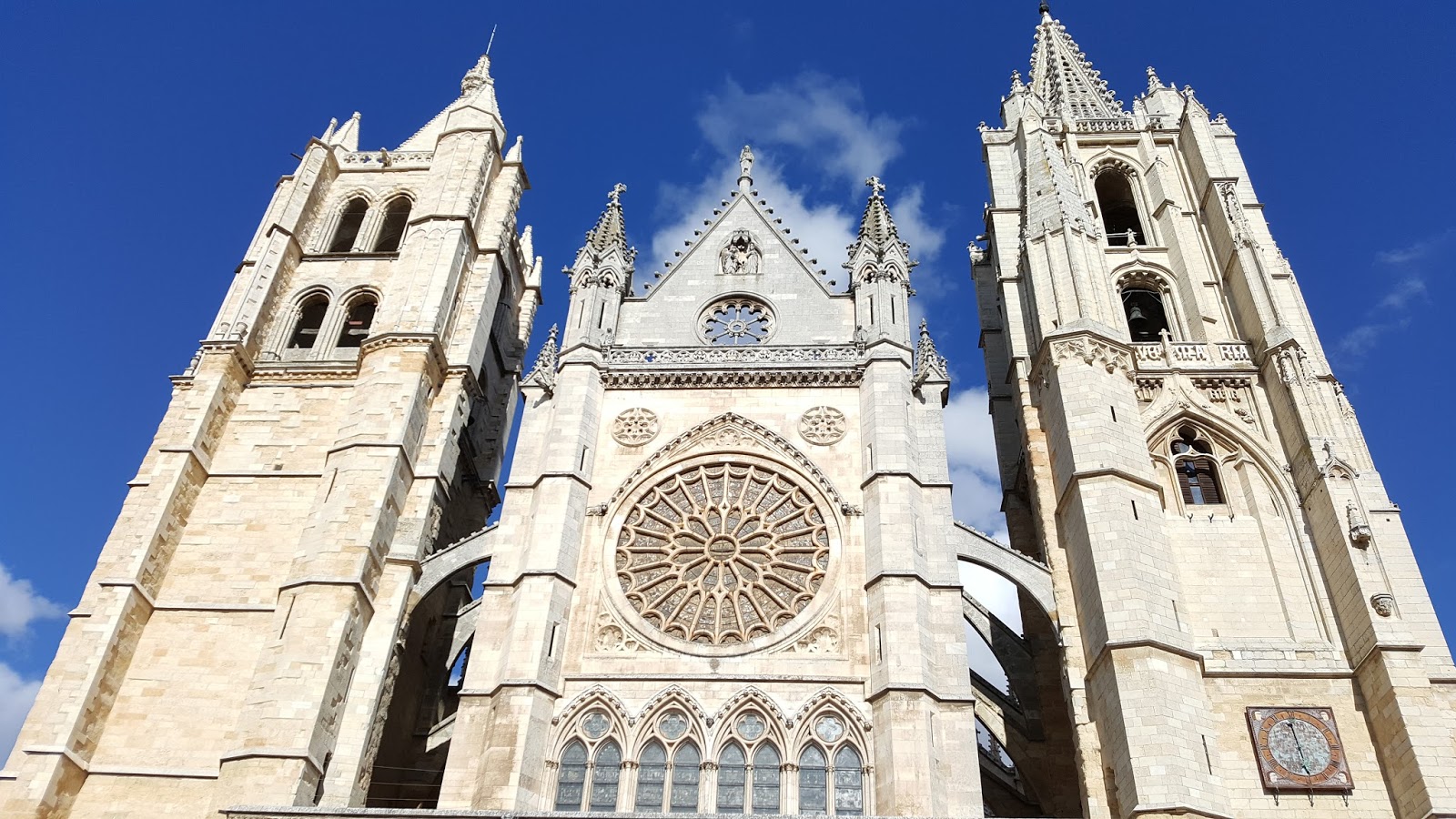
Later in the afternoon there was time for us to stroll around the city centre. We had a quick look at the city walls near the convent – so like their counterparts at Mansilla. We then walked up to Plaza San Marcelo where we examined Gaudi’s Casa Botines, had coffee and cakes in a beautiful traditional cafe nearby and then wandered up to the Cathedral. The city was vibrant with people strolling around on the late Saturday afternoon sunshine; couples holding hands, friends stopping to chat; families out enjoying themselves. The atmosphere was very appealing.
It was also coming up to Easter and so many of the shop windows were decorated with Holy Week themes and we stopped to enjoy some of them. One of the big features of Easter in Spain are the religious processions organised by confraternities which dress up in different coloured hooded outfits to carry the elaborate often full-size religious scenes and holy statues. The Spanish are well used to these outfits and the idea of them I suppose, is to emphasize penitential anonymity, however to other nationalities the confraternity outfits do look very sinster and strange and well…very Ku Klux Klan! Our favourite window display was in a pharmacy, just down from the cathedral, where model confraternity characters were carrying a tableau of the Last Supper made from a medication box and with tablets featuring as the bread!
We returned to the convent in time to hear the nuns sing Vespers. There were only about twelve nuns and one who spoke English came over and greeted us, giving us service sheets with the psalms to be sung in Spanish translated into English. There were only a handful of us in the congregation, but it was quite beautiful and I was surprised when David and Heather both said they had enjoyed it as I didn’t think it would be their kind of thing.
Part of the convent had been turned into a nice hotel and we rounded off the evening with a pilgrim menu in the rather fancy dining room. I rang Liz on WhatsApp afterwards, but the call turned out to be fairly brief as I soon got accosted by a drunk in the convent courtyard and had to retreat back inside the albergue for safety and this caused him to go off and annoy some German pilgrims instead.

Monday, 14 August 2017

Camino Day 22: Calzadilla de los Hermanillos – Mansilla de las Mulas (31/03/17)

It was our last day experiencing the splendid isolation of the Meseta; we would be walking 24.7km to Mansilla - 19.4km of it on the Calzada Romana – the section considered to be the most perfect surviving section of Roman road in Spain; through a largely empty landscape without villages and even farmsteads and certainly no opportunity for even a medicinal glass of Rioja for second breakfast! The isolation and the tranquillity of the Meseta had been a revelation to me and I was sorry to be finishing it as we drew ever nearer to hustle and bustle of León. Nonetheless, it seemed a very long day for all four of us and it took us 8 hours and 10 minutes to reach the albergue in Mansilla.
Leaving Hermanillos in the rain
We left Hermanillos on the 4.5km of asphalt road out of town to a T junction. A light rain began and we were forced to don our ponchos, but the weather soon brightened up and I later actually got sunburn on my nose. Despite this, a very cold wind blew the entire time from the left and when we crossed the T junction onto the Calzada Romana, Heather found the going very hard as the track surface was extremely stony and very uncomfortable on her already painful feet.
We stopped in a shelter for a snack and then walked on; away to our right on the horizon in the north we could see the snow-capped tops of the Cordillera Cantábrica mountains which are an extension of the Pyrenees.
Extant stretch of original Roman road
Eventually we came down into the small river valley of the Arroyo Madriz de la Cava and took the opportunity of shelter from the worst of the cold wind to stop for lunch and also take communion together. Out of the wind there was relative stillness and some cattle grazed in the lush vegetation by the stream and not far off a Cuckoo called.
Walking on the Calzada Romana
Climbing back out of the valley we came across some large preserved stretches of the original Roman road which had been fenced off to protect them from livestock. I was astonished to see that the convex camber of the Roman road could still be easily discerned under the light vegetation and wild herbs that had grown over the ancient road surface. In places, the stony paving of the road could still be seen. I was taken back to my history lessons at Secondary School when we had studied how the Romans built up their roads with different layers of gravel and stone, with a convex camber and with drainage ditches along the sides and here was an actual real surviving example right in front of me like something straight out of my school textbook!
Reliegos
 I climbed over the fence and walked along the centre of the road and was surprised to find that somehow, I was deeply moved and felt a deep connection to the past. This was the Roman road that had linked the gold mines of Galicia with Rome via Astorga, known back then as Asturica Augusta. Along this road had marched Caesar Augustus, Visigoths, Muslim armies and Charlemagne, but it wasn’t thinking about any of them that moved me; instead in my imagination I saw millions of pilgrims who had used this road in the medieval period, tramping along in worn leather shoes, shabby clothes and with staff in hand, seeking God in the only way they knew how; searching for salvation and a purpose to life. Suddenly as I walked where their feet had trod I truly felt on my way to Santiago and felt sure that I would reach it!
Heather in Bar Elvis
Later in the afternoon, we climbed a hill, where more bodegas where sunk into the hillside and seeing Reliegos below us and Mansilla across the plain in the distance, we descended and stopped for a coffee and snack in Bar Elvis. The bar turned out to one of those unique colourful drinking holes that can only be found on the Camino; the proprietor called Sinín, wore a black beret and bore a striking resemblance to Salvador Dali. The walls were covered in colourful graffiti in every conceivable language contributed by years of passing pilgrims.
David with Sinín
Unfortunately, however, Heather began to feel faint as we were finishing our drink and so we sat outside the bar, away from the cigarette smoke and I gave her an energy gel, whilst David and Matthew went off to buy some food and chocolate from the village shop. When they returned, we briefly considered staying in Reliegos, but Heather felt much better after another snack and so we pressed on along the roadside senda until we reached the El Jardin private albergue at Mansilla.
Albergue El Jardin
The albergue turned out to be clean and modern with a café downstairs, a large dormitory, good bathroom facilities and even a small garden. After a wash and a rest, we had a drink in the café and then I repaired Heather’s feet in a lean-to marquee area in the garden.
Romanesque walls
 We then had a walk into town. Mansilla is surrounded by Romanesque town walls – still largely intact, although some of the original town gates have been demolished. They date from the 12th Century when king Fernando II of León resettled the town in 1181. Constructed from large stones taken from the river, they are an impressive three metres thick and are similar to the city walls we would later see at León.
Plaza del Grano
We walked into the centre through the Puerta Castilla and along calle Santa Maria to the Plaza del Pozo. We made our way down to the rio Esla where we could examine the walls running alongside the river in detail; here they seemed well preserved and the area made a pleasant riverside walk where a few locals were walking their dogs. 
Double bodied lion
A small sally port gateway then led us by a narrow alleyway into Plaza del Grano (it’s name which means “Grain Square” recalls the importance of Mansilla as an agricultural and livestock market over the centuries) before we made our way to the 12th Century church of San Martin. The church is now a cultural centre, and David, Matthew and Heather chatted, while I examined the pillar capitals framing the portal, which had an interesting rendition of a double bodied lion sharing one head on one and a very worn but, nonetheless pleasingly dynamic angel on the other (above). 
David explaining complex issues to a wrapt audience!
Finally, we exited the town centre through the Arco de Santa Maria and following the north-eastern curve of the town walls, made our way back to the albergue to enjoy a perfectly satisfactory pilgrim menu before settling down for the night.
The happy couple at Arco de Santa Maria

Sunday, 13 August 2017

Camino Day 21: Sahagún – Calzadilla de los Hermanillos (30/03/17)

 
The next morning David and I met up with Matthew and Heather for breakfast in a café in Plaza Mayor; now quiet and deserted in the early morning compared with the bustle of the previous afternoon.
Plaza Mayor, Sahagun
We made our way out of town – back past our albergue and down the steep slope to the rio Cea where we paused to look at the impressive stone crucifix before crossing the Puente de Canto – built by Alfonso VI in 1085 on Roman foundations and renewed in the 16th Century. It was amazing to think that this solid little bridge was the only river crossing in Sahagún until as late as 1992.

On the far side of the bridge is a poplar grove that legend says miraculously grew from the shafts of the lances of Charlemagne’s soldiers that were planted in the ground when Charlemagne was pursuing the Muslim Caliph Aigolando.
I was still feeling somewhat discouraged and morose and took the opportunity to quietly hang back from the others and have a stretch of walking by myself. My frame of mind was made worse by the fact that I was feeling very tired because my sinuses were really bothering me during the night hours so that I was waking up at 5am every morning with sinus pressure and a headache behind my right eye which then kept me awake or caused me to dose fitfully. Although the pressure and headache would go away after about an hour, once I got up and took a decongestant and some Ibuprofen, the result was that I wasn’t getting enough sleep, which only exacerbated my vaguely melancholic state. It was hard to say if the sinus problems were due to the ongoing issues with Sarcoidosis, an allergy to some type of pollen on the Meseta or maybe the dustiness of some of the albergues.
Podiatric repairs
After crossing a roundabout and passing under the A-231, we stopped for second breakfast at Calzada de Coto and afterwards found a nearby small children’s playground where I set up a mobile outdoor Podiatry Clinic and performed another repair job on Heather’s feet – renewing the dressings and areas of padding to keep her moving. Although some of Heather’s blisters were slowly getting larger because of her digital deformities and were causing her some discomfort, overall, she was doing really well and I was impressed how well she kept going. 

Leaving Cazada de Coto, we somehow managed to get to take the wrong track and after about fifteen or twenty minutes realised that the A-231 was still on our left and the railway line in the distance on our right, when in fact we should have been heading towards the railway line. We managed to double back, past some woods and after asking a local man walking his dog for directions, followed a path alongside the railway line back to the bridge that crossed over it and so rejoined the Camino path.
Yellow flowering Rush
The detour hadn’t been a total waste of time though, as we had found that the side of the track was speckled with a constellation of beautiful small crocuses coloured a delicate white with petals fringed with light purple and a centre of yellow stamens and anther. 
Wild Geranium
Toadflax
The more we looked, the more unobtrusive and delicate wild flowers we started to see in what had initially seemed like only dry grass; a yellow flowering Rush, wild lilac Geraniums and a species of Toadflax. We had also stopped to watch a Red Kite hunting over some nearby fields, which suddenly dropped out of sight onto it’s prey. Matthew also pointed out the sun which had a circular halo around it; presumably due to ice crystals in the upper atmosphere?

After crossing the railway, we walked along a fine stretch of Roman road; the ancient Via Traiana. A wide orange dusty track proceeded through gloriously isolated countryside, past fields and scrubland and lined by trees and bushes. The silence was broken only by the crunch of our feet, the occasional call of a Cuckoo or the sigh of the breeze in the trees and grass and I loved it! My Camino guidebook stated that there were still some original Roman milestones along this stretch and indeed , we did see several small white stone pillars, but whether these were Roman or more modern markers I couldn’t say. It didn’t matter – I still enjoyed thinking of the Romans crunching along in the gravel just as we were at that moment.
Matthew & Heather near end of detour
The weather was sunny with a slight breeze and I got slightly sunburned on my arms. The weather was also getting warmer and more humid and by now we were feeling a little tired, so we stopped for a rest and a snack at the Fuente de Peregrino – a delightfully cool and shady spot where a natural spring flows into a stone trough and is shaded by Poplar trees. The trees provided shelter for birds which sang with fluty notes and added to the sense of tranquility. My shoulders and neck were also getting sore, as I needed to adjust the straps on my bag and Matthew kindly gave me a therapeutic massage which was most restorative.
Via Traiana
We felt very refreshed and could have stayed at this spot for a long time, but we pressed on and reached Calzadilla de los Hermanillos after 8 hours and 50 minutes. Calzadilla itself is no more than a large village, but was interesting nonetheless. The Hermanillos in it’s name refers to Franciscan Friars sent out from Sahagún to man this intermediate pilgrim station between Sahagún and Mansilla de las Mulas.
Fuente de Peregrino
We located the municipal albergue and were surprised to find that it was self- service. We had to sign ourselves into the visitor’s book and stamp our own credencials. A cleaner calls once a day. A middle-aged Japanese pilgrim had already arrived before us and showed us what to do. I unfortunately made a faux pas when I first met him by asking if he was Korean (as we had met numerous Koreans and no Japanese pilgrims hitherto), rather than “where are you from?” which is of course what I should have asked. However, I felt that the long lecture I got in response about how rude it was in his culture to guess someone’s nationality instead of asking where they were from, slightly excessive! He was friendly enough though, worked as a Chef in Belgium and was walking the Camino for the second time.
Decisons, decisions!
After a short perusal of the albergue, David in his role as a retired Fire Officer, pointed out to me various areas of concern where fire regulations were being infringed or were just being totally ignored; there was only one exit from the building, there were bars over the windows, the partitions between the sleeping quarters were constructed from easily combustible MDF and his biggest concern – a PVC armchair situated extremely close to the wood burning stove. David invited me to feel the temperature of the PVC – which was nearly too hot to touch and he quietly moved the armchair much further away from the stove. Seeing albergues through the eyes of a Fire Safety Officer is very concerning indeed!
Our friendly shopkeeper
After a shower and a rest, we went in search of a local shop to buy provisions for the next day as we knew we would be walking across a large empty stretch of the Meseta. Some hand painted arrows on the road led off to the left and when we met two local men talking on a street corner we asked about the location of the shop (Tiende) and a tiny middle-aged man beamed at us, pointed proudly at his chest and turning out to be the shop keeper, led us to the front door of his shop, before disappearing around the back, whilst chasing his little brown dog, to open up from inside.
Mudejar east end of the Hermitage of the Virgin of Sorrows
What a shop it was! A veritable Aladdin’s cave full of every conceivable product – wheels of cheese, joints of ham to be sliced on a bacon slicer, fruit, vegetables, bread, eggs, shelves groaning with provisions, boxes of pastries and delicious biscuits! The choice was mesmerising and we got quite carried away, choosing stuff for our picnic the following day!
The Wash House
Our shopkeeper kept tempting us with more interesting foodstuffs as he could see that we were easily persuadable, but even we declined some Whiskey he suggested! A tiny old woman appeared, who we presumed to be the owner’s mother and sat on a chair to watch us. We were interested how both of them were only about five feet in height as we also noticed other very small people in villages in the area and wondered if this was a particular feature of the inhabitants in this area?  The shop took me back to my childhood in the 1970’s when my grandmother who lived on the Stranmillis Road in Belfast, used to send me down to a shop just like it, staffed by an elderly lady called Maudie, to pick up some “messages” as we say in Ireland. Back home, shops like this one have nearly disappeared, except in the most remote areas, superseded during my lifetime by the exorable rise of the Supermarket.
After stocking up, we found a surprisingly trendy bar for a drink and again met our Japanese friend reading a Kindle. Matthew and Heather headed back to the albergue for a rest and David and I wandered around the village. There were a few interesting things to see; the Hermitage of the Virgin of the Sorrows which has Romanesque and Mudejar elements – Mass was being celebrated, so we didn’t go inside. There was an interesting covered Wash House on the edge of the village that has recently been restored and consists of a spring fed stone trough with stone rubbing boards along the sides, where traditionally, the woman of the village would have come together to communally wash their clothes. Finally, near the parish church a small green had been turned into an open-air museum with examples of Roman stonework from the Via Traiana such as milestone pillars and irrigation channels. Interesting information boards gave more information and there was also a reconstruction of a section of Roman road.
Matthew enjoying his dining experience
When I had been planning the trip, I had come across the website for a Casa Rural called Casa El Cura which had looked really lovely and appeared to serve high quality meals made from locally sourced seasonal ingredients. We decided we would go and investigate as it was time for dinner! When we arrived the owners were most apologetic – there was already a large party of German pilgrims and they had exhausted the evening’s menu, but if we were willing to take whatever they could serve us, they were sure they could “throw something together” for us? We agreed. The meal turned out to be a culinary tour de force – a gourmet experience! It was definitely the best meal that we have had on the Camino – trumping even the one David and I had at Cirueña! A lovely fresh salad was followed by mussels in lemon juice, a main course of hake and white asparagus accompanied by an excellent light white wine, a dessert of lemon mousse and finished off with chocolates and coffee; and all for €12 each! If you are in Calzadilla de los Hermanillos do not miss this culinary experience!

Saturday, 1 July 2017

Camino Day 20: Ledigos – Sahagún Part II (29/03/17)

After a rest, David and I set off to examine Sahagún in more detail. The town has Roman origins and it was here that Saints Facundo and Primitivo were martyred. The name of the town is a corruption of Sanctum Facundum” which became “”Safagún” and finally “Sahagún” A monastery to the two saints was founded in the 9th century and destroyed by the Moors in 873 before being refounded. But Sahagún’s golden age began in 1068 when king Alfonso VI made it his ecclesiastical and cultural centre.
San Lorenzo
We have already come across Alfonso VI (pictured above from a medieval manuscript) at many places along the Camino – he was a great promoter of the Camino route and to encourage pilgrimage and the social and economic development of his kingdom built bridges and encouraged holy men like Santo Domingo de la Calzada to build up the road. 

It had seemed unlikely that Alfonso VI would ever become king of Castille – he was the second son of Ferdinand I and shouldn’t have inherited the throne, but his father decided to split his kingdom into three parts; one kingdom for each of his three sons; Castille, León and Galicia and give the patronage of the monasteries to his daughters Urraca and Elvira. Alfonso’s older brother, Sancho, didn’t like this arrangement as he felt that he should have inherited everything and so on their father’s death, a Game of Thrones type war broke out between the brothers with Alfonso VI at times having to flee León to the Muslim principalities to the South and at other times being a refugee in the monastery at Sahagún. Eventually however Alfonso triumphed, as his younger brother was killed and his older brother unexpectedly died. Alfonso inherited the lot and went on to capture Toledo from the Muslims styling himself as “Emperor of All Spain”.
La Virgen Peregrina
Alfonso was resonsible for opening up Spain to the rest of Europe and instigated major reforms of the church and his kingdom, inviting the Benedictine monastery of Cluny in Burgundy to guide these changes and re-establish the monastery in Sahagún which became a major cultural centre and had a university faculty up to the 18th century. The town was also granted a charter by the king who often held court there and it flourished from the influx of pilgrims. 
Mudejar pargetting
Sahagún however, began to decline in the 16th century as it fell out of favour with the monarchy and a devastating fire in the 19th century caused enormous damage. Because many of the buildings were built in brick because there is no stone locally many of the buildings have not survived, but enough does to hint at the town’s former importance.
David and I went first to the former 13th century Franciscan Convent of La Virgen Peregrina, which is on a hill above the town. The convent has recently been restored as a museum and gallery and had fine surviving Mudéjar polychromatic plasterwork or pargetting that is really worth seeing in the 15th century chapel of Los Sandoval. The pargetting features beautifully elaborate geometric and vegetal motifs. Another significant feature of a visit to the convent is that you can pick up a certificate stating that you have reached the half way point of the Camino. I think this is a great idea by Sahagún town council and I will certainly be proudly framing mine and hanging it on the wall back home in my study!
Halfway to Santiago
& certified!
We moved on to the Museum of the Benedictine Convent of Madres Benedictinas de la Santa Cruz. We went into the entrance hall and rang a bell following the instructions in Spanish on a handwritten note pinned to the doorframe. Suddenly a hatch in the wall slid back and we were scrutinised by a fierce looking nun, who for €2 each, gave us tickets before sliding the hatch back. Just when we had given up, another door opened and we were ushered in where the nun started a recorded narration in English, demonstrated that we should let ourselves out at the end and disappeared. 
Tomb of Alfonso VI
The narration was rather monotonous - "...in case two,  number one is a 16th century relic of St. Bernard, number two is a 17th century monstrance" etc etc etc! However, there was an interesting Roman bathtub, an incredibly ornate 1711 Baroque altarpiece in a style known as “Chirruguesque” and the thing I really wanted to see - the tomb of Alfonso VI who was originally buried in the Monastery of Santos Facundo y Primitivo, but when that was destroyed, now lies here in a plain 20th century sarcophagus with four of his six wives. I was taking too long standing in front of the tomb at the end of the narration and a nun appeared from a side door and looked at me, so I dutifully thanked her and quickly scuttled off, letting myself out, suitably rebuked!
San Lorenzo
After this, David and I wandered through the town. We took in the lovely San Benito Arch, built by Felipe Berrojo in 1662. We examined the nearby 13th century church of San Lorenzo with it’s triple Mudéjar apses and pyramid -shaped tower, which somehow still manages to look light despite its great dimensions. We walked across town and examined the ornate Mudéjar brickwork on the 12th Century church of San Tirso, which is apparently considered one of the finest examples of Mudéjar architecture on the Iberian Peninsula. The brickwork glowed in the late afternoon sunshine which accentuated the geometric designs and threw them into relief.
Arco San Benito
As well as the tomb of Alfonso VI, I had hoped to see the chest containing the remains of Saints Facundo and Primitivo in the 17th Century church of San Juan, however it was closed, so David and I made our way down to the Plaza Mayor, where we had a drink and a snack and watched young children playing in the square as their parents chatted amongst themselves.
San Tirso
Matthew and Heather joined us, refreshed from their rest in the hotel and we walked over to our albergue for dinner, stopping for quite a while at the 19th century clock tower of the Monastery of Saints Primitivo and Facundo to watch two kestrels wheeling around the tower, where they were obviously nesting. We agreed that some of those reclining metal couches from the Virgen del Puente would have been ideal, so we could lie back and watch the kestrels more comfortably!
San Juan
Dinner at the albergue was excellent and included a starter of Pardina (brown) lentil stew; the lentils are widely grown locally. After Matthew and Heather had gone, the hospitalero returned with our laundry which he had tumble dried but was still very damp. We pointed this out and he took it away and put it in the tumble drier again. It was returned just as damp! We gave up and took it back to our cold dormitory – you must learn to accept all things on the Camino! 
Monastery of Saints Facundo & Primitivo