It was Sunday; the last day the four of us would be
together, before Matthew and Heather returned home to and David and I walked on
for a few more days and we had set the day aside for some sightseeing in León.
There were two places I especially wanted to visit; the Romanesque basilica of
San Isidoro with all it’s treasures including Urraca’s Chalice and the Royal
Pantheon - the burial place of the kings of León,
and also the great 13th century Gothic cathedral – the Pulchra Leonina.
 |
| San Marco in the early morning sun |
The city has a long and interesting past dating back
to the Roman period when it was the military garrison or Castra of the VII Legion “Gemina”, which was formed out of other
Hispanic contingents by Galba before he briefly became emperor in A.D. 69.
León’s name itself is a corruption from the Latin “Legio” and the castra was defended by a rectangular fence or quadrata that measured 550 x 380 metres
with a gate on each side and it was this that formed the basis for the medieval
walled city.
 |
| Pilgrim statue outside San Marco |
After the Visigothic invasions little is known
about León until the Moorish leader Muza conquered it in the 8th
Century. Alfonso I and Ordoño I rebuilt it and it
became the capital of the kingdom of Asturias & León under Ordoño II in
914. Although devastated again in 988 by the Moorish leader Almanzor, it became
the most important capital city of Christian Spain in the 10th &
11th centuries, but after the union of the kingdoms of Castille
& León in the 13th century, it lost
it’s status as a capital city. The present city walls were built in the 14th
century, incorporating many Roman elements.
 |
| Podiatry on the pilgrim feet! |
After a warm night in the convent dormitory, we had
a light breakfast of coffee or hot chocolate and bread and jam sitting around a
long communal table with other pilgrims and then left the albergue to walk
through the city centre to the Hospital and Monastery of San Marcos, where we
had decided to treat ourselves by having a luxury stay in the Parador hotel
which now occupies the building. San Marcos looked lovely; it’s Renaissance
Plateresque façade gilded in the early morning sunlight and we stopped to look
at the medieval cross in the plaza in front of it, which I believe was
originally sited on the Alto de Portillo and
now features a bronze statue of a weary pilgrim sitting at it’s base with feet
that looked even worse than Heather’s, so I took a few seconds to offer him
some Podiatry treatment! But more about
San Marcos later; we dropped our bags at reception as we couldn’t check in
until the afternoon and made our way back to San Isidoro.
We reached the outside of the basilica just as our
Danish friend from the day before was passing on by his way out of the city and
he pointed at San Isidoro and exclaimed “there is a good museum in there and I recommend
you visit it!” “Yes…I know!”, I thought to myself.
San Isidoro wasn’t open yet as it was still well
before 10 am, so we looked around and found a bar opposite the basilica in the
corner of the plaza and went in to order a nice breakfast. While Matthew was at
the bar ordering his he was approached by another customer sitting at the bar
who was clearly drunk and possibly also on some form of drugs. Matthew chatted
to him politely, however he then followed him back to our table and quickly
became a bit of a problem. He was harmless enough, although his behaviour was
starting to make Heather nervous as he began invading our personal space and
began rambling away, sometimes incoherently and in halting and slurred English,
whilst being over familiar and over sentimental in the way of some people who
are drunk. He would then leave us briefly before repeatedly returning to talk
to us some more. He said he was half Spanish and half Mexican, but was also
claimed to be a Muslim and went on at great lengths about how he loved everyone
and how all religions should live together. We felt sorry for him and tried to
be respectful, but his behaviour was becoming increasingly intrusive and after
the waitress brought us a coffee that he had insisted on paying for, even
though we had politely declined, we decided that we would have to move on to shake
him off.
Before we did, I visited the toilets, which were
situated downstairs below the bar in a basement. Just after I had gone into the
cubicle and was standing in front of the toilet, the door suddenly crashed open
and another man burst in; I was convinced that I was about to be attacked by
our drunk friend and maybe stabbed and robbed. Luckily, it just turned out that
the lock on the door was not working properly and another customer was just innocently
coming in to use the loo! He retreated apologetically, but the episode gave me quite
a fright!
The whole incident in the bar and also that of
being accosted by the other drunk in the convent courtyard the previous night,
gave me pause for thought concerning the city. My impression was that León
seemed more “down at heel” than Burgos; there seemed to be more social
deprivation and the town seemed scruffier. I wondered whether the Junta of
Castille and León spent more money on Burgos, which
had seemed more prosperous. Certainly, it was interesting that when David and I
later walked on to Astorga we saw Junta signs with Castille scored out and
other graffiti saying, “León sin
Castilla!” “León without Castille!”. I recently listened to the excellent
BBC Radio series “The Invention of Spain”
and as one historian commented – when you think of the regional rivalries in
Spain you should think of the UK and then multiply it by at least four. Even
the Spanish National Anthem doesn’t have words, because it can’t be agreed what
they should be!

The museum of San Isidoro opened and we took the
first guided tour in English. A convent was built in the north-west corner of
the Roman camp during the reign of king Sancho the Fat (don’t you just love the
names of some of these kings!) who reigned A.D. 955 – 67, however a new basilica
in the Romanesque style was constructed by Ferdinand I (1037 – 65) and his
wife, Queen Sancha. The portico of the church became the royal pantheon of the
kings of León (in this period non-religious burials could not be placed inside
the church) and the relics of two saints - San Isidoro from Seville and St.
Vincent from Avila were translated to the basilica to increase it’s status.
 |
Urraca's Chalice
|
The tour was excellent. We were first taken up a
winding staircase inside the “Cockerel Tower”. This is a free-standing tower
built in the 11th century and is so named because it is topped by a
replica of a gilt-bronze medieval Arab cockerel which was captured from Muslim
Spain. The original is now on display protected from the elements in one of the
cloisters. Apparently, the cockerel would have originally been a garden water
feature and pollen analysis shows that it came from the Middle East.
|
|
City Walls and the Cockerel Tower
|
The main treasure to be seen in the tower is the Chalice of Urraca; this was something I
was eager to see. It is an ornate chalice consisting of two pieces of agate - a
cup and a dish – the latter forming the base, the two having been joined together
with ornate bands of sheet gold encrusted with filigree gold decoration, gilded
silver, and precious stones such as amethysts and emeralds, seed pearls and
even a vitreous enamel cameo face. The stem of the chalice where the two pieces
of agate are joined is further ornamented with green enamels, cabochon pearls,
emeralds and sapphires. Apparently, the workmanship bears many similarities
with German goldwork from the same period in Vienna.
 |
Royal Burial Vault
https://en.wikipedia.org/wiki/File:Pante%C3%B3nSanIsidoroLe%C3%B3n.jpg |
An inscription on the gold banding “IN NOMINE
D[OMI]NI VRRACA FERDINA[N]DI” - “In the
name of God, Fernando’s Urraca” and this shows that it was donated to the
basilica by the same Princess Urraca, daughter of Ferdinand I and sister of
Alfonso VI that I mentioned in my post about Sahagún. As mentioned, she along
with her sister Elvira had been given charge of the monasteries of the kingdom
as their patrimony in their father’s controversial will, as long as she
remained unmarried and Urraca governed them from León. It was spectacular piece and enjoyed examining
it at close range inside it secure glass display case.
The chalice however, recently came to much greater prominence
in 2014 when two researchers - Margarita Torres Sevilla and
José Miguel Ortega del Río in their published research ‘The Kings of the Grail: Tracing the
Historic Journey of the Holy Grail from Jerusalem to Spain’ claimed they had uncovered evidence that the
chalice was in fact the Holy Grail. Interest in what had been a relatively
obscure Romanesque treasure rocketed and it was moved to it’s present location
in the Cockerel Tower for greater security. Apparently, carbon dating has shown
that it is indeed a Roman cup dating from between 200 B.C. and 100 A.D. and
records show that it reached Spain from Egypt via a Muslim Emir and then was given
to Ferdinand I as a dilpomatic offering by an Andalusian ruler, but so what?
There are 200 chalices and cups around Europe that also claim to be the Holy
Grail and Diarmuid MacCulloch, Professor of the History of the Church at Oxford
University, described the claims as “idiotic”.
Personally, I don’t understand the obsession with
Holy and all the legends and secret rituals supposedly associated the Holy
Grail; things like king Arthur or the Knights Templar, legends and mysteries
that have often unfortunately also been linked with the Camino itself. As far
as I am concerned it is all a load of rubbish! Such “mysteries” tend to promote
the Holy Grail itself as an item of misguided (and idolatrous) veneration
instead of focussing on what Christ did himself for us on the cross to pay for
our sins and achieve for us salvation and eternal life. Whatever type of cup it
was that Jesus served wine in to his disciples at the Last Supper is of no
importance. (No doubt it was probably
just some peasant’s pottery drinking cup rather than some ornate jewel
encrusted agate bowl!) What is important however, is what the wine and the
bread themselves symbolised for them, gathered in that little room and what it
still symbolises today for us when we take Holy Communion – life! When we
declare with our mouths ‘Jesus is Lord’ and believe in our hearts that God
raised him from the dead – then we are saved! (Romans 10:9). And there are no
secret initiation ceremonies or secret rituals needed to know God – God’s
message is freely available to everyone and all we need to do is believe – it’s
as simple as that. Taking the bread and the wine to remind ourselves about what
Christ did for us and by choosing to identify his him in his death and
resurrection is infinitely more precious than any treasure this world can
offer!
I was excited
to see the Chalice of Urraca; but not because it was the Holy Grail; for me
it’s value is in it’s historical interest because it is a tangible link with Medieval
Spain, and Alfonso VI whose tomb I had visited back in Sahagún and in my view
the most interesting and greatest of all the royal patrons of the Camino!
Descending the stairs of the tower once more, we
came to the Royal Burial Vault. Also known as St. Catherine’s Chapel, the
structure is really the narthex or portico of Ferdinand and Sancha’s Romanesque
church; the bricked-up doorway into the church itself can still be seen in the
east wall. Eight metres square, a surviving wall from the Royal Palace forms
the south side, while the west and north are bordered by an open gallery. In
the centre are two robust columns and from these spring six arches that form
the vaulting of the ceiling that connects with the wall columns and the
arcading. 21 pillar capitals contain some of the first Romanesque stone carving
in Iberia and haver a variety of iconographic motifs including scenes from the
gospels such as the Raising of Lazarus or the Healing of the Leper, Old
Testament scenes like the sacrifice of Isaac or Balaam and his Donkey or phyto-zoomorphic
scenes of animals entwined with vegetative motives such as wolves’ heads, wild
animals vomiting serpents or gryphons drinking from a vase set amidst
palmettes, leaves, stalks, and vines.
Here, in stone sarcophagi, lie eleven kings, fourteen
queens, as well as princes, princesses, counts and countesses and other notable
figures from the kingdom of León:
Alfonso IV, Ramiro II, Ordoño III, Sancho I, Ramiro III, Vermudo II,
Alfonso V, Vermudo III, Sancho the Great of Navarre, Ferdinand I, Garcia of
Galicia, Urraca, wife of Alfonso IV, Elvira, wife of Ordoño III, Urraca, wife
of Ramiro III, Elvira, wife of Vermudo II, Elvira, wife of Alfonso V, Jimena,
wife of Vermudo III, Sancha, wife of Ferdinand I, Urraca, Queen of Zamora, Elvira,
Queen of Toro, Isabel, wife of Alfonso VI, Zaida the Moorish queen of Alfonso
VI, Urraca, queen regnant, Sancha the Princess-Queen, Teresa, wife of Ferdinand
II.(1)
An amazing litany of medieval Spanish rulers!
However, like the royal tombs of Castille in the
monastery of Santa Maria la Real de
Huelgas, the tombs were pillaged for their treasures by French Napoleonic
troops. On the 30th December 1808, San Isidoro was occupied by the
invading army and the minutes of the Chapter record what happened:
“Not satisfied with the expulsion of the Canons…they reduced this holy
temple to a barn, putting it’s altars out of use, looting and selling the
ornaments and sacred vessels and throwing out the bones and ashes of so many
kings and royal personages without the least respect”. (1)
After the occupation, the bones, which had been
jumbled up were piled into a few of the coffins and it was only in 1997 that
the Spanish Palaeopathological Association studied the bones and sought to
reassemble the skeletons. It is hoped that further studies and DNA analysis
will eventually allow identification of some of individuals who lie in the
plain stone coffins.
If the present plain sarcophagi are but are a
shadow of what must have once been a sumptuous display of royal tombs,
thankfully the chief glory of the Royal Burial vault remains largely undamaged
by Napoleonic vandalism – and that is the outstanding painted ceiling. The
vault is often called the Sistine Chapel
of Romanesque Art because of the of the outstanding quality of the painting
and what amazed us was the way the colours and scenes have survived largely intact
over so many centuries; even Matthew and Heather seemed impressed and we stood
for a long time beneath them enjoying the explanation given the tour guide.
Painted sometime before 1150 by now anonymous
artists, the scheme of the design largely follows the Mozarabic Mass that was
used in medieval Spain before the introduction of the Latin Mass by Alfonso VI
in his ecclesiastical reforms. The scenes portrayed are the Annunciation, the Tidings
brought to the Shepherds, the Circumcision, Epiphany, the Murder of the
Innocents, the Arrest in the Garden, the Crucifixion, the Ascension and Christ
in Majesty. There is also a striking portrayal of Christ Pantokrator surrounded
by the symbols of the Evangelists, and a delightful farming calendar for each
month of the year (January is shown as two-faced Janus looking backwards and
forwards, March as a farmer pruning his vines and December as a farmer warming
himself in front of a brazier). We particularly enjoyed the scene of the
shepherds as it shows scenes from everyday life in the Montes de León during
the period – a shepherd is playing his pan pipes, whilst another is so startled
at the appearance of the angel that he doesn’t notice that his dog, a León
mastiff, is lapping milk out of his cup! Nearby some goats are locking horns
and a herd of pigs are eating nuts falling from a tree. It is a delightfully
rendered scene, full of life and vitality.
During the tour, we also visited the cloisters and
saw various other treasures including: the wonderfully illuminated
Visigothic-Mozarabic Bible dating from A.D. 960; St. Isidoro’s silver reliquary
chest dating from 1063, which to me was astonishing because inside the lid it
still has a surviving lining of Arabic embroidery in the lid and cloth from
El-Andalus inside the chest; and the only Viking artefact in medieval Spain - a
unique cylindrical box made from Reindeer bone deeply carved with an open-work
pattern of entwined animals – quite astonishing! The tour is well worth the
effort and is to be highly recommended!
Returning outside into the plaza, we took time to
examine the exterior of the basilica, warm Spring sunshine threw into bold
relief the iconography on the wonderful carvings around the different doorways.
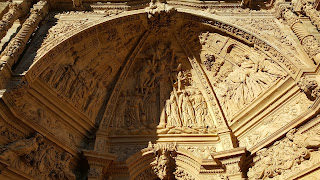
On the tympanum of the main doorway of the basilica Abraham is about to
sacrifice Isaac, Ishmael is riding through the desert and Sarah is looking out from
the door of her tent; all below a roundel of the Lamb of God.
 |
| San Isidoro |
Further to the right
is the Pardon Doorway; so-called because pilgrims who couldn’t make it to
Santiago could receive a pardon by passing through the door and it is still
opened to celebrate Holy Years (when the Feast Day of St. James, the 25th
July, falls on a Sunday). Above the doorway is displayed the Deposition, the
three Marys before the Sepulchre and the Ascension, although we felt that the rendering
of a dog’s head below the door lintel looked rather too much like a teddy bear
to be impressive and lacked gravitas!
 |
| Door of Pardon Tympanum |
We completed our visit by spending a long time
sitting inside church itself, enjoying the peace and tranquillity as we took
some time to meditate and seek God. Even though Romanesque architecture can
often be heavy, the church was full of warmth and light – helped by the
sunshine outside and the golden glow of the stonework. A lovely vaulted gothic
chancel also drew the eye and added to the feeling of airiness. The modern
wooden pews were very comfortable and there were even mini radiators at shin
level which I have never seen before in a church which made praying much more
pleasant!
At the end of our visit, David and I had one of
those lovely moments that for me make the Camino so memorable. We walked over
to the Sacristy to request a stamp for our credencials. We were ushered inside
by an elderly robed priest who was very welcoming. He stamped our credencials
and then asked in broken English if we were Catholic or Protestant and if we
were English? Having explained that we were Protestant / Christian and Irish,
he smiled and nodded, reached into a drawer and produced three cards -two in
English for both of us and one in Spanish, then, as we stood together, he raised
his hands in blessing and prayed the prayer on the card in Spanish, whilst we
followed along in English. It was a beautiful, touching, and intimate moment
and we felt sent on our way with God’s protection and the blessing of a
Patriarch!
Blessing
and Prayer for the Pilgrim
Dear Lord Jesus Christ, who brought your
servant Abraham out of the city of Caldeas,
protecting him through all his travels / wandering,
and who was the Hebrew nation’s guide through the
desert,
we ask you to bless these children of yours who,
for the love they bear your name,
are on a pilgrimage to Compostela.
Be for them their companion on the way,
Their guide at the cross-roads,
Their shelter on the road,
Their shade in the heat,
Their light in the darkness,
Their comfort in weariness and their resolve in
intentions.
So that through your guidance they arrive sound at
the end of their road,
And enriched with grace and virtue,
return home healthy and full of worthy virtues.
In the name of Jesus Christ our Lord.
March in the name of Christ who is the way,
And pray for us in Compostela.
 |
| Chancel of San Isidoro |
(1)
St. Isidore’s Basilica – The Treasure House of León.
2nd Edition. Antonio Viñayo González. Edilesa.