Friday, 8 January 2016

Camino Day 14: San Juan De Ortega - Burgos Part II (06/10/15)

It was after 2pm by the time we finally left Cartuja de Miraflores and we were feeling very tired and hungry. I was particularly concerned about Matthew, who had been very patient while I looked round the monastery, but now looked very pale and exhausted and was suffering with the pain in his knee. As we walked back down the hill towards Burgos, he looked ready to collapse, so I insisted that he sucked the entire contents of a tube of glucose energy gel that I gave him. I remembered having my slump on the way to San Millán, so I knew what it could feel like!
We walked back to where we had left the path beside the rio Arlanzón (this took about 20 minutes and then continued until we reached a large wide boulevard called Timoteo Arnaiz. Unfortunately, to add to our hunger, tiredness and weakness, we now had to face again the inaccuracy of the urban maps in John Brierley’s guidebook. I was keen that we stay at the Casa de Peregrinos Emaús Albergue; a Parish albergue that I liked the sound of in the guidebook because it said that it had a shared meal with Christian prayer and a pilgrim blessing. It was situated on the south side of the river, on the opposite side from the medieval city centre. The map of Burgos in the guidebook showed clearly that all we had to do was walk down Timoteo Arnaiz and turn right onto calle de San Pedro de Cardeña. The Albergue was shown as being situated at the corner of the calle and calle Molinillo and the accompanying blurb said that it was at 31 calle de San Pedro de Cardeña.
We trudged in a very weary manner along the above streets. They turned out to be longer than they looked on the map and the area was rather scruffy and had that ugly urban look that many city suburbs have, which did not enhance our mood. I kept a concerned eye on Matthew who looked thoroughly exhausted and fed up.
We finally reached the site marked on the map as the location of the albergue, but instead, were confused and rather irritated to find a bar! We looked up and down the street, but could see no albergue or church. Exhausted, we decided to go into the bar to see if they served pintxos and regroup! Luckily, the bar was still serving a good variety of pintxos and I immediately ordered a large selection accompanied by three glasses of rioja whilst Matthew went off to the bathroom for what seemed a very long time (he later told me that he was so tired that he was nearly in tears and so thought he had better go in the bathroom for a while. He had felt like giving up, but as I said to him later, he didn’t – perserverance makes a real pilgrim and he showed it that day and I was proud of my friend). When he returned, he told me that he didn’t feel like eating but David and I told him we didn’t care whether he felt like it or not and ordered him to eat to regain his strength. By the time we had all eaten several pintxos, had some wine and then coffees (and a hot chocolate for Matthew), we all began to feel a bit better at least!
We now discussed what we were going to do. Should we give up attempting to find the Emaús albergue and walk on into the city centre? We showed the barman the map, but he looked at it in astonishment and couldn’t make it out and just shrugged. He didn’t seem to have heard of the Emaús albergue. I returned to the table and then had the bright idea that since in the guidebook it said that the albergue was situated behind the church of San José Obrero, maybe he had heard of the church, if not the albergue? I tried again – “Por favour – iglesia San José Obrero?” Ah! This time recognition from the barman and he drew directions on a piece of paper. It turned out that the albergue was not on calle de San Pedro de Cardeña at all, but in a street that ran parallel behind it and was not even marked on the map! Note to John Brierley, Camino Guides and Findhorn Press – please improve your urban maps!!
We walked round to the church in less than two minutes and found a door at the side with a notice that said that pilgrims could only stay there if they had not already stayed at another albergue in Burgos. Matt had arrived in Burgos the day before and although he had also seen the sign earlier in the day, he had tried to bluff his way in and stay there, but was turned away when he presented his credencial and the stamp from the previous night was spotted – I don’t know why he even tried it!? He texted us and told us that he was now staying at Hostal Evolucion in the city centre instead.
We rang the bell and were greeted by the Hospitalero, a very friendly French woman called Marie-Noelle who explained that the rules of the Emaús albergue were different than in most albergues. Firstly we had to keep the noise down as there was a continuous adoration of the eucharist taking place in the chapel downstairs inside the building. The worshippers were also praying for the pilgrims who stayed in the albergue. Secondly there was a mass and pilgrim blessing at 6.30pm and the albergue locked its doors at 8pm (most albergues stay open until 10pm) because there was a communal meal and prayer time after the mass. “These are the rules – we try to create a place of rest for pilgrims, do you still want to stay?” We said we were quite happy to do so – it sounded great to us!
Inside, the albergue was very well appointed and the nicest that I have stayed in – better even than the Check In Rioja albergue in Logroño! Marie-Noelle explained that the building had been a Jesuit Seminary which had closed and become dilapidated. The parish priest now in residence had the visionary idea of raising money to restore the seminary building, create an albergue inside part of it and create a chapel to provide mass for the locals. At the time the priest had been told that he was mad, would never raise enough money, would bankrupt himself and that pilgrims would not want to stay in this part of the city. However, he preserved and eventually, the work was completed to an extraordinary level of quality and detail.

The Jesuit Seminary staircase

Leaving our boots on the ground floor, Marie-Noelle took us up the wide sweeping staircase of the old seminary with it’s stained glass windows, to the second floor where the albergue had been created. On one side of the staircase landing were the bedrooms and bathrooms, furnished with bunks and lockers in Scandinavian style light wood. The showers were good quality and we even discovered the following morning that there were speakers set into the walls to wake us up with gentle choral music! On the other side of the landing there was a lovely cosy lounge area also clad with timber, steps to a small balcony library, an open plan dining area and a well-appointed kitchen.
Several other pilgrims were already staying at the albergue – an Italian called David from Turin, a Danish lady who lived in Sweden, a German lady and a brother and sister from Poland. All spoke good English and we chatted to them and enjoyed their company.

We gratefully showered and washed our clothes (including re-washing the damp ones we had not manged to dry at San Juan de Ortega. Although the tumble drier wasn’t working, there was a balcony and we hung our clothes to dry there instead.
Walking along the rio Arlanzon into Burgos
Matthew was feeling more energised now that he had digested his pintxos and showered and so we texted Matt and agreed to meet him in the city centre after I had shown Matthew the cathedral. Marie-Noelle informed us that entrance to the cathedral was free on that day.
Matt with the churros con chocolate
The walk into town took about twenty minutes and we spent an hour walking around the cathedral before bumping into Matt near the chapels around the high altar. We were slightly limited for time, because we wanted to be back at the albergue for the mass and pilgrim blessing, so we left the cathedral and went to the Favour Chocolate café in Plaza Santa Maria – opposite the main entrance of the cathedral. The café was decorated in early twentieth century gentile splendour and we indulged in churros con chocolate – very large, long fingers of fried dough, sprinkled with sugar for dipping in really superb thick viscous chocolate caliente. Excellente! Mega calorie intake! We felt however that we could afford to indulge after all our walking! We were rather shocked to see that the menu suggested that one serving should consist of seven churros to eat for each person, but we managed to reduce this and ask for one serving of churros only to share with our three hot chocolates!
Matt had been walking for a few days by himself since Ben had left him at Najera to go to Brazil and had not seen either of us for about two weeks, so he was extremely talkative in a way that Matthew and I found rather shocking after David and ourselves had lived fairly quietly together for the last few days. In the café Matt started a random stream of consciousness that he specialises in at times, sharing with us his knowledge of Spain gleaned over the previous two weeks, telling us about the various pilgrims he was walking with and even explaining the “correct” pronunciation of Najera to me ;-) We love him dearly and were glad to see him, but in a way, we were also glad to leave him talking to the tourists at the next table whilst we headed back to the Emaús albergue!


Marie-Noelle with German pilgrim
We returned just in time for the mass. The chapel was full of locals from the area surrounding the church, which I liked as I felt it had an authentic feel and lacked the “touristy” feel of some of the churches I have been in on the Camino. A local signalled at Matthew and made room for him on a pew and I sat at the back with David from Turin. The three of us observed the Mass, whilst most of the pilgrims went forward and took the Eucharist. Afterwards all of us went forward for a pilgrim blessing from the priest.
Marie- Noelle then escorted us back upstairs, where we set the dining table and had a simple but filling meal, whilst sharing our stories and laughing and chatting together. Marie-Noelle explained how, each morning, she bought food for the evening meal using money donated by pilgrims who had stayed the previous night.
Matthew, Marie- Noelle, David, Me, David from Turin,
with the Polish, German and Danish pilgrims
After our meal we washed the dishes together, set the table for breakfast and then shared a time of communal prayer together. We were given a little booklet as a gift and read Luke chapter 24, verses 13-35 together before praying the pilgrim blessing. It was a wonderful time of fellowship; a time of peace and unity despite being from so many nationalities and the whole visit to the albergue was such a restful experience – a credit to Marie- Noelle who welcomes pilgrims day after day and yet seems unflagging in her gracious welcome and hospitality to pilgrims.
Luke 24: 23-35
Now that same day two of them were going to a village called Emmaus, about seven miles from Jerusalem. They were talking with each other about everything that had happened. As they talked and discussed these things with each other, Jesus himself came up and walked along with them; He asked them, ‘What are you discussing together as you walk along?’ They stood still, their faces downcast. One of them, named Cleopas, asked him, and ‘Are you the only one visiting Jerusalem who does not know the things that have happened there in these days?’ ‘What things?’ he asked. ‘About Jesus of Nazareth,’ they replied. ‘He was a prophet, powerful in word and deed before God and all the people. The chief priests and our rulers handed him over to be sentenced to death, and they crucified him; but we had hoped that he was the one who was going to redeem Israel. And what is more, it is the third day since all this took place. In addition, some of our women amazed us. They went to the tomb early this morning but didn’t find his body. They came and told us that they had seen a vision of angels, who said he was alive. Then some of our companions went to the tomb and found it just as the women had said, but they did not see Jesus.’ He said to them, ‘How foolish you are, and how slow to believe all that the prophets have spoken! Did not the Messiah have to suffer these things and then enter his glory?’ And beginning with Moses and all the Prophets, he explained to them what was said in all the Scriptures concerning himself. As they approached the village to which they were going, Jesus continued on as if he were going further. But they urged him strongly, ‘Stay with us, for it is nearly evening; the day is almost over.’ So he went in to stay with them. When he was at the table with them, he took bread, gave thanks, broke it and began to give it to them. Then their eyes were opened and they recognised him, and he disappeared from their sight. They asked each other, ‘Were not our hearts burning within us while he talked with us on the road and opened the Scriptures to us?’ They got up and returned at once to Jerusalem. There they found the Eleven and those with them, assembled together and saying, ‘It is true! The Lord has risen and has appeared to Simon.’ Then the two told what had happened on the way, and how Jesus was recognised by them when he broke the bread.
Bendición del Peregrino

Lord, bless the pilgrim’s feet…Bless his suffering, the result of many kilometres.

Bless these feet which have borne the weight of the day; bless every step of this way and bless all the ways and steps of his life. Lord, bless his history.

Lord, bless his rucksack. Bless the weight he carries on his shoulders, bless everything he has left at home before leaving and suffering; bless his family, his work, his relationships…May your blessing, Lord, lighten the weight of the day.

Lord, bless his eyes. You made them for contemplation. All along the way, may his eyes become familiar with the beauty of creation, the beauty of each pilgrim, the beauty of each gesture of affection and of service. Open his eyes, that one day they may meet you and recognise you!

Lord, bless his heart. That all along the road YOU may be his special guest. Like the disciples of Emmaus, I say to you: “Stay with me, Lord and YOU shall be my greatest blessing”.

Amen!

Wednesday, 6 January 2016

The Monastery of Cartuja De Miraflores, Burgos (06/10/15)

The monastery of Cartuja de Miraflores was founded in 1442 by King Juan II of Castille and Leon when he donated his hunting lodge and it’s surrounding lands (the name Miraflores was the name of the hunting lodge) to the Carthusian Order. The buildings themselves however, are almost entirely due to the patronage of his daughter Queen Isabella of Castille “La Católica”, (who we mentioned back at San Juan de Ortega, and who was also responsible, with her husband Ferdinand, amongst other things for funding Christopher Columbus’s exploratory trip west).
Polychromatic sculpture of King Juan II at prayer
on Reredos
Initially started by the German architect Hans of Cologne and then continued by his son Simon, the monastery was built in the late gothic style towards the end of fifteenth century. Both these architects were also largely responsible for the construction of Burgos Cathedral. The monastery church consists of a large, high-vaulted single aisled hall and I found it reminiscent of the chapel of King’s College, Cambridge, which is it’s slightly earlier contemporary.

Cartuja de Miraflores
The Carthusian Order (in Spanish Cartuja) is named after the Chartreuse Mountains in the French Alps where St. Bruno of Cologne established his first hermitage in 1084. In England, Carthusian monasteries were known as Charterhouses and the interesting thing about a Carthusian house compared with other types of monastery is that rather than the monk living with other monks and sharing a communal dormitory, dining area and garden, each Carthusian monk or hermit, who is a priest, has his own cell or living quarters where he lives, works, studies and prays and a small garden where he grows flowers and vegetables for exercise. The cells open onto a corridor and usually, the monk will only leave his cell three times a day for prayer services in the monastery chapel. The emphasis is on contemplation and meditative prayer.
Entrance to Monastery
I had visited the ruined Carthusian monastery of Mount Grace in North Yorkshire, England and I was interested to see one which hadn’t been touched by the Reformation.
Close up of Pieta
We passed through the gateway into a modern glazed corridor equipped with a reception desk and after giving a donation and getting our credencials stamped, we entered the courtyard and admired the entrance to the monastery. A doorway is framed with a Pietá in the gothic arch and above, on the left and right are the coats of arms of King Juan II and the kingdom of Castille and Leon.
The interior of the church is, according to the liturgical tradition of the Carthusians, divided into several spaces. Going through the doorway, the atrium had graceful vaulting and this led to what is called the Vestibule of the Faithful, beyond which a metal screen and gate led the eye through to the Laybrother’s Choir. Beyond that, a beautiful gilded Baroque doorway could be seen and the impressive vaulting and internal height of the church appreciated for the first time.
View from Vestibule of the Faithful
We passed through the gilded doorway and entered what is called the Father’s Choir and here were confronted with two extraordinary sights; the first is the richly gilded high altar or reredos. This was constructed in 1499 by the master sculptor, Giles of Siloe and the beautiful polychromatic painting on it was executed by Diego de la Cruz. 
The Reredos
The high altar is rich in detail and depicts the Mystery of Redemption and is so rich in detail that many paragraphs could be expended explaining its rich iconography. However in brief, in the circular central piece, the border of which is created by a host of angels, the crucifixion is depicted. The cross is held by representations of God the Father on one side and the Holy Spirit on the other (unusually crowned with a Papal Tiara). Below, Mary and the Apostle John look up from where they are standing on either side of the Tabernacle (where the Host is kept for Eucharist).
Four scenes of the passion of Christ surround the cross. Around this central area are four more circular panels depicting the symbols of the four Evangelists and a rich variety of saints including Peter, Paul, early church fathers, John the Baptist and Mary Magdalene, as well as scenes from the life of Christ. At the extreme bottom on the left and right, King Juan II and Queen Isabela, kneel in prayer. The niche below the Tabernacle even revolves to display different sculptures to mark each of the major feasts of the church calendar such as Christmas and Easter in order to help focus the monk’s worship.
As if this amazing sculptural ensemble were not enough, the second feature of note lies in front of the altar and is the astonishing double tomb of King Juan II and his second wife, Isabel of Portugal. It dates from 1489 – 1493 and made from glowing crisp alabaster. Queen Isabel La Catolica had it created for her parents. In the shape of an eight pointed star, it is adorned with a profusion of sculptures – biblical characters on King Juan’s side and allegorical ones on the queen’s side.

Tomb of King Juan II
Tomb of Isabel of Portugal

Beyond the main church are three side chapels. The first containing treasures belonging to the monastery and of particular interest was the restored Chapel of Our Lady of Miraflores with it’s exuberant Baroque multi-coloured frescoes, freshly restored to their original glory.
Samson from King Juan II's tomb

King David
Abraham sacrificing Isaac
Ironically for me, however, the greatest treasure in the whole monastery is in the final chapel and is not any of the gilded or polychromatic sculptures or the gold and silver articles of treasure, but a 20th Century monochrome painting called the Elevation of the Cross by the Spanish Impressionist painter Joaquín Sorolla. This unusual portrayal of the crucifixion shows the brutality of the execution through it’s limited pallet (it seems to be in black and white, but closer inspection reveals rich brushstrokes of gold and shades of brown. 
Sorolla's Elevation of the Cross
The almost industrial intrusion of rough, brutal hands in the foreground are pulling ropes which themselves are obviously connected to pulleys which although unseen are suggested outside the view and are hoisting the cross forward and upright towards it’s sickening, joint dislocating thud into it’s socket, for which Christ has closed his eyes and braced himself in readiness. Christ’s mother reels back in tortured anguish, while St. John’s turns his distraught gaze, full of pathos and concern, suddenly towards her, emphasised by a suggestion of wind whipping at his hair.
Mary’s outstretched arms of grief and despair seem to echo those of Christ on the cross. The men pulling the rope almost seem to be pulling in rebellion against Heaven itself. But isn’t that the rebellious state of all our hearts? We pull against God and his love and it is this which put Christ on the cross for our sins.


Sorolla painted this deeply moving scene for a friend who was a monk in the monastery and had it on a wall of his cell for many years. I stood transfixed before it for some time contemplating the scene and could only pull myself away from John’s powerful gaze it with some difficulty.
When I got home to Ireland, I asked my friend Martin Stelcik (http://stelcikmartin.wix.com/drawing) to create for me a pastel sketch of the painting for my study and I think he produced a very moving copy which captures all the drama of the original.


Baroque detailing from Chapel of Our Lady of Miraflores
It was time to leave the monastery, find lunch and finish our walk to an albergue, but I was so glad I had made the effort to visit Cartuja de Miraflores and if you are walking the Camino, I would recommend that you make the effort to take a detour – you will be richly rewarded.
Vaulting above reredos

Tuesday, 5 January 2016

Camino Day 14: San Juan De Ortega - Burgos Part I (06/10/15)

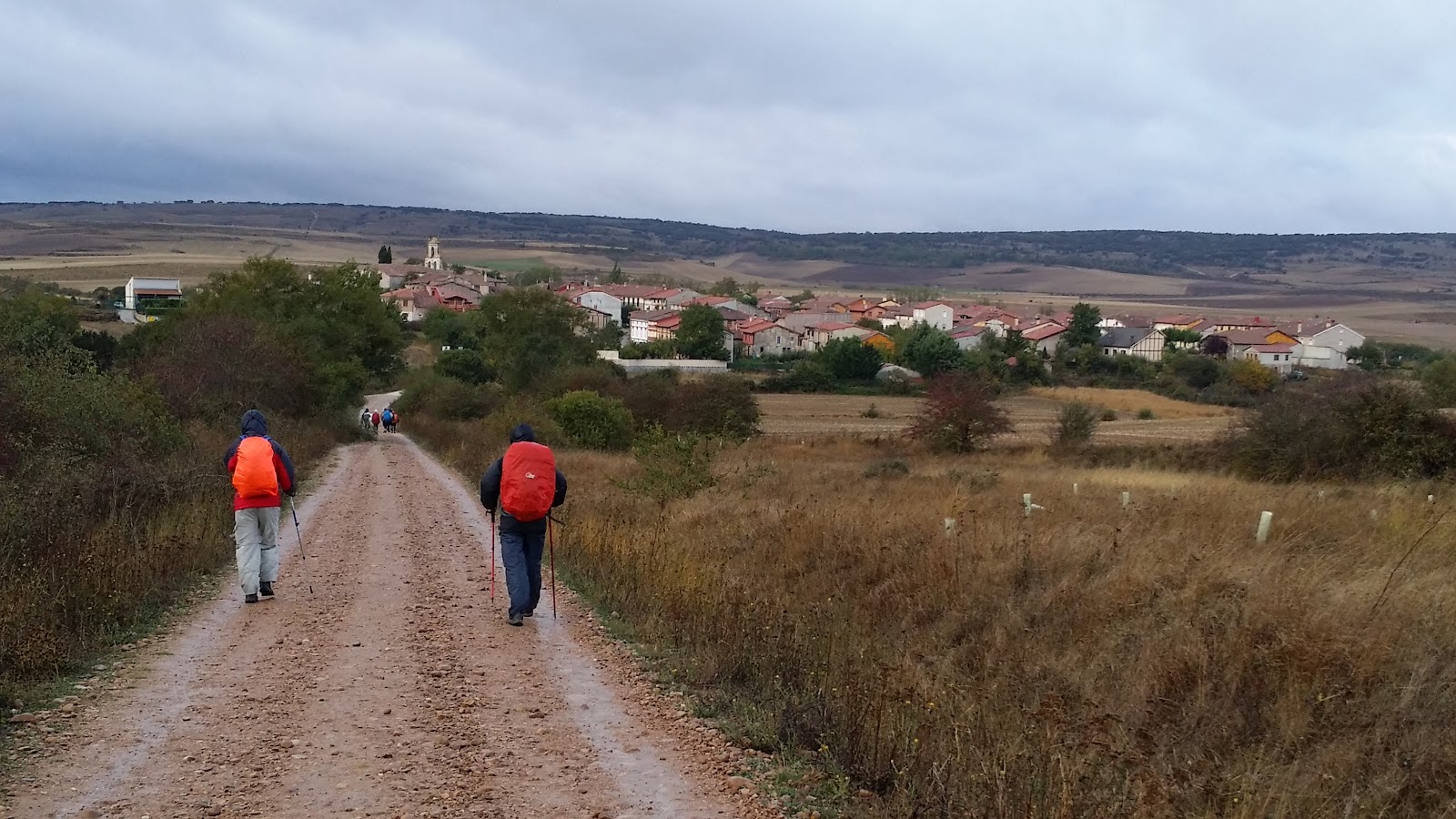
This day turned out to be the hardest day that I have walked on the Camino so far; not because the terrain was especially difficult, but because of the poor weather and the surprising lack of cafés and bars along the route.

We hoped to get breakfast at the bar in San Juan de Ortega, but this was closed when we left the albergue and so we had to go back inside and got drinks and a snacks from the vending machine in the foyer.

The weather was fairly miserable; the final effects of the edge of the storm that had been causing havoc in the South of France was making itself felt and it was cold and wet with a strong wind still blowing. We had not got far down the lane when a downpour started and I had to stop and don my poncho.

Climbing over a small hill after leaving San Juan, we fell into conversation with a young Irish couple from Dublin who were walking to Burgos and then hiring bikes to cycle across the Meseta. I had heard descriptions of how flat, boring and soul-less the high Meseta plateau was and we were reaching it in a couple of days, I was quite concerned; I was determined though, that I would be walking across it and not cycling or indeed , giving it a miss altogether, like some people do.

Descending the hill into Agés village, the path was very exposed and as the wind was very strong, my poncho kept inflating and fluttering noisily in the cross-wind and I felt rather like a 16th century Spanish Galleon weathering heavy weather around the coast of Britain during the 1588 Armada!
Matthew & David approaching Agés
There was a café open at Agés, but as we had just had a snack half an hour earlier so we opted to wait for breakfast until Atapuerca. This was a big mistake!

Just after Agés there is a pretty little medieval bridge over the rio Vena built by San Juan de Ortega – a modern road and bridge runs close beside it and other pilgrims were dashing past and ignoring it, but I took the time to take the little detour to cross it like my ancient pilgrim forbears and think about San Juan and Santo Domingo developing the early Camino route. Going by the sign beside the bridge, some pilgrims at least are oblivious to the bridge’s historical significance and only view as a convenient place for the toilet!
Crossing San Juan de Ortega's bridge over the rio Vena
This got me thinking about one type of person you meet on the Camino who just seems to be eager to dash from place to place as fast possible and never seems to take in the wonderful scenery and places around them. A Latvian friend of mine in Ireland has another friend who was “walking” the Camino the same time as us and doing it in 50km stages per day. This, to my mind, is totally missing the point of the Camino which surely is an opportunity to take time out from normal life and allow space for reflection, spiritual reflection and personal engagement with God?
Graphic toilet ban sign at bridge!
Approaching Atapuerca there was a modern circle of standing stones. Near this site the “Battle” of Atapuerca took place in 1054 when the Navarrese king Don García was killed by his brother Fernando I of Castille and Leon in a jousting contest to settle a dispute concerning the areas of Briviesca and Montes de Oca (we saw his tomb back at Najera). On the hills above the village, archaeological investigations of prehistoric remains found in the caves that honeycomb the area have identified them as being the oldest human remains found in Europe (reputedly dating back 900,000 years).
We were cold, dripping in the rain and very hungry, when we reached Atapuerca and I felt I was hungry enough to kill a wild bison or woolly mammoth like my prehistoric ancestors, but they were long gone from the surrounding sodden fields although we scoured the entire village, every café was also closed and not a living soul or stray dog could be seen Atapuerca apart from a few Northern Irish pilgrims walking through who passed the time of day with us and then moved on. The inhabitants of Atapuerca seemed to have become extinct like their prehistoric ancestors! We stopped at a fountain to shiver and eat an orange each that David handed us as well as a few nuts and raisins. What we really wanted though, was some warm drinks and decent food and I began to dream of pintxos (with a glass of Rioja and tortilla potato, all washed down with a final café con leche.
Cross on Matagrande
Disconsolately, we trudged on and now had to ascend the steep little hill of Matagrande to reach a cross at 1,070m. The going was hard as the path consisted of eroded stony ground, made muddy and slippery by all the rain, but Matthew and I made the best of it and I got my Kindle out and we did Morning Prayer together and sang some worship songs. We again found the Old Testament reading appropriate as we slipped over the mud as it was from Jeremiah 38:1-13 and talked about the Prophet Jeremiah being thrown into a cistern and sinking into the mud! David was leading up the rear as he sometimes has to take hills slowly because he starts to get a roaring in his ears if he over exerts himself, but commented on the singing of angels that he heard when he reached us at the cross – the wind had carried our singing down the hill to him or maybe we were just very loud?
David ascending Matagrande
There was an optional route across the high ground, but we were by now so ravenous that we descended to Viilaval in the hope of finding a café. Nothing! There was a Roman Well to be seen, but even I was so hungry I couldn’t really care!

We trudged into Cardeñuela and oh joy; there was finally a café! I downed a thick and filling fruit smoothy, devoured a rather excellent chorizo omelette and finished off with a Café con leche. Surely there is a business opportunity for some enterprising individual to open a café between Agés and Cardeñuela? By the time we finished gulping and guzzling, the café was fairly empty apart from a Glaswegian pilgrim that I had chatted to at Villaval. An interesting character in his mid thirties who had a red beard and interesting South American style felt bowler hat; he was still sitting in the café as we left, creating interesting impressionistic art work by staining watercolour paper with coffee dripped from a straw.

We left the café thinking things were looking up; from now on there must be more places to eat and drink and we were sure we wouldn’t get into such a state of hunger again? Wrong!
Orbaneja
We carried on through Orbaneja and over the A-1 motorway. Shortly after this there was an optional route that was recommended by John Brierley in his guidebook, which we wanted to take as it brought us into Burgos along the side of the river. At first the optional route seemed unclear, as it descended an indistinct path beside a modern housing estate, but we soon picked up the yellow arrows again. The path took us cross-country through fields and alongside the security fence of Burgos Airport. After all the rain, the path consisted of thick cloying mud that suck to our boots and made them very heavy. It was extremely hard, tiring work to walk and we began to regret taking the path. It was after 12.00pm by now, so Matthew and I took our mind off the mud by reciting Midday Prayer as I tried not to drop my Kindle in it. The path alongside the airport fence seemed interminable and at one stage the three of us sat on a concrete bridge to eat a snack and rest for a moment.
David and Matthew sharing a joke at Orbaneja
Finally, we reached the Burgos suburb of Castañares. Time for lunch – surely there must be a café here that was open? Nothing could be found, which I found astounding! We walked on, leaving the suburb and entering a pleasant leafy country park that ran alongside the rio Arlanzón into Burgos. The storm that had dogged us since we arrived had finally departed and the sun was coming out. Locals were out walking their dogs or jogging and I began to feel quite cheerful. Matthew however, was starting to lag far behind David and I as his knee was hurting and being in his mid-twenties, and therefore largely unacquainted with his own mortality unlike us middle aged guys, was not used to aches and pains in his body! He was quite put out by this new phenomenon! When I ribbed him later about the old fellas leading the way into Burgos while the young tried to keep up, he retorted that every day he spent with me made him feel young and fit as I was so near death’s door that he was reminded of his mortality just by looking at me! No respect for his elders!

We entered the outskirts of Burgos. I was keen to visit the Carthusian Monastery of Cartuja de Miraflores. This involved a detour, which looked quite short on the map, but turned out to take about thirty minutes or so and also involved a tiresome walk alongside a ring road and a climb up quite a steep hill. Matthew wasn’t very happy about this and I sensed mutiny might not be far off if we didn’t feed him! We were relieved to spot a café as we reached the top of the hill as by now we were again very hungry, but were dismayed to find it was closed for during wintermonths! As it was 1pm  and the monastery closed at 2pm – 4pm, there was nothing for it but to visit it without having lunch first.
Despite my hunger I found Cartuja de Miraflores one of the most architecturally beautiful monasteries I have visited on the Camino and well worth the detour (although I doubt Matthew would agree with me!). As we climbed the final hill a priest and a group of Senior Citizens passed us, commenting in Spanish about the “Pereginos”. Apparently they too were on a pilgrimage as I later discovered that the 6th October was also the anniversary of the death of the Founder of the Carthusian Order, St. Bruno. This wonderful place deserves a description all of its own, so more in my next post.

Sunday, 3 January 2016

San Juan De Ortega (05/10/15)

The old monastery buildings and church of San Juan de Ortega, isolated as they are in the Montes de Oca, with their apparent remoteness only enhanced by being approached by pilgrims after a long walk in the forest, are some of the most atmospheric and evocative places I have visited on the Camino so far. Our stay there has personal significance for me and will long remain as a high point in my memory, even though the accommodation at the albergue was fairly basic and initially, at least, very cold, draughty and damp!
The story concerning the founding and development of the monastery in such a remote location is very interesting. San Juan himself was born about 1080 in Quintanaortuño and as a disciple of Santo Domingo de la Calzada, helped him to develop the Camino route in the Twelfth Century by building roads, bridges and hospitals for pilgrims.
Monastery Church
He decided to go on a pilgrimage to the Holy Land and on his way home afterwards, his ship encountered a severe storm and fearing that he would be shipwrecked, San Juan prayed to St. Nicolas of Bari, who reputedly appeared to him and calmed the storm. In gratitude, San Juan promised to build a chapel when he returned home and dedicate it St. Nicolas.
Doorway in monastic buildings
(As a digression, this is the same St. Nicolas who is known today as “Santa Claus”. He was Bishop of Myra in Turkey in the 4th Century and tradition tells us that when he heard that the two daughters of a poor man were going to have to be sold into slavery because the family was destitute, he threw two bags of gold through the window of their house anonymously to save them from this fate and thus become associated with giving gifts. When the Muslims invaded Turkey, his relics were secretly taken to Bari in Southern Italy were they remain in the cathedral today. In Medieval times he was a popular saint to pray to; especially concerning dangers, shipwrecks, fires and economic problems and over two hundred churches are dedicated to him.)
Fifteenth Century Cloister
Upon reaching home, San Juan found that there was a lot of unrest in his native Castille and so withdrew to this wild and uninhabited place (Ortiga means nettles in Spanish) to live as a hermit and build a simple shelter, which he did when he had obtained permission to do so from Doña Urraca, Abbess of Cañas.
Fruitless attempts to dry clothes in cloister
In 1115, San Juan, was granted the right by king Alfonso “The Battler” to establish a proper monastery and immediately started work on the construction of monastic cells and a chapel dedicated to St, Nicolas to fulfil his promise. In this work he was helped by his brother Martin and a small order of Augustinian Canons Regular that he had established. Although their work was opposed by local bandits who stole the tools, burnt the wagons, and even threatened to kill San Juan himself, the chapel and monastery were eventually completed. San Juan also built a pilgrim hospital and received the support of Pope Innocent II in 1138 and that of king Alfonso VII who granted him all the Crown lands in the Montes de Oca. San Juan also started work on the monastery church, but only the apses were completed at his death in 1163 and subsequently the monastery gradually went into decline.
Chapel of St. Nicolas
In 1431 however, the Bishop of Burgos granted the monastery to the Jeronymite Order and the monastery began to flourish once more/ In 1477 Queen Isabel (la Católica) visited the monastery. She had been unable to conceive after seven years of marriage and was drawn to San Juan’s reputation as an intercessor in cases of infertility. The Queen was reportedly cured of her sterility and in thanks had the Chapel of St. Nicolas rebuilt in a much more sumptuous style.
Romanesque central apse
The Jeronymites also added the gothic naves to the monastery church and built a larger cloister in the Herrera style, but in the Medizabal confiscations of 1835, the monastery was finally abandoned and fell into ruin.
Bronze wall plaque of Emmaus Road
Copy of carving at Santo Domingo de Silos monastery
It was only in 1964, that work began to restore the monastery. The monastery church was restored first and then the fifteenth century cloister. A further €4,000,000 worth of restoration work is planned on the other buildings and while we were there, we found the Chapel of St. Nicolas closed for restoration and two large cranes were working on the other monastic buildings.
Baldachin in the nave
We checked into the albergue. It consisted of a large dining room (with small wood burning stove) downstairs and a staircase that led to two large dormitory rooms and male and female bathrooms grouped around the fifteenth century two storey cloister. It was cold and draughty and we met one middle aged Irish pilgrim who had checked in and then decided that it was so cold that she couldn’t stand it and so then checked into the Casa Rural opposite the church for something more luxurious! Luckily for us though, we found that as the evening wore on the dormitories warmed up quite a lot and became much more comfortable. In addition our beds were away from the windows, which seemed quite draughty and this probably helped.
We were tired after our long walk from Belorado and were looking forward to showers and washing our clothes, however the bathroom facilities were very primitive! A lot of pilgrims had already showered and the tiled floor was swimming in water and very slippery. The bathroom itself was also very cold! There were three shower cubicles; David took the first one and began what sounded like a pleasant enough shower; I took the second one as the third one had no door and I didn’t fancy a public shower! This didn’t stop another pilgrim later however, who showered in full view later on while I was washing my clothes –rather disconcerting for a reserved Irish pilgrim like myself!
Close up of Baldachin canopy
Having stripped off, and standing shivering in the cold, I eagerly switched on the shower…a miniscule, very lukewarm dribble of water emanated from the shower head that was so tiny that I could barely wet my hair with it, never mind clean my body! I therefore patiently waited (shivering) until David finished his shower as I hoped that the water pressure would then increase. Nothing happened however, and so when he gave me the all clear that no one else was in the bathroom, I streaked naked into the other shower cubicle and finally managed to have a shower in relative comfort!
Effigy of San Juan under canopy
Things unfortunately were not much better when it came to washing our clothes. There were only hand washing sinks and the water was cold (never mind naked showering pilgrims in the mirror behind me!). Drying facilities only consisted of hanging clothes on lines around the cloister and as the weather was cold and damp, there was no chance of getting the clothes dry; the next morning my clothes and towel had not dried at all and I had to pack them wet in my plastic bag and hope the next albergue had better facilities!
Scene from life of San Juan on Baldachin
Somehow though, these privations did not dampen our spirits; I have the personal attitude (taken from the pilgrim mediation that I obtained at Estella) that I should take each albergue as I find it and seek to be grateful and content and avoid whining.
As I said, the dormitories began to warm up and the communal pilgrim meal of sopa de ajo (garlic soup), pasta and a segundo of pork, salad and chips and even an orange to finish was hearty and welcome. We paid a few euros for a bottle of red wine and it warmed and encouraged us further!
Matthew enjoying dinner
After dinner, David parked himself by the wood burning stove and Matthew and I took ourselves over to the church to observe the pilgrim mass. Orders of Service were helpfully provided in English (the first time I have seen this on the Camino – why doesn’t it happen more often?) and although we didn’t take the Eucharist, as we are Evangelical Christians and not Catholics, we took part in the liturgy and prayers where we could, as much of it is obviously the same as in the Anglican Book of Common Prayer.

After the mass there was a pilgrim blessing in the chapel to the left (facing the altar). Pilgrims of various nationalities gathered and were given orders of service in their own language. We participated in the prayers and then went forward and to be blessed by the priest, who then placed a necklace containing a patriarchal cross over each of our heads as a gift. The cross is a copy of one engraved on the wall of the chapel. It was touching and unexpected to receive such a gift and I wondered how much it must have cost to distribute the crosses to pilgrims. As for the significance of the Patriarchal cross as a symbol with it’s two bars – no one is quite sure of it’s meaning, but it is a popular symbol in the Eastern Church and the two bars are thought to mean either: secular and ecclesiastical authority, the cross with the sign “Jesus King of the Jews above it, or to symbolise the cross and the Holy Spirit. I chose to go with the third meaning and the cross is a special reminder for me of a special place.
The interior of the church itself is relatively small, but very beautiful. The first thing that catches the eye upon entering is the ornate baldachin or canopy of the tomb of San Juan. The canopy is in a florid Elizabethan Gothic style and dates from 1464. It covers a recumbent effigy of the saint and around the sides are carved six scenes from San Juan’s life, such as his journey to the Holy Land. Originally the tomb of San Juan was in the crypt below the church, but this flooded in 2005 and has been closed and the canopy and sarcophagi inside were moved into the church. The baldachin was placed in the central nave and the simple stone sarcophagus of San Juan now lies in front of the altar in the chapel where we received our crosses. An outer, richly carved Romanesque sarcophagus, is also on display, but unfortunately, I forgot to look out for it – rather remiss of me!
Simple stone sarcophagus of San Juan
Other things of note in the church include the wonderful Romanesque apse with it splayed windows glazed with alabaster. (The apse was lit up during mass highlighting the wonderful detail) and the church also has many fine twelfth century Romanesque pillar capitals. The most famous is the Annunciation capital; again situated in the chapel where we received our crosses. This capital shows the angel Gabriel kneeling in front of the Virgin Mary and announcing that she will conceive and bear Jesus. In 1974 it was rediscovered that twice a year on the Spring and Autumn Equinoxes; on March 21st at 6pm and September 22nd at 7pm, a beam of light shines through the church window and illuminates the carving of Mary. Whether this phenomenon was designed by the original builders or is accidental, is not known, but it seems unlikely surely, to be accidental, given San Juan’s reputation in medieval times to heal infertility?
Annunciation capital - it's hard to see, but Mary is on far left at the corner
The pilgrim blessing finished at 8pm and the worshippers filed out leaving Matthew and myself alone in the church which did not close until 9pm. Unusually for a Spanish Church, it was warm inside and so we decided to do Evening Prayer together. The chapel to the right of the altar (dedicated to St Jerome and with an effigy of Santo Domingo de la Calzada) had been kitted out for comfortable praying; with rugs on the floor strewn with cushions and a large stone bowl full of sand and multi-coloured candles. We lit a candle each and prayed together and just enjoyed comfortable brotherly companionship in Christ. We realised how grateful we were for each other’s friendship. Fellowship shared in Christ can be a deep and precious thing; more like having a brother than just a friend and I was reminded of Psalm 113 that says:

How wonderful, how beautiful, when brothers and sisters get along!

It’s like costly anointing oil flowing down head and beard,

Flowing down Aaron’s beard, flowing down the collar of his priestly robes.

It’s like the dew on Mount Hermon flowing down the slopes of Zion.

Yes, that’s where God commands the blessing, ordains eternal life.


Psalm 133:1-3 MSG

And also Proverbs 18:24 which says:

One who has unreliable friends soon comes to ruin,

but there is a friend who sticks closer than a brother.


Proverbs 18:24 NIVUK

Apart from praying, we also sang some worship songs together and were touched when a middle aged pilgrim lady came to pray near us by the altar and joined us in our singing.
We very reluctantly left the church at 9pm feeling something very rare and of a special quality had taken place; the Holy Spirit had been there; deep fellowship had been experienced and things would not be quite the same again. God had indeed commanded the blessing in our unity.

I slept well that night despite the large dormitories, but as ever, being a man in my forties, I needed to get up for the loo at 3am. The journey was one of the longest and most interesting I have also experienced in any of the albergues: out of the dormitory through some double doors, across the staircase landing and through more double doors, into the moonlit cloister, around two sides of the cloister, through more doors, along a corridor, and finally into the bathroom. Quite an adventure for a sleepy pilgrim!!