Showing posts with label #Najera. Show all posts

Tuesday, 5 January 2016

Camino Day 14: San Juan De Ortega - Burgos Part I (06/10/15)

This day turned out to be the hardest day that I have walked on the Camino so far; not because the terrain was especially difficult, but because of the poor weather and the surprising lack of cafés and bars along the route.

We hoped to get breakfast at the bar in San Juan de Ortega, but this was closed when we left the albergue and so we had to go back inside and got drinks and a snacks from the vending machine in the foyer.

The weather was fairly miserable; the final effects of the edge of the storm that had been causing havoc in the South of France was making itself felt and it was cold and wet with a strong wind still blowing. We had not got far down the lane when a downpour started and I had to stop and don my poncho.

Climbing over a small hill after leaving San Juan, we fell into conversation with a young Irish couple from Dublin who were walking to Burgos and then hiring bikes to cycle across the Meseta. I had heard descriptions of how flat, boring and soul-less the high Meseta plateau was and we were reaching it in a couple of days, I was quite concerned; I was determined though, that I would be walking across it and not cycling or indeed , giving it a miss altogether, like some people do.

Descending the hill into Agés village, the path was very exposed and as the wind was very strong, my poncho kept inflating and fluttering noisily in the cross-wind and I felt rather like a 16th century Spanish Galleon weathering heavy weather around the coast of Britain during the 1588 Armada!
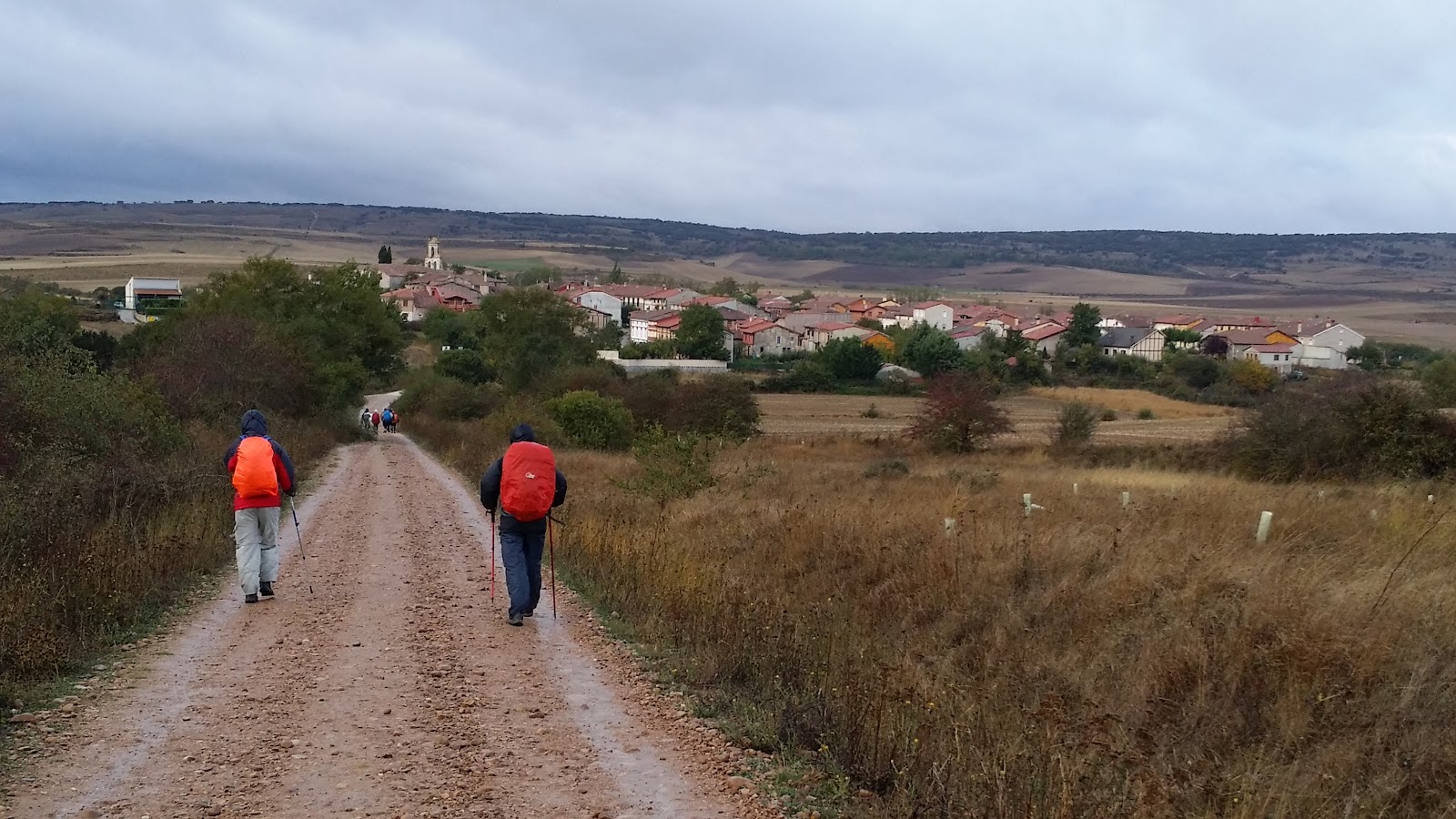
Matthew & David approaching Agés
There was a café open at Agés, but as we had just had a snack half an hour earlier so we opted to wait for breakfast until Atapuerca. This was a big mistake!

Just after Agés there is a pretty little medieval bridge over the rio Vena built by San Juan de Ortega – a modern road and bridge runs close beside it and other pilgrims were dashing past and ignoring it, but I took the time to take the little detour to cross it like my ancient pilgrim forbears and think about San Juan and Santo Domingo developing the early Camino route. Going by the sign beside the bridge, some pilgrims at least are oblivious to the bridge’s historical significance and only view as a convenient place for the toilet!
Crossing San Juan de Ortega's bridge over the rio Vena
This got me thinking about one type of person you meet on the Camino who just seems to be eager to dash from place to place as fast possible and never seems to take in the wonderful scenery and places around them. A Latvian friend of mine in Ireland has another friend who was “walking” the Camino the same time as us and doing it in 50km stages per day. This, to my mind, is totally missing the point of the Camino which surely is an opportunity to take time out from normal life and allow space for reflection, spiritual reflection and personal engagement with God?
Graphic toilet ban sign at bridge!
Approaching Atapuerca there was a modern circle of standing stones. Near this site the “Battle” of Atapuerca took place in 1054 when the Navarrese king Don García was killed by his brother Fernando I of Castille and Leon in a jousting contest to settle a dispute concerning the areas of Briviesca and Montes de Oca (we saw his tomb back at Najera). On the hills above the village, archaeological investigations of prehistoric remains found in the caves that honeycomb the area have identified them as being the oldest human remains found in Europe (reputedly dating back 900,000 years).
We were cold, dripping in the rain and very hungry, when we reached Atapuerca and I felt I was hungry enough to kill a wild bison or woolly mammoth like my prehistoric ancestors, but they were long gone from the surrounding sodden fields although we scoured the entire village, every café was also closed and not a living soul or stray dog could be seen Atapuerca apart from a few Northern Irish pilgrims walking through who passed the time of day with us and then moved on. The inhabitants of Atapuerca seemed to have become extinct like their prehistoric ancestors! We stopped at a fountain to shiver and eat an orange each that David handed us as well as a few nuts and raisins. What we really wanted though, was some warm drinks and decent food and I began to dream of pintxos (with a glass of Rioja and tortilla potato, all washed down with a final café con leche.
Cross on Matagrande
Disconsolately, we trudged on and now had to ascend the steep little hill of Matagrande to reach a cross at 1,070m. The going was hard as the path consisted of eroded stony ground, made muddy and slippery by all the rain, but Matthew and I made the best of it and I got my Kindle out and we did Morning Prayer together and sang some worship songs. We again found the Old Testament reading appropriate as we slipped over the mud as it was from Jeremiah 38:1-13 and talked about the Prophet Jeremiah being thrown into a cistern and sinking into the mud! David was leading up the rear as he sometimes has to take hills slowly because he starts to get a roaring in his ears if he over exerts himself, but commented on the singing of angels that he heard when he reached us at the cross – the wind had carried our singing down the hill to him or maybe we were just very loud?
David ascending Matagrande
There was an optional route across the high ground, but we were by now so ravenous that we descended to Viilaval in the hope of finding a café. Nothing! There was a Roman Well to be seen, but even I was so hungry I couldn’t really care!

We trudged into Cardeñuela and oh joy; there was finally a café! I downed a thick and filling fruit smoothy, devoured a rather excellent chorizo omelette and finished off with a Café con leche. Surely there is a business opportunity for some enterprising individual to open a café between Agés and Cardeñuela? By the time we finished gulping and guzzling, the café was fairly empty apart from a Glaswegian pilgrim that I had chatted to at Villaval. An interesting character in his mid thirties who had a red beard and interesting South American style felt bowler hat; he was still sitting in the café as we left, creating interesting impressionistic art work by staining watercolour paper with coffee dripped from a straw.

We left the café thinking things were looking up; from now on there must be more places to eat and drink and we were sure we wouldn’t get into such a state of hunger again? Wrong!
Orbaneja
We carried on through Orbaneja and over the A-1 motorway. Shortly after this there was an optional route that was recommended by John Brierley in his guidebook, which we wanted to take as it brought us into Burgos along the side of the river. At first the optional route seemed unclear, as it descended an indistinct path beside a modern housing estate, but we soon picked up the yellow arrows again. The path took us cross-country through fields and alongside the security fence of Burgos Airport. After all the rain, the path consisted of thick cloying mud that suck to our boots and made them very heavy. It was extremely hard, tiring work to walk and we began to regret taking the path. It was after 12.00pm by now, so Matthew and I took our mind off the mud by reciting Midday Prayer as I tried not to drop my Kindle in it. The path alongside the airport fence seemed interminable and at one stage the three of us sat on a concrete bridge to eat a snack and rest for a moment.
David and Matthew sharing a joke at Orbaneja
Finally, we reached the Burgos suburb of Castañares. Time for lunch – surely there must be a café here that was open? Nothing could be found, which I found astounding! We walked on, leaving the suburb and entering a pleasant leafy country park that ran alongside the rio Arlanzón into Burgos. The storm that had dogged us since we arrived had finally departed and the sun was coming out. Locals were out walking their dogs or jogging and I began to feel quite cheerful. Matthew however, was starting to lag far behind David and I as his knee was hurting and being in his mid-twenties, and therefore largely unacquainted with his own mortality unlike us middle aged guys, was not used to aches and pains in his body! He was quite put out by this new phenomenon! When I ribbed him later about the old fellas leading the way into Burgos while the young tried to keep up, he retorted that every day he spent with me made him feel young and fit as I was so near death’s door that he was reminded of his mortality just by looking at me! No respect for his elders!

We entered the outskirts of Burgos. I was keen to visit the Carthusian Monastery of Cartuja de Miraflores. This involved a detour, which looked quite short on the map, but turned out to take about thirty minutes or so and also involved a tiresome walk alongside a ring road and a climb up quite a steep hill. Matthew wasn’t very happy about this and I sensed mutiny might not be far off if we didn’t feed him! We were relieved to spot a café as we reached the top of the hill as by now we were again very hungry, but were dismayed to find it was closed for during wintermonths! As it was 1pm  and the monastery closed at 2pm – 4pm, there was nothing for it but to visit it without having lunch first.
Despite my hunger I found Cartuja de Miraflores one of the most architecturally beautiful monasteries I have visited on the Camino and well worth the detour (although I doubt Matthew would agree with me!). As we climbed the final hill a priest and a group of Senior Citizens passed us, commenting in Spanish about the “Pereginos”. Apparently they too were on a pilgrimage as I later discovered that the 6th October was also the anniversary of the death of the Founder of the Carthusian Order, St. Bruno. This wonderful place deserves a description all of its own, so more in my next post.

Sunday, 10 May 2015

San Millán de la Cogolla & San Millán de Yuso (18/03/14)

The village of San Millán de la Cogolla sits at the end of a beautiful valley whose steep sides are thickly wooded. Large sandstone bluffs protrude in places from the trees and add dramatic beauty to the scenery. Even though it was raining when we arrived and continued to lightly drizzle during our stay, this only seemed to add to the beauty as wisps of mist clung to the trees on the higher slopes and I was reminded of the damp tranquility of Glendalough; David and I agreed that the scenery made us feel like we were in Co. Wicklow as the valley and weather had a very Irish feel.

San Millán
The suffix of the place name de la Cogolla means “of the cowl” and refers to the monastic cowl or hood and is variously thought to be a reference to the shape of the valley or the monastic history of the area. This is because
San Millán is primarily famous not for it’s scenery, but for it’s two monasteries; San Millán de Suso founded in the 6th Century and San Millán de Yuso founded in the 11th. Suso and Yuso mean “upper” and “lower” (from the Latin “sursum” – “above” and “deorsum” - below) in archaic Castillian because  San Millán de Suso developed high up the side of the valley in the forest and then later, because there was little room to expand the monastery buildings, San Millán de Yuso was built on the valley floor.


In 1997 both monasteries were declared a UNESCO World Heritage site for two main reasons. Firstly because San Millán de la Cogolla is considered, as UNESCO acknowledges “the birthplace of the modern written and spoken Spanish language” – the third most widely spoken language on the globe. Sometime in the 11th Century, an anonymous monk in the scriptorium at Suso wrote a codex manuscript now called the Glosa Emilianenses. The main text was written in a simplified form of Latin, but importantly, he wrote notes or marginalia around the edges in Medieval Basque and a medieval form of a Hispanic language which scholars debate was either Castillian or Old Spanish or alternatively Navarro- Aragonese. The main point is that these notes are the earliest written example of the Basque language and one of the earliest examples of early Spanish (the Real Academia Española declared in 2010 that written Spanish found in another medieval document , Cartularies of Valpuesta from the Province of Burgos is actually earlier that the Glosa Emilianenses).
Copy of the Glosa Emilianenses
The second reason for the UNESCO declaration is that the two monasteries are important because they show the transition from the earlier Eremitic monastic tradition, where a hermit might live in a cave and maybe slowly gather a group of followers around themselves, to the Cenobitic or Community tradition, which became the dominant form of monasticism, where monks live together under a monastic rule.
San Millan de Yuso
The monastic history of the area begins during the Visigothic period with Saint Aemilian (Emilianus in Latin and San Millán in Spanish). According to a Vita or saintly biography written by Braulius, Bishop of Caesaraugusta (modern Zaragoza) written between 50 – 100 years after the saint’s death, and based on the testimony of four of his disciples, San Millán was born in Berceo in A.D.473 and according to tradition, lived over one hundred years, dying in 574.


He spent his early years as a shepherd in the mountains, but about the age of twenty he had a dream and decided to dedicate his life to serving God. He decided to seek advice and training from a hermit at Bilibio, San Felices or Felix and lived with him for a number of years before becoming a travelling hermit (or gyrovagus) living in the mountains and remote regions along the ancient Roman road that developed into the Camino de Santiago between Logroño and Burgos. Tradition says that he spent much of this period, about 40 years, living in the hills around La Cogolla.

Eventually, against San Millán’s personal wishes, Didymus, Bishop of Tarazona ordained him as a priest, however he soon drew upon himself the opposition and anger of his fellow priests because he gave away his possessions in alms and was accused of wasting the goods of the church and deprived of his office.
Yuso Cloister
After this, San Millán returned to the wilderness and became famous for his holiness, miracle working and compassion for the poor. In his last years, although his ascetic lifestyle increased, he allowed a small band of disciples to live with him in his cell.
Entrance to abbey church from cloister
Braulius records miracles that were supposed to have occurred after San Millán’s death and some of San Millán’s liturgical prayers were written down by a medieval poet San Eugenio in A.D. 634 who also dedicated some Latin distichs (elegiac verses) to him. The monastery of San Millán de Suso was built over the site of his hermit’s caves and tomb and became increasingly popular as the Camino de Santiago developed.
Interior of church door
By the 10th Century the rival kingdoms of Castille and Navarre were both interested in bringing the monastery within their sphere of influence because it was already setting up monastic colonies, copying out codexes and providing both royal courts with scribes. Both kingdoms vied with each other to grant the monastery privileges. In 1030 Sancho the Great as part of his efforts to develop the Camino de Santiago, ordered San Millán’s relics to be exhumed and displayed to encourage prayer. At the same time San Millán was declared a saint and was in time came to be considered the patron saint of Castille and Navarre.
High Altar with painting of San Millan
Sancho’s son Don Garcia of Najéra began the construction of a second monastery, San Millán de Yuso. Like the evocative story of Don Garcia entering the cave at Najéra, there is another legend associated with the same king and the founding of Yuso. It is a story reminiscent of the biblical account of the return of the Ark of the Covenant to the Israelites from the Philistines in the book of 1 Samuel chapter 6. According to tradition Don Garcia decided to transfer San Millán’s relics to the monastery of Santa Maria la Real in Najéra from Suso. The remains were placed inside some wooden caskets decorated with ivory panels and precious stones and placed on an ox cart. However, when the oxen reached the bottom of the valley they refused to continue and everyone then understood that the saint did not want to leave the valley and so San Millán de Yuso was built on the spot where the oxen stopped and the saint’s relics are still kept at Yuso today.
Dome over crossing
The two monasteries had separate abbots until the 12th Century and became Benedictine foundations. Work on Yuso was finished in 1067 during the reign of Sancho IV el de Peñalen and around the same time a marble reliquary for San Millán’s remains was completed.
Baroque altarpiece in Parish Church
The Benedictines claimed San Millán as their own and representations of the saint show him in a Benedictine monk’s cowl, although San Millán himself was never a member of a monastic order or organised community. He is also often shown in a similar way to images of Santiago Matamoros – Moor slayer, with a wavy sword to distinguish him from St James, as he was supposed to have miraculously appeared at the battle of Hacinas in favour of the Christian forces.
Imprisoned saint in Parish Church side chapel
Later figures linked with the monasteries include Santo Domingo de Silos (or Cañas), Santo Domingo de la Calzada (who we shall come across in future posts) who was considered so intellectually dull that he got thrown out of Yuso, and a poet famous in Spanish literature, Gonzalo de Berceo.


Once David and I had rested, we walked the short distance from the guest house over to San Millán de Yuso. It was still raining and it was now late afternoon, so we agreed that we would visit Yuso and then examine the smaller monastery of San Millán de Suso the following morning before we walked to Cirueña to rejoin the main Camino route.
Sacristy
Yuso could only be viewed via a guided tour which took approximately one hour. Although the tour guide only spoke in Spanish, there were excellent information boards in French, English and German throughout the tour. 


Sacristy Fresco


The monastery complex of San Millán de Yuso is an enormous edifice with stupendously opulent Baroque interiors and additions and we greatly enjoyed our tour. We were led firstly into a hall by the cloister to view a facsimile of the Glosa Emilianenses and then through the cloister and an elaborate doorway (the interior of which was a stunning confection of gilded Rococo motifs) to the abbey church.


The church itself was built between 1504 and 1540 and is the first example of a Hall Church or so called Hallen-Kirchen (a church with a nave and side aisles of approximately equal heights) in Spain. The front part of the church is used as the monastery church and the rear as the local parish church.

Gilded carvings in Sacristy
A 17th Century renaissance altarpiece has paintings by Fray Juan Ricci, a Benedictine monk who belonged to the school of El Greco and the central panels show San Millán appearing at the battle of Hacinas with the Assumption of the Virgin above. A small dome above the crossing is tastefully plastered with stucco in a surprisingly muted manner and reminded me of the tiny domed church of San Carlo alle Quattro Fontane that I saw last year in Rome.
Cloister
At the rear of the monastery church an incredibly elaborate screen made by Sebastian de Medina in 1676, divides the choir off from the parish church area. A very interesting feature of the screen is a large circle above the door through to the Parish Church, where on the Spring and Autumn equinoxes on the 21st March and 21st September at 17:30 the sun shines through the church window and forms a perfect ellipse on the choir floor through this circular screen opening, thus demonstrating the west – east axis of the church.
Monk's cells
The parish church section is dominated by the elaborate 18th Century baroque altarpiece made from walnut wood covered in gold leaf which forms the far side of the dividing screen and is decorated with carvings of saints associated with the life of San Millán. There are several side chapels where masses were said for the locals; some of them have interesting altarpieces featuring carvings of imprisoned saints behind bars!
Gregorian Chant Books
We moved on to the extraordinary sacristy which made us gasp due to the richness of it’s gilded walnut carvings and vibrant coloured frescoes which date from 1766 when the abbot Fray José Fernándes converted the Chapter House. The richness of the original colours has survived because the floor is made from alabaster which maintains a constant temperature and humidity. The frescoes are an exuberant riot of dancing musical cherubs framed by swags of fruit and flowers.
Codex Calixtinus
On the second floor of the cloister we passed the monk’s cells and then viewed the storeroom where a collection of 25 original books of Gregorian Chant are kept in locked wooden store cupboards. Copied between 1729 and 1731 on calfskin parchment, each book was impressively large. There are only four such surviving complete collections of Gregorian Chant in Spain including this one at Yuso; two in Madrid, at the Palacio Real  and El Escorial and the fourth at the Monastery of Guadalupe (Cáceres). Nearby in the same room was an illuminated 13th Century copy of the Codex Calixtinus – the most famous medieval account of pilgrimage on the Camino de Santiago.
Reliquary of San Millan
Before leaving the monastery we finally were taken to see the chapel were the silver reliquaries containing the remains of San Millán and San Felices de Bilibio are kept. Both were created in 1944 under the orders of General Francisco Franco; “Prudentissimo Duci Maximo” as the inscription on San Millán’s reliquary describes him. San Millán’s reliquary is decorated with delightful 11th Century ivory plates showing scenes from San Millán’s life and miracles and the panels are one of the most important surviving pieces of Romanesque art. San Felice’s box is also decorated with ivory panels, but this time from the 12th Century. I spent a long time enjoying the panels with their intricate carvings of religious scenes and their evocation of medieval chapels, castles, knights, horses and costumes with the hand of God blessing all from above.
Ivory panel
Also nearby at the back of the room and not to be missed, was a 16th Century Italian gilt bronze crucifix attributed to Benvenuto Cellini.

We left the monastery feeling very pleased that we had achieved so much in one day; not only had we managed to walk from Najéra to San Millán de la Cogolla, but we had been able to view two important monasteries – Cañas and Yuso and had the satisfaction of knowing that we still had Suso to see the following morning.
16th Century Italian crucifix
We enjoyed a well-deserved meal at the restaurant opposite Yuso which included a segundo fish course washed down with half a bottle of rioja each, then retired to our guesthouse to rest. David snored the rest of the evening away whilst I wrote up my journal and read!