Showing posts with label #SanMillan. Show all posts

Thursday, 31 December 2015

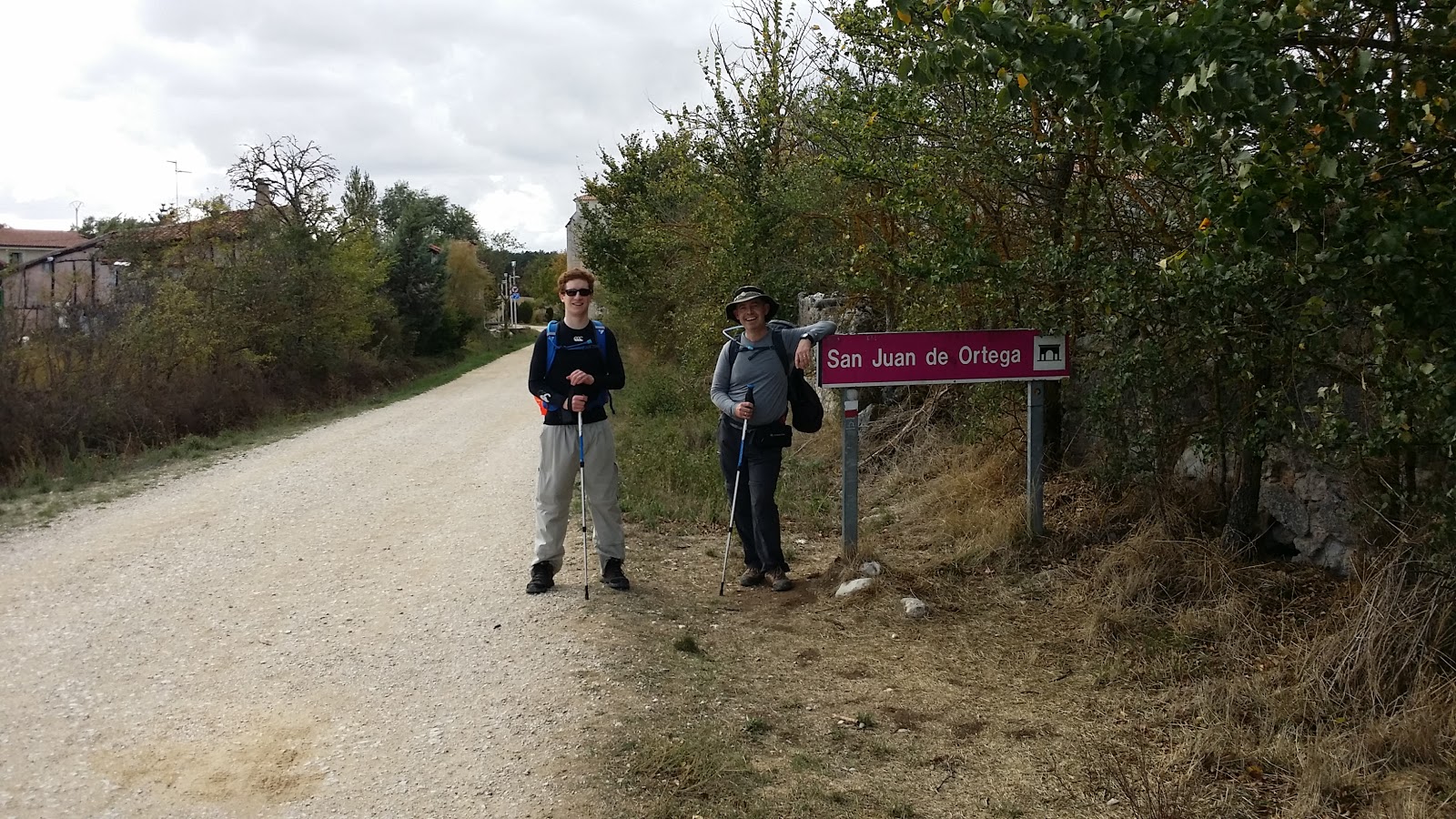
Camino Day 13: Belorado - San Juan De Ortega (05/10/15)


After a good breakfast in the albergue, the three of us headed out into a very grey and drizzly dawn. The distant storm in France was making itself felt with very breezy conditions and a mix of sunshine and showers. David and Matthew put rain covers over their rucksacks and I opted to wait and see how things went and only get out my poncho if necessary. Although the rain gradually subsided as we walked, the strong wind lasted the entire day. This was significant moment for Matthew; his first day walking on the Camino!
Matthew preparing for his first day on the Camino
The day’s walk was really in two parts; the first half consisted of walking across wide expansive farmland and the second half through mountain pine forest.
Leaving Belorado
We quickly passed through the small modern suburbs of Belorado, crossed the rio Tirón on a pedestrian bridge and onto the Camino track which runs raised above the N-120 along which we had come by bus the previous day. The sun came out and illuminated a vibrant rainbow against the dark sky and our early morning shadows lengthened in front of us.
Very soon over to our right, lit up by the sunshine near Tosantos, small cliffs came into view. These contain more hermit’s caves, like those below Belorado Castle and the 12th Century hermitage of Our Lady of the Rock Ermita de Nuestra Señora de la Peña, which apparently contains a Romanesque statue of the Virgin which is venerated locally.
Ermita de Nuestra Señora de la Peña
At Villambistia, we stopped in the grounds of Iglesia San Roque for Morning Prayer; which the three of us did sitting on a bench in the church grounds.
Doorway at San Roque
Our reading from Psalms was from Psalm 25: 6-10 and verse 10 struck us as highly appropriate for our first day walking again on the Camino:

“the paths of the Lord are love and faithfulness to those who keep his covenant and testimonies”
At San Roque
Just after the church we saw a sign to the right advertising a café and so we enthusiastically took the detour as it was definitely time for Second breakfast and enjoyed chocolate caliente and cakes!
Villambistia
Beyond Villambistia the expansive farmland continued and Matthew soon produced his binoculars to look at Griffon Vultures soaring in the distance and soon several Red Kites were also seen at closer quarters. Indeed Matthew’s inexhaustible enthusiasm each time we saw Red Kites (and we saw plenty during our walk!) quickly became a source of good natured banter between us as I pretended to yawn each time Matthew whipped out his bins to look at another one and he in response made exaggeratedly bored remarks about Romanesque baptismal fonts!
Fountain in Villambistia
We crossed the N-120 at Espinosa del Camino and about half a kilometre from Villafranca we descended a small ridge and came to Ábside de San Felices (San Felice’s Apse). The apse is all that remains of a 10th Century Mozarabic monastery that was dedicated to San Millán’s mentor, San Felices.
Matthew at Ábside de San Felices
The remains are interesting because the structure still contains a horseshoe arch influenced by Arabic architecture and has a small dome inside. I also noted a reused inscribed stone built into the apse which seemed to part of a Roman (or was it Visigothic?) gravestone? San Felices is also the reputed burial place of Count Diego Rodríguez, who founded Burgos in A.D. 884 and whose statue can be seen in the city in Plaza San Juan.
Interesting stone at San Felices
Shortly after this, we rejoined the N-120 and entered the town of Villafranca Montes de Oca. On the outskirts as we crossed the rio Oca, we passed a group of of about a dozen Senior Citizens filling numerous bulging carrier bags with the large amounts of walnuts which they were collecting off the ground. As I like a bit of foraging in the hedgerows back home for Sloe Gin and Blackberry Vodka, I was most impressed!
Looking back at San Felices
We found a small shop and stocked up on picnic provisions as we knew that this was our last chance before we climbed into the forests of the Montes de Oca. Next door was a bar (with a friendly cat) so I bought a glass of Rioja and poured it into my empty water bottle so that we would have wine for communion together when we did Midday Prayer later.
Friendly Cat!
Villafranca itself seemed fairly unremarkable (although maybe we missed the interesting bits?) and walking through it one could be forgiven for thinking that it is of relatively little historical importance. However it actually has great historical and ecclesiastical importance. According to tradition, when St. James came to Hispania on his evangelistic missionary trip, he brought with him seven Apostles, one of whom was San Indalecio. He was reputedly made a Bishop and converted the Auca area to Christianity. 2.3 km from Villafranca is the remote Ermita de Nuestra Señora de Oca and behind this is a medieval bridge Puente Viejo which leads to a stone water tank, the Pozo de San Indalecio, where legend says that San Indalecio was martyred. Each year on the Feast Day of San Indalecio (11th of June) a local pilgrimage to the site takes place.

What is certain, is that Villafranca was the site of the ancient episcopal see of ‘Auca’ (Oca). It’s first recorded Bishop was Asterio, whose signature appears in A.D. 589 at the Third Council of Toledo. Alfonso VI however moved the See to Burgos in 1075 which was a common practice in the period as kings sought to centre Episcopal Sees in the centres of secular power, the Norman kings did the same in England.
In the medieval period the town was an important stop on the Camino and had a pilgrim hospital as early as the 9th century. The name ‘Villafranca’ shows that like many other towns on the Way of St. James, it was resettled with Franks who arrived as pilgrims and then returned as artisans. The second half of the name “de Oca” comes from the Spanish for wild geese but is probably a corruption of the ancient name of Auca.
Taking a turn off the main road and up a track by the church we quickly began a very hard climb up into the forested Montes de Oca. This came as a shock to the system as it was our first day of proper walking. As I have explained previously, I am walking the Camino in stages of about one week or so each, as I cannot afford to take the annual leave from work needed to walk the entire Camino in one go. There are advantages and disadvantages to doing the Camino this way. On the positive side of things it means that I have time to really take the time to absorb all that the Camino has to offer and not feel constrained to reach Santiago in a limited timeframe of a few weeks. On the negative side however, each time my body is just getting used to increased levels of fitness and settling into the rhythm of the Camino and the aches and pains are beginning to subside, it is time to come home. As we climbed breathlessly into the Montes de Oca, I was reminded of this once again!
View as we climbed the Montes de Oca
The previous day Matt had texted us to warn us that “the pine forest goes on and on” and that he found it very tedious. The three of us however liked this stretch and enjoyed the seclusion and wildness of the forest. We fell into an enjoyable rhythm of chatting interspersed with periods of comfortable silence.

Although enjoyable to us, the Montes de Oca were once considered to be one of the most feared stretches of the Camino; a remote borderland place on the edge of Castille, full of dense forest and undergrowth where bloodthirsty bandits lurked who would prey on pilgrims and rob them. In keeping with this dangerous reputation the Book of Miracles in the famous Codex Calixtinus records 22 miracles in this area.
Although the initial climb was hard, it afforded expansive views back towards Belorado. We took a welcome break at Fuente de Mojapán – Moisten Bread Fountain where there was a shelter with a bench to sit in and eat a snack, though not of stale bread needing softening like out medieval pilgrim forbears.
Monumento de los Caídos
Eventually, we reached the stark Monumento de los Caídos – Monument to the Fallen. This is the site of two mass graves of about 160 combatants from the Spanish Civil War who were buried here in 1936. The first grave site was bleak enough with it’s concrete obelisk, concrete wall (with railing), small cross and another concrete marker. But nearby we found the second mass grave site, isolated amongst the trees and demarcated by a simple wooden fence and gate. Somehow the isolated nature of this second site made the atrocities of the Spanish Civil War seem much more real. Both mass graves had be excavated in the 1990’s by archaeologists and the bodies identified and returned to living relatives.
David at the second mass grave
The grave sites had be marked out with wooden sleepers and white stones. Information boards explained how the archaeologists had done their work and archaeological multi-coloured scaled diagrams showed the jumbled positions of the skeletons when excavated. Nearby a headstone listed the names of the dead. A pot plant left as a memorial, had blown over in front of it. I have never seen a mass grave before.

I don’t know which I found more disturbing; seeing the names of the dead in their long stark columns, the vibrant colours of the mathematically measured skeleton diagrams or the Fascist swastikas and graffiti that had been daubed everywhere showing that undercurrents of pain and hatred still remain just below the surface for some in modern Spain.

David and I stood a long time in silence. I reflected on the appalling thing that had happened here in this quiet forest not really that long ago; in the year that my grandparents had married in Ireland these kinds of terrible atrocities were happening and were only a foretaste of the many more mass graves that would disfigure Europe in the days ahead as the dark cloud of World War II approached. Soberingly, they were also just like the ones that had happened during the time of my own married life in the former Yugoslavia. I silently lifted the pot plant and set it back in front of the headstone; it was as the only mark of respect I could think of offering.
Nearby were a group of picnic tables which seemed to me an incongruous site for lunch so near as they were to the graves, but we were now fairly hungry so we ate lunch and then said Midday Prayer together, before taking a little of the bread we had reserved and the wine I had bought at Villafranca and sharing Communion.
Matthew and I
Refreshed, we carefully descended the very steep track down to the footbridge over the Peroja stream, before ascending once more to reach the summit of our walk that day at 1,150M. We carried on through a long stretch of pine and oak forest. Along the way we found that the wide forest path was strewn with messages that other pilgrims had written using stones. It was fun to read them. The possible monotony of the forest also was also broken by a forest clearing where colourful totem pole sculptures of pilgrims and goofy faces had been erected.
Messages in stones!
Finally, the forest began to break up into some open clearings and in the distance we could see the buildings of San Juan de Ortega. It was a welcome sight; we were all getting tired. However there was a little life in the old dog yet – Matthew is very competitive and can’t resist a challenge, so when I saw the sign for San Juan in the distance I deliberately started to running because I knew Matthew wouldn’t be able to resist and have to go tearing past me to stop me saying that a forty year old had beaten him to San Juan! It worked of course – Matthew soon raced past whilst I chuckled and David, the only the mature member of our group, told us off for risking injuring ourselves when our bodies were tired at the end of a long walk!
Altogether the walk had taken 8 hours and 5 minutes.
David & Matthew powering towards San Juan
San Juan at last!

Thursday, 14 May 2015

San Millán de Suso (19/03/15)

The following morning we had a hearty Continental breakfast of yoghurt, fruit, chorizo and bread at the Hospederia La Calera guesthouse, settled the bill (which we thought at €25 each, was good value for the standard of accommodation we had experienced) and made our way back over to San Millán de Yuso. Part of the monastery complex has been turned into a hotel and beside it there is a modern visitor’s centre and reception facing onto the external courtyard where tickets for the guided tours of both monasteries can be purchased.
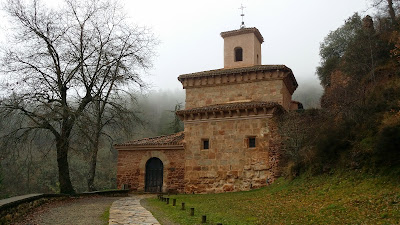
San Millán de Suso
The monastery of San Millán de Suso is much smaller and more ancient than it’s grandiose younger brother Yuso. Due to factors such as the age of the structure, it’s geographical location on a hillside, the rainfall levels in the area, the vicissitudes of history (it was burnt by Almanzor, Vizier and de facto ruler of El Andalus in 1002 and sacked by the Black Prince, son of Edward III of England, who was an ally of Pedro the Cruel, king of Castille, in the 1300’s) and neglect, the building has been severely damaged and has required restoration and reinforcement. This has meant that access is only with a tour guide in timed groups of about 20 people.

We booked on the 10:25 tour and received a reduction on the ticket price due to being pilgrims with a credencial. A small bus took us up the mountainside on a winding road through mature deciduous woodland.
San Millán de Suso viewed from Yuso
Arriving, the first thing that struck me was the sense of tranquility. Standing still for a short time and letting the other visitors in the group go on ahead, I was mesmerised by the sound of birdsong, woodpeckers and sheep bells drifting through the dripping trees. I could easily imagine San Millán and his band of followers living here in the surrounding caves as hermits in the 6th Century. Originally, before the monastery was built abutting onto the cliff face of a outcrop of rock, a natural crevice contained several caves which provided shelter for a community of hermits who lived here in contemplation. These included San Millán himself who was subsequently buried in one of the caves.

The tour guide brought me back to reality from my reverie by shouting up the path at me. I don’t speak Spanish, but a rough translation would probably be “stop hanging around daydreaming and get inside the monastery with the other visitors or you will miss the tour!” and indeed when I looked the other visitors had already gone through the outer door! I ran up to the door, pushed it open and quickly joined them along with David, who was already getting used to my dreamy detailed examinations of ancient buildings!

I have visited ancient Orthodox monasteries in Albania on several occasions and to my mind, the monastery building itself reminded me much more of these than any monastery I have visited in Western Europe before. It combines Visigothic (post-Roman and pre-Arab invasions in A.D. 711), Mozarabic (Christians who lived under Muslim rule) and Romanesque architectural elements. The square tower beside the entrance gate with it’s overhanging eaves and tiled roofs is very picturesque when viewed through the woodland.
View of San Millán de Yuso in valley below from Suso
Stepping through the door I found a cobbled verandah – like atrium with arched openings from which the valley below could be viewed through the mist. The cobbling dates from Visigothic times and the floor is lined with the tombs of the Seven Infants of Lara with the tomb of their tutor, Don Nuño Salido.
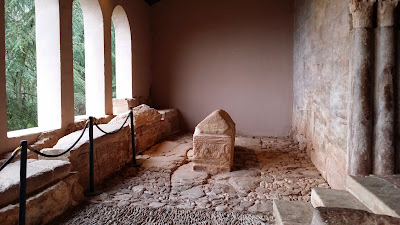
Tombs of the Seven Infants of Lara and Don Nuño Salido
The Legend of the Seven Infants of Lara is told in a Spanish epic poem, which like the Chanson de Roland mixes real events and people with wildly exaggerated myths. The “Seven Infants” and their tutor Don Nuño Salido probably were real individuals who lived in the 10th Century.

They were said to be the the sons of Gonzalo Gustioz the Lord of Salas (an area near Burgos). Reputedly of the blood of the Counts of Castille, they were trained in Cavalry skills by Nuño Salido, and were said to be knighted on the same day. They took part in the Reconquest or wars against the Muslims in Southern Spain.

The theme of revenge runs through the poem and at a wedding in Burgos in 986, one of the infants Gonzalez, the youngest of the seven brothers, quarrels with and kills Alvar Sanchez the relative of the bride called Doña Lambra. Her husband Ruy Velázquez Lord of Villaren, is persuaded to avenge this offence and so Velázquez sends Gonzalo Gustioz, a guest at the wedding to Cordoba, capital of the Umayyad Caliphate, unknowingly carrying a letter written in Arabic addressed to Almanzor asking the Vizier to murder him. Almanzor however, does not murder him, but imprisons him in Cordoba.

Meanwhile Velázquez pretends to make an incursion into Moorish territory accompanied by the seven brothers and arranges for them to be ambushed. The seven infants and Salido fight to the death and are slain and their bodies beheaded. Their heads are displayed in Cordoba, (where a street is still called the Street of Heads). Almanzor shows the heads to Gustioz who weeps when he recognises them, and so Almanzor has pity on him and asks his sister to visit Gustioz and console him. She seems to do this very effectively (!) because she gives birth to Gustioz’s son who is named Mudarra.

Mudarra is raised in Cordoba and Gustioz is released and returns to Salas. But when Mudarra turns fourteen he goes in search of his father and learning of the treachery of Velázquez he avenges the death of his half-brothers by killing Ruy Velázquez while he is on a hunting expedition, and then gathering together a band of follower, he attacks the castle of Villaren, where Doña Lambra is captured, stoned and burnt at the stake. Mudarra then lives happily ever after as he is adopted by Gustioz’s and inherits his estate.  

This story of revenge and blood feud seemed strangely at odds with the peace and tranquillity of Suso, but I suppose all human passion, hatred, ambition and strife is ultimately stilled by death and the stone sarcophagi in the atrium spoke of this. Certainly the epic conjures up well, the mixed loyalties of the Reconquest period given that, for example, king Sancho the Strong married his sister to Almanzor and Christians sometimes allied with the Muslims as the early Spanish kingdoms struggled with each other as well as the Moors. To quote the poem itself seems appropriate:

        “Seven gentler boys, nor braver, were never nursed in Spain,       
          And blood of Moors, God rest your souls, ye shed on her like rain.”

This is not the only literary association with Suso as according to tradition, the atrium is said to be the spot where Gonzalo de Berceo, the 13th Century Benedictine monk, wrote his poetry in the developing vernacular language of his time instead of in Latin, thereby creating the earliest literature by a known author in Spanish. It was also at Suso that the Glosa Emilianensis was written.
Medieval Graffiti
At the other end of the atrium are the tombs of three queens of Navarre Doña Toda, Doña Elvira and Doña Jimena dating from the 10th and 11th Centuries. The walls of the atrium are covered with graffiti written by pilgrims and monks in the 11th and 12th Centuries.
http://es.wikipedia.org/wiki/Monasterio_de_San_Mill%C3%A1n_de_Suso
Accessing the main building through a Mozarabic doorway from the atrium, three different phases of construction can be discerned although the construction at first seems quite complicated. The first phase of building construction is in front of the original caves where the hermits lived and has been built onto the original cliff face. It is Visigothic and dates from the 6th and 7th Centuries.
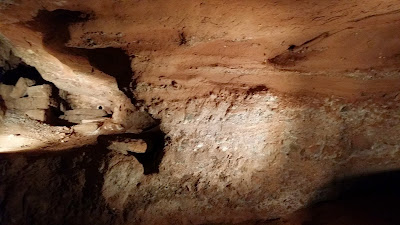
Original Hermit's Caves
The most westerly facing cave contains bones from medieval burials, which can be seen in an alcove through a modern glass window. These must be the burials of important people being sited so close to the tomb of San Millán, but their names have been lost.

Beside this is the Oratory Cave of San Millán where the saint was originally buried in A.D. 574. Although his actual relics were removed to Yuso in 1030, a dark alabaster sepulchre was placed in the cave in the 12th Century and is one of the oldest statues in Spain. Beside this can be seen further caves

Sepulchre of San Millan
Photo: Cruccone
http://upload.wikimedia.org/wikipedia/commons/0/09/Monasterio_Suso_cenotafio_SMillan.jpg
In front of the caves can be seen the 10th Century Mozarabic monastery which was built in A.D. 959 with characteristic horseshoe shaped arches. This second part of the building took advantage of some of the caves and is oriented to the south and west. In 1002 Almanzor, burnt this part of the building and the original monochrome decoration on the arches has been largely destroyed, though remnants remain.

Visigothic structure left, Mozarab horseshoe arches right.
Blue tiled Reliquary of the Wood to right of central arch
Photo: Jose Luis Filp Cabana
http://commons.wikimedia.org/wiki/File:Monasterio_de_San_Mill%C3%A1n_de_Suso._Iglesia.jpg
The third part of the building was completed in the 11th and 12th Centuries when the Benedictines arrived and lengthened the horseshoe arches with two further Romanesque ones.

Other extensions to the building have not survived and the building was finally abandoned in 1835 when Mendizábal closed many religious houses including Yuso and Suso (although Yuso was later given to the Augustinians).

Near the Ossuary cave can be also be seen an unusual reliquary consisting of a blue tiled box attached to one of the pillars which contains an ancient piece of wood. This relates to a story about San Millán in which some workers were said to be building a barn when they found that the timber they were going to use as a support was not the right length. However, after San Millán had prayed, the timber was miraculously found to have lengthened in size and a left over piece of wood not used for building was preserved in the reliquary!
The monastery of San Millán de Suso is an interesting and atmospheric place evocative of so much Spanish and Camino history and with added benefit of being in such a beautiful location. David and I agreed that it our visit to San Millán de la Cogolla had been well worth the effort involved in taking a detour off the main Camino Francés route.

Sunday, 10 May 2015

San Millán de la Cogolla & San Millán de Yuso (18/03/14)

The village of San Millán de la Cogolla sits at the end of a beautiful valley whose steep sides are thickly wooded. Large sandstone bluffs protrude in places from the trees and add dramatic beauty to the scenery. Even though it was raining when we arrived and continued to lightly drizzle during our stay, this only seemed to add to the beauty as wisps of mist clung to the trees on the higher slopes and I was reminded of the damp tranquility of Glendalough; David and I agreed that the scenery made us feel like we were in Co. Wicklow as the valley and weather had a very Irish feel.

San Millán
The suffix of the place name de la Cogolla means “of the cowl” and refers to the monastic cowl or hood and is variously thought to be a reference to the shape of the valley or the monastic history of the area. This is because
San Millán is primarily famous not for it’s scenery, but for it’s two monasteries; San Millán de Suso founded in the 6th Century and San Millán de Yuso founded in the 11th. Suso and Yuso mean “upper” and “lower” (from the Latin “sursum” – “above” and “deorsum” - below) in archaic Castillian because  San Millán de Suso developed high up the side of the valley in the forest and then later, because there was little room to expand the monastery buildings, San Millán de Yuso was built on the valley floor.


In 1997 both monasteries were declared a UNESCO World Heritage site for two main reasons. Firstly because San Millán de la Cogolla is considered, as UNESCO acknowledges “the birthplace of the modern written and spoken Spanish language” – the third most widely spoken language on the globe. Sometime in the 11th Century, an anonymous monk in the scriptorium at Suso wrote a codex manuscript now called the Glosa Emilianenses. The main text was written in a simplified form of Latin, but importantly, he wrote notes or marginalia around the edges in Medieval Basque and a medieval form of a Hispanic language which scholars debate was either Castillian or Old Spanish or alternatively Navarro- Aragonese. The main point is that these notes are the earliest written example of the Basque language and one of the earliest examples of early Spanish (the Real Academia Española declared in 2010 that written Spanish found in another medieval document , Cartularies of Valpuesta from the Province of Burgos is actually earlier that the Glosa Emilianenses).
Copy of the Glosa Emilianenses
The second reason for the UNESCO declaration is that the two monasteries are important because they show the transition from the earlier Eremitic monastic tradition, where a hermit might live in a cave and maybe slowly gather a group of followers around themselves, to the Cenobitic or Community tradition, which became the dominant form of monasticism, where monks live together under a monastic rule.
San Millan de Yuso
The monastic history of the area begins during the Visigothic period with Saint Aemilian (Emilianus in Latin and San Millán in Spanish). According to a Vita or saintly biography written by Braulius, Bishop of Caesaraugusta (modern Zaragoza) written between 50 – 100 years after the saint’s death, and based on the testimony of four of his disciples, San Millán was born in Berceo in A.D.473 and according to tradition, lived over one hundred years, dying in 574.


He spent his early years as a shepherd in the mountains, but about the age of twenty he had a dream and decided to dedicate his life to serving God. He decided to seek advice and training from a hermit at Bilibio, San Felices or Felix and lived with him for a number of years before becoming a travelling hermit (or gyrovagus) living in the mountains and remote regions along the ancient Roman road that developed into the Camino de Santiago between Logroño and Burgos. Tradition says that he spent much of this period, about 40 years, living in the hills around La Cogolla.

Eventually, against San Millán’s personal wishes, Didymus, Bishop of Tarazona ordained him as a priest, however he soon drew upon himself the opposition and anger of his fellow priests because he gave away his possessions in alms and was accused of wasting the goods of the church and deprived of his office.
Yuso Cloister
After this, San Millán returned to the wilderness and became famous for his holiness, miracle working and compassion for the poor. In his last years, although his ascetic lifestyle increased, he allowed a small band of disciples to live with him in his cell.
Entrance to abbey church from cloister
Braulius records miracles that were supposed to have occurred after San Millán’s death and some of San Millán’s liturgical prayers were written down by a medieval poet San Eugenio in A.D. 634 who also dedicated some Latin distichs (elegiac verses) to him. The monastery of San Millán de Suso was built over the site of his hermit’s caves and tomb and became increasingly popular as the Camino de Santiago developed.
Interior of church door
By the 10th Century the rival kingdoms of Castille and Navarre were both interested in bringing the monastery within their sphere of influence because it was already setting up monastic colonies, copying out codexes and providing both royal courts with scribes. Both kingdoms vied with each other to grant the monastery privileges. In 1030 Sancho the Great as part of his efforts to develop the Camino de Santiago, ordered San Millán’s relics to be exhumed and displayed to encourage prayer. At the same time San Millán was declared a saint and was in time came to be considered the patron saint of Castille and Navarre.
High Altar with painting of San Millan
Sancho’s son Don Garcia of Najéra began the construction of a second monastery, San Millán de Yuso. Like the evocative story of Don Garcia entering the cave at Najéra, there is another legend associated with the same king and the founding of Yuso. It is a story reminiscent of the biblical account of the return of the Ark of the Covenant to the Israelites from the Philistines in the book of 1 Samuel chapter 6. According to tradition Don Garcia decided to transfer San Millán’s relics to the monastery of Santa Maria la Real in Najéra from Suso. The remains were placed inside some wooden caskets decorated with ivory panels and precious stones and placed on an ox cart. However, when the oxen reached the bottom of the valley they refused to continue and everyone then understood that the saint did not want to leave the valley and so San Millán de Yuso was built on the spot where the oxen stopped and the saint’s relics are still kept at Yuso today.
Dome over crossing
The two monasteries had separate abbots until the 12th Century and became Benedictine foundations. Work on Yuso was finished in 1067 during the reign of Sancho IV el de Peñalen and around the same time a marble reliquary for San Millán’s remains was completed.
Baroque altarpiece in Parish Church
The Benedictines claimed San Millán as their own and representations of the saint show him in a Benedictine monk’s cowl, although San Millán himself was never a member of a monastic order or organised community. He is also often shown in a similar way to images of Santiago Matamoros – Moor slayer, with a wavy sword to distinguish him from St James, as he was supposed to have miraculously appeared at the battle of Hacinas in favour of the Christian forces.
Imprisoned saint in Parish Church side chapel
Later figures linked with the monasteries include Santo Domingo de Silos (or Cañas), Santo Domingo de la Calzada (who we shall come across in future posts) who was considered so intellectually dull that he got thrown out of Yuso, and a poet famous in Spanish literature, Gonzalo de Berceo.


Once David and I had rested, we walked the short distance from the guest house over to San Millán de Yuso. It was still raining and it was now late afternoon, so we agreed that we would visit Yuso and then examine the smaller monastery of San Millán de Suso the following morning before we walked to Cirueña to rejoin the main Camino route.
Sacristy
Yuso could only be viewed via a guided tour which took approximately one hour. Although the tour guide only spoke in Spanish, there were excellent information boards in French, English and German throughout the tour. 


Sacristy Fresco


The monastery complex of San Millán de Yuso is an enormous edifice with stupendously opulent Baroque interiors and additions and we greatly enjoyed our tour. We were led firstly into a hall by the cloister to view a facsimile of the Glosa Emilianenses and then through the cloister and an elaborate doorway (the interior of which was a stunning confection of gilded Rococo motifs) to the abbey church.


The church itself was built between 1504 and 1540 and is the first example of a Hall Church or so called Hallen-Kirchen (a church with a nave and side aisles of approximately equal heights) in Spain. The front part of the church is used as the monastery church and the rear as the local parish church.

Gilded carvings in Sacristy
A 17th Century renaissance altarpiece has paintings by Fray Juan Ricci, a Benedictine monk who belonged to the school of El Greco and the central panels show San Millán appearing at the battle of Hacinas with the Assumption of the Virgin above. A small dome above the crossing is tastefully plastered with stucco in a surprisingly muted manner and reminded me of the tiny domed church of San Carlo alle Quattro Fontane that I saw last year in Rome.
Cloister
At the rear of the monastery church an incredibly elaborate screen made by Sebastian de Medina in 1676, divides the choir off from the parish church area. A very interesting feature of the screen is a large circle above the door through to the Parish Church, where on the Spring and Autumn equinoxes on the 21st March and 21st September at 17:30 the sun shines through the church window and forms a perfect ellipse on the choir floor through this circular screen opening, thus demonstrating the west – east axis of the church.
Monk's cells
The parish church section is dominated by the elaborate 18th Century baroque altarpiece made from walnut wood covered in gold leaf which forms the far side of the dividing screen and is decorated with carvings of saints associated with the life of San Millán. There are several side chapels where masses were said for the locals; some of them have interesting altarpieces featuring carvings of imprisoned saints behind bars!
Gregorian Chant Books
We moved on to the extraordinary sacristy which made us gasp due to the richness of it’s gilded walnut carvings and vibrant coloured frescoes which date from 1766 when the abbot Fray José Fernándes converted the Chapter House. The richness of the original colours has survived because the floor is made from alabaster which maintains a constant temperature and humidity. The frescoes are an exuberant riot of dancing musical cherubs framed by swags of fruit and flowers.
Codex Calixtinus
On the second floor of the cloister we passed the monk’s cells and then viewed the storeroom where a collection of 25 original books of Gregorian Chant are kept in locked wooden store cupboards. Copied between 1729 and 1731 on calfskin parchment, each book was impressively large. There are only four such surviving complete collections of Gregorian Chant in Spain including this one at Yuso; two in Madrid, at the Palacio Real  and El Escorial and the fourth at the Monastery of Guadalupe (Cáceres). Nearby in the same room was an illuminated 13th Century copy of the Codex Calixtinus – the most famous medieval account of pilgrimage on the Camino de Santiago.
Reliquary of San Millan
Before leaving the monastery we finally were taken to see the chapel were the silver reliquaries containing the remains of San Millán and San Felices de Bilibio are kept. Both were created in 1944 under the orders of General Francisco Franco; “Prudentissimo Duci Maximo” as the inscription on San Millán’s reliquary describes him. San Millán’s reliquary is decorated with delightful 11th Century ivory plates showing scenes from San Millán’s life and miracles and the panels are one of the most important surviving pieces of Romanesque art. San Felice’s box is also decorated with ivory panels, but this time from the 12th Century. I spent a long time enjoying the panels with their intricate carvings of religious scenes and their evocation of medieval chapels, castles, knights, horses and costumes with the hand of God blessing all from above.
Ivory panel
Also nearby at the back of the room and not to be missed, was a 16th Century Italian gilt bronze crucifix attributed to Benvenuto Cellini.

We left the monastery feeling very pleased that we had achieved so much in one day; not only had we managed to walk from Najéra to San Millán de la Cogolla, but we had been able to view two important monasteries – Cañas and Yuso and had the satisfaction of knowing that we still had Suso to see the following morning.
16th Century Italian crucifix
We enjoyed a well-deserved meal at the restaurant opposite Yuso which included a segundo fish course washed down with half a bottle of rioja each, then retired to our guesthouse to rest. David snored the rest of the evening away whilst I wrote up my journal and read!