Showing posts with label Santo Domingo de la Calzada. Show all posts

Sunday, 3 January 2016

San Juan De Ortega (05/10/15)

The old monastery buildings and church of San Juan de Ortega, isolated as they are in the Montes de Oca, with their apparent remoteness only enhanced by being approached by pilgrims after a long walk in the forest, are some of the most atmospheric and evocative places I have visited on the Camino so far. Our stay there has personal significance for me and will long remain as a high point in my memory, even though the accommodation at the albergue was fairly basic and initially, at least, very cold, draughty and damp!
The story concerning the founding and development of the monastery in such a remote location is very interesting. San Juan himself was born about 1080 in Quintanaortuño and as a disciple of Santo Domingo de la Calzada, helped him to develop the Camino route in the Twelfth Century by building roads, bridges and hospitals for pilgrims.
Monastery Church
He decided to go on a pilgrimage to the Holy Land and on his way home afterwards, his ship encountered a severe storm and fearing that he would be shipwrecked, San Juan prayed to St. Nicolas of Bari, who reputedly appeared to him and calmed the storm. In gratitude, San Juan promised to build a chapel when he returned home and dedicate it St. Nicolas.
Doorway in monastic buildings
(As a digression, this is the same St. Nicolas who is known today as “Santa Claus”. He was Bishop of Myra in Turkey in the 4th Century and tradition tells us that when he heard that the two daughters of a poor man were going to have to be sold into slavery because the family was destitute, he threw two bags of gold through the window of their house anonymously to save them from this fate and thus become associated with giving gifts. When the Muslims invaded Turkey, his relics were secretly taken to Bari in Southern Italy were they remain in the cathedral today. In Medieval times he was a popular saint to pray to; especially concerning dangers, shipwrecks, fires and economic problems and over two hundred churches are dedicated to him.)
Fifteenth Century Cloister
Upon reaching home, San Juan found that there was a lot of unrest in his native Castille and so withdrew to this wild and uninhabited place (Ortiga means nettles in Spanish) to live as a hermit and build a simple shelter, which he did when he had obtained permission to do so from Doña Urraca, Abbess of Cañas.
Fruitless attempts to dry clothes in cloister
In 1115, San Juan, was granted the right by king Alfonso “The Battler” to establish a proper monastery and immediately started work on the construction of monastic cells and a chapel dedicated to St, Nicolas to fulfil his promise. In this work he was helped by his brother Martin and a small order of Augustinian Canons Regular that he had established. Although their work was opposed by local bandits who stole the tools, burnt the wagons, and even threatened to kill San Juan himself, the chapel and monastery were eventually completed. San Juan also built a pilgrim hospital and received the support of Pope Innocent II in 1138 and that of king Alfonso VII who granted him all the Crown lands in the Montes de Oca. San Juan also started work on the monastery church, but only the apses were completed at his death in 1163 and subsequently the monastery gradually went into decline.
Chapel of St. Nicolas
In 1431 however, the Bishop of Burgos granted the monastery to the Jeronymite Order and the monastery began to flourish once more/ In 1477 Queen Isabel (la Católica) visited the monastery. She had been unable to conceive after seven years of marriage and was drawn to San Juan’s reputation as an intercessor in cases of infertility. The Queen was reportedly cured of her sterility and in thanks had the Chapel of St. Nicolas rebuilt in a much more sumptuous style.
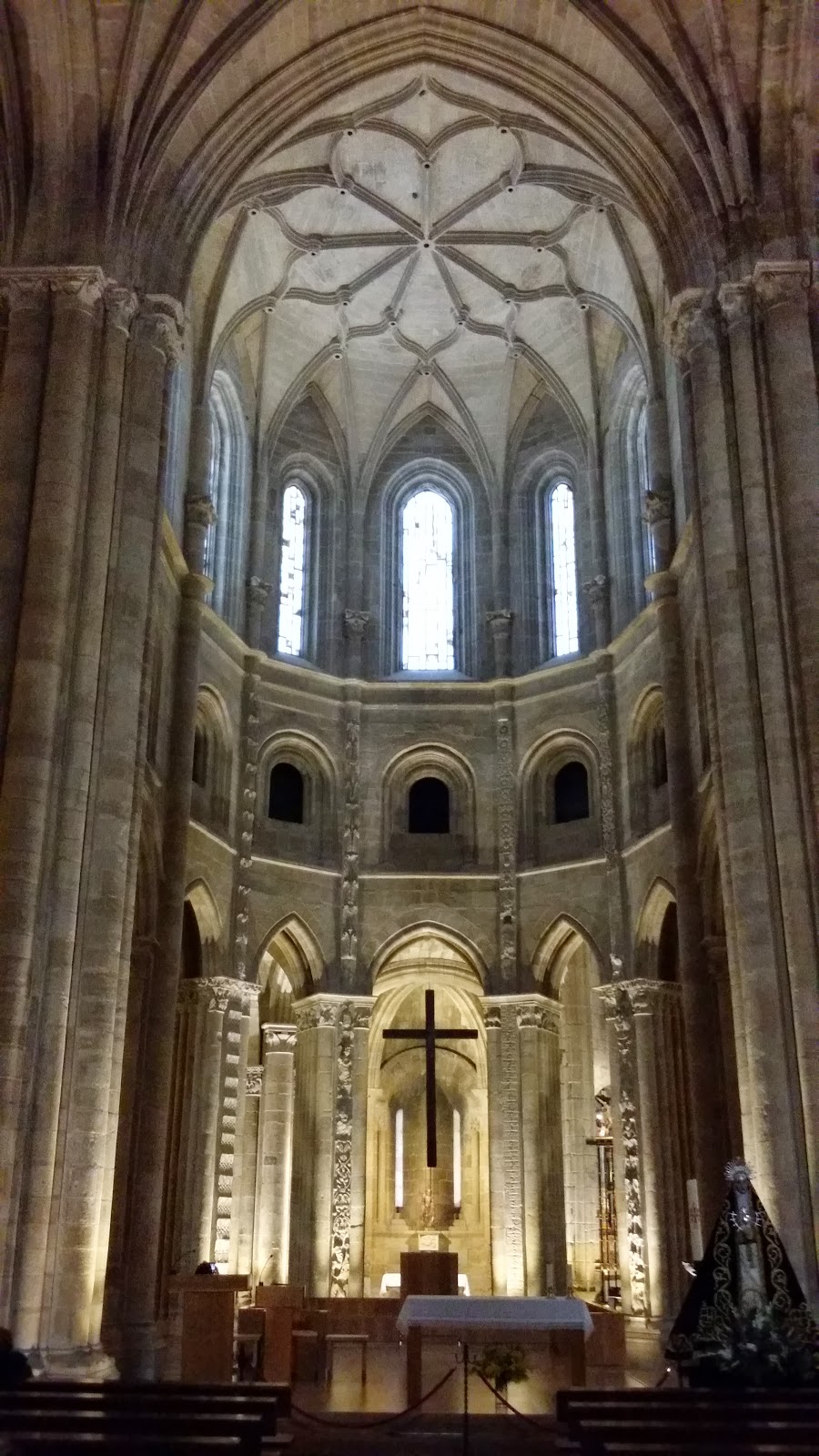
Romanesque central apse
The Jeronymites also added the gothic naves to the monastery church and built a larger cloister in the Herrera style, but in the Medizabal confiscations of 1835, the monastery was finally abandoned and fell into ruin.
Bronze wall plaque of Emmaus Road
Copy of carving at Santo Domingo de Silos monastery
It was only in 1964, that work began to restore the monastery. The monastery church was restored first and then the fifteenth century cloister. A further €4,000,000 worth of restoration work is planned on the other buildings and while we were there, we found the Chapel of St. Nicolas closed for restoration and two large cranes were working on the other monastic buildings.
Baldachin in the nave
We checked into the albergue. It consisted of a large dining room (with small wood burning stove) downstairs and a staircase that led to two large dormitory rooms and male and female bathrooms grouped around the fifteenth century two storey cloister. It was cold and draughty and we met one middle aged Irish pilgrim who had checked in and then decided that it was so cold that she couldn’t stand it and so then checked into the Casa Rural opposite the church for something more luxurious! Luckily for us though, we found that as the evening wore on the dormitories warmed up quite a lot and became much more comfortable. In addition our beds were away from the windows, which seemed quite draughty and this probably helped.
We were tired after our long walk from Belorado and were looking forward to showers and washing our clothes, however the bathroom facilities were very primitive! A lot of pilgrims had already showered and the tiled floor was swimming in water and very slippery. The bathroom itself was also very cold! There were three shower cubicles; David took the first one and began what sounded like a pleasant enough shower; I took the second one as the third one had no door and I didn’t fancy a public shower! This didn’t stop another pilgrim later however, who showered in full view later on while I was washing my clothes –rather disconcerting for a reserved Irish pilgrim like myself!
Close up of Baldachin canopy
Having stripped off, and standing shivering in the cold, I eagerly switched on the shower…a miniscule, very lukewarm dribble of water emanated from the shower head that was so tiny that I could barely wet my hair with it, never mind clean my body! I therefore patiently waited (shivering) until David finished his shower as I hoped that the water pressure would then increase. Nothing happened however, and so when he gave me the all clear that no one else was in the bathroom, I streaked naked into the other shower cubicle and finally managed to have a shower in relative comfort!
Effigy of San Juan under canopy
Things unfortunately were not much better when it came to washing our clothes. There were only hand washing sinks and the water was cold (never mind naked showering pilgrims in the mirror behind me!). Drying facilities only consisted of hanging clothes on lines around the cloister and as the weather was cold and damp, there was no chance of getting the clothes dry; the next morning my clothes and towel had not dried at all and I had to pack them wet in my plastic bag and hope the next albergue had better facilities!
Scene from life of San Juan on Baldachin
Somehow though, these privations did not dampen our spirits; I have the personal attitude (taken from the pilgrim mediation that I obtained at Estella) that I should take each albergue as I find it and seek to be grateful and content and avoid whining.
As I said, the dormitories began to warm up and the communal pilgrim meal of sopa de ajo (garlic soup), pasta and a segundo of pork, salad and chips and even an orange to finish was hearty and welcome. We paid a few euros for a bottle of red wine and it warmed and encouraged us further!
Matthew enjoying dinner
After dinner, David parked himself by the wood burning stove and Matthew and I took ourselves over to the church to observe the pilgrim mass. Orders of Service were helpfully provided in English (the first time I have seen this on the Camino – why doesn’t it happen more often?) and although we didn’t take the Eucharist, as we are Evangelical Christians and not Catholics, we took part in the liturgy and prayers where we could, as much of it is obviously the same as in the Anglican Book of Common Prayer.

After the mass there was a pilgrim blessing in the chapel to the left (facing the altar). Pilgrims of various nationalities gathered and were given orders of service in their own language. We participated in the prayers and then went forward and to be blessed by the priest, who then placed a necklace containing a patriarchal cross over each of our heads as a gift. The cross is a copy of one engraved on the wall of the chapel. It was touching and unexpected to receive such a gift and I wondered how much it must have cost to distribute the crosses to pilgrims. As for the significance of the Patriarchal cross as a symbol with it’s two bars – no one is quite sure of it’s meaning, but it is a popular symbol in the Eastern Church and the two bars are thought to mean either: secular and ecclesiastical authority, the cross with the sign “Jesus King of the Jews above it, or to symbolise the cross and the Holy Spirit. I chose to go with the third meaning and the cross is a special reminder for me of a special place.
The interior of the church itself is relatively small, but very beautiful. The first thing that catches the eye upon entering is the ornate baldachin or canopy of the tomb of San Juan. The canopy is in a florid Elizabethan Gothic style and dates from 1464. It covers a recumbent effigy of the saint and around the sides are carved six scenes from San Juan’s life, such as his journey to the Holy Land. Originally the tomb of San Juan was in the crypt below the church, but this flooded in 2005 and has been closed and the canopy and sarcophagi inside were moved into the church. The baldachin was placed in the central nave and the simple stone sarcophagus of San Juan now lies in front of the altar in the chapel where we received our crosses. An outer, richly carved Romanesque sarcophagus, is also on display, but unfortunately, I forgot to look out for it – rather remiss of me!
Simple stone sarcophagus of San Juan
Other things of note in the church include the wonderful Romanesque apse with it splayed windows glazed with alabaster. (The apse was lit up during mass highlighting the wonderful detail) and the church also has many fine twelfth century Romanesque pillar capitals. The most famous is the Annunciation capital; again situated in the chapel where we received our crosses. This capital shows the angel Gabriel kneeling in front of the Virgin Mary and announcing that she will conceive and bear Jesus. In 1974 it was rediscovered that twice a year on the Spring and Autumn Equinoxes; on March 21st at 6pm and September 22nd at 7pm, a beam of light shines through the church window and illuminates the carving of Mary. Whether this phenomenon was designed by the original builders or is accidental, is not known, but it seems unlikely surely, to be accidental, given San Juan’s reputation in medieval times to heal infertility?
Annunciation capital - it's hard to see, but Mary is on far left at the corner
The pilgrim blessing finished at 8pm and the worshippers filed out leaving Matthew and myself alone in the church which did not close until 9pm. Unusually for a Spanish Church, it was warm inside and so we decided to do Evening Prayer together. The chapel to the right of the altar (dedicated to St Jerome and with an effigy of Santo Domingo de la Calzada) had been kitted out for comfortable praying; with rugs on the floor strewn with cushions and a large stone bowl full of sand and multi-coloured candles. We lit a candle each and prayed together and just enjoyed comfortable brotherly companionship in Christ. We realised how grateful we were for each other’s friendship. Fellowship shared in Christ can be a deep and precious thing; more like having a brother than just a friend and I was reminded of Psalm 113 that says:

How wonderful, how beautiful, when brothers and sisters get along!

It’s like costly anointing oil flowing down head and beard,

Flowing down Aaron’s beard, flowing down the collar of his priestly robes.

It’s like the dew on Mount Hermon flowing down the slopes of Zion.

Yes, that’s where God commands the blessing, ordains eternal life.


Psalm 133:1-3 MSG

And also Proverbs 18:24 which says:

One who has unreliable friends soon comes to ruin,

but there is a friend who sticks closer than a brother.


Proverbs 18:24 NIVUK

Apart from praying, we also sang some worship songs together and were touched when a middle aged pilgrim lady came to pray near us by the altar and joined us in our singing.
We very reluctantly left the church at 9pm feeling something very rare and of a special quality had taken place; the Holy Spirit had been there; deep fellowship had been experienced and things would not be quite the same again. God had indeed commanded the blessing in our unity.

I slept well that night despite the large dormitories, but as ever, being a man in my forties, I needed to get up for the loo at 3am. The journey was one of the longest and most interesting I have also experienced in any of the albergues: out of the dormitory through some double doors, across the staircase landing and through more double doors, into the moonlit cloister, around two sides of the cloister, through more doors, along a corridor, and finally into the bathroom. Quite an adventure for a sleepy pilgrim!!

Monday, 1 June 2015

Camino Day 12: Santo Domingo de la Calzada – Belorado (20/03/15)


The lights were switched on by the Hospitalero at 6am and I crawled out of my sleeping bag to assess the perilous descent from my top bunk to the floor below.

I had woken at 3am bursting for the toilet and as the metal bunk bed ladder was at the foot of the bed, I had experienced considerable difficulty waking up enough to crawl to the end of my bunk and then turn 90° to go down the ladder without bumping my head against the slanted roof inches in front of me! Once finally down, the door through to the kitchen area to get through to the bathroom, had creaked loudly and involved flooding the dormitory with light. I am sure the other pilgrims must have been cursing me as I made loads of noise swaying around on the bunk in the dark, before thumping onto the floor and then opening the door! The bathroom floor was also still flooded and paddling in water at 3am had been tiresome. I had been relieved to finally flop back in bed and morning seemed to come all too quickly!

In the kitchen, the Korean men were frying vast amounts of eggs; “Chicken Village” was tucking into them with gusto and a further dozen or so were being boiled by the Korean women to eat for the day’s journey ahead. David and I ate a sandwich and some fruit and filled our water bladders.

Returning to the dormitory, we were amused to see that the grinning Hospitalero had reappeared to rouse the final pilgrims who were still snoozing in their bunks with cheerful exclamations of ¡Buenos Diaz! whilst loudly playing Latin dance music on his mobile phone which he waved near their ears. The recalcitrant snoozers abandoned any further thoughts of sleep and finally staggered out of bed groaning.
Early morning Santo Domingo
We stepped out of the albergue just after 7am and were surprised how cold it was; only about 1°C and a near freezing fog hung over everything, which lasted sporadically throughout the whole day. It was definitely the coldest day since we left Pamplona.
Leaving Santo Domingo
Making our way out of town we reached the fairly modern version of the Puenta del Santo over the rio Oja; the latest incarnation of the first bridge that Santo Domingo built nearly 1,000 years ago. At the start of the bridge there was a small brick oratory. Oratories beside bridges where pilgrims could pray before crossing dangerous rivers were a common site in Medieval times; I can think of two surviving examples in England that I have seen at Wakefield and Derby. In this case, an information board told us that this one had been built in 1912 to replace an earlier one swept away in a disastrous flood. Looking at the broad gravelly river bed which was much wider than the present river flowing through it, David and I agreed that we could well imagine raging flood torrents sweeping through at times of flood. It made Santo Domingo’s achievement of building the first bridge here seem all the more impressive.
Puente del Santo
Beyond the bridge a fairly bleak foggy vista opened up. To our left was the main N-120 road and some derelict looking factories with a stork nesting on top of an abandoned chimney. We walked past the senior Korean, who was walking alone and had such a look of sadness and weary solemnity on his face that he looked like he was carrying the weight of the world on his shoulders.
Bridge Oratory
After we crossed the N-120 and had reached a tree-lined stretch running parallel to the road, David walked on ahead of me, to pray and continue memorising Ephesians, I had tried wearing some new foot orthotics on Day 1 when we had left Estella, but all they had done was cause a large blister on my right heel which I had been carefully protecting ever since by covering with Compeed silicone plasters. The Compeed had worked well and the blister had remained manageable, although it had slowly become larger. I had also realised that my walking boots were getting old and were no longer adequate for protecting my feet from friction and shearing forces around the heels. Leaving Santo Domingo on this final day of walking before we returned home, the blister was quite sore and I was limping as a result, although I found as the day went on that it became much more bearable.

 I fell into the rhythm of walking and found myself praying and seeking God; reciting the prayer of confession from the Anglican Book of Common Prayer, repeating psalms that came to mind and most of all feeling the need to pray for my family; my wonderful wife and children and my mother who would be recovering after her shoulder operation. As I lifted up their needs and mine, to my surprise I gradually found myself crying in a deep gentle way, much as I had done the day I had been walking up Alto del Perdon. I felt spiritually vulnerable and acutely aware of the need for more of God in my life.

The reasons for this feeling of vulnerability and open-ness to God that I felt leaving Santo Domingo and have felt at other times on the Camino interests me a lot. The materialist person would probably say that it is just prompted by tiredness, the physical challenge of walking day after day, my painful blister, or even just the melancholy foggy weather, and some of that no doubt is true; inevitably our physical bodies will influence our spiritual condition, but I firmly believe that this feeling of open-ness to God is so much more than that;

Rónán Johnstone in his thought provoking book “Trust Surrender Believe Receive”  (www.goodnewsbooks.net) talks about how our desires and longings; the need for things such as affirmation, sex, and even our banal desires like eating drinking and sleeping are really only pointers to our deepest desire for more of God, which lies at the core of our being.  Johnstone points out that “To really engage with Jesus is to begin to acknowledge that I don’t have total independence…to admit that I don’t have the power to fulfil my own life…I am not enough in myself”. We secretly know this but have a fear of admitting our dependency so he points out that we try to cover “the deep inner fulfilment” that we crave by trying to satisfy our desires with such things as relationships, careers, material possessions, and activities, but that ultimately they do not satisfy. Why? Because our desires are actually a gift that are supposed to help us realise our dependency on God and lead us to him. “Desire is a reminder that we are not self-sufficient…the very gift which will lead us to the one who created us in the beginning...to show us that nothing compares to the love of God made known to us in Jesus His Son”.

 My point is that fundamentally, I feel that the whole experience of the Camino; the rhythm of rising early and going to bed, walking in the fresh air, having time to reflect and just take time out of ordinary life, strips away the superficial shell of activities with which we so often surround ourselves and use to hide from our deepest desires and needs, and forces us instead to start to be more real with ourselves and God so that we begin interacting with Him on a deeper level.

My weeping was what Paul describes in the New Testament book of Romans 8:26 as “groaning in the Spirit”; my spirit responding from deep inside me; calling out to God and desiring his love and refreshment.

In the same way, the Spirit helps us in our weakness. We do not know what we ought to pray for, but the Spirit himself intercedes for us through wordless groans”

Walking the Camino forces me to take time out to be what the author Richard Foster calls “to be present where we are” in his book on Prayer.

“God wants us to be present where we are. He invites us to see and to hear what is around us and, through it all to discern the footprints of the Holy”

I caught up with David at La Cruz de los Valientes. A modern metal cross beside the gravel track above the N-120, where it cuts through a hill, marks the site of medieval combat between two local champions; one from Santo Domingo and one from the next town of Grañon. The story goes that both towns were in dispute about ownership of a piece of land half-way between them both, so the argument was settled by trial by combat between a representative from each community, the idea being that God would favour the innocent party. In this case the town of Grañon won the fight.

David was sitting on a bench beside the cross, which was covered with items that other pilgrims had left – crosses, stones, prayers. One laminated memorial card, wedged onto the cross had really drawn his attention and he pointed it out to me; it was a simple card with a photograph of a handsome, well dressed young man called Edward Robnett Archer. The card gave the dates of his short life “November 1, 1997 – May 11, 2014 and the Bible verse from John 1:5

The Light shines in the darkness and the darkness has not overcome it”.

As we looked at the card we were deeply moved; I realised that this young man was almost exactly the same age as my daughter and I imagined the horror of what it would be like to lose her. We could only imagine the terrible grief and heartache that the Archer family and their friends must be going through and we realised that someone who had known this young man and loved him had walked on the Camino recently to try and deal with their grief, leaving this card at the cross.

As we sat on the bench thinking of this, David began weeping. We prayed for the Archer family and their loss and as we read the Psalms of Ascents that we had allocated for the day, we were amazed yet again, how appropriate they seemed on that dark, cold foggy morning. 

"Out of the depths I cry to you, Lord;

Lord, hear my voice.

Let your ears be attentive to my cry for mercy.”

Psalm 130: 1-2

We walked on and reached Grañon – just as we entered it or Latin music playing Hospitalero was turning around with a friend to walk back to Santo Domingo – clearly each morning after he had seen the pilgrims on their way, he would take a walk for exercise to Grañon and back!

The fog had lifted slightly as we reached the village and daylight was beginning to break through more effectively at times. It was still early and the Church of St John the Baptist was closed, but opposite was a cheerful little café-cum-shop and we stepped inside as the Koreans were leaving, to indulge in what the Germans like to call Zweites Frühstuck - Second Breakfast. We managed to get the window seat surrounded by local artwork which was for sale and I enjoyed coffee and Tostada – great slabs of toasted bread slathered in butter and marmalade; ideal comfort food for a cold foggy morning!
David in the Café at Granon
We continued uphill and out of Grañon, descending through a wide open landscape of large fields into a small valley and then up the far side. As we had travelled across La Rioja each kilometre of the Camino had been marked with wooden posts telling the traveller the remaining distance to Santiago. Just outside Grañon we found the post showing that we had 555km to go so I photographed David standing beside this interesting number.
David walking uphill in Granon
Just further on we met Alex the Brazilian really struggling with the agony of shin splints. He was in a bad way and walking very slowly and at times going backwards uphill as this put less stress on his tibial muscles – pain I remembered only too well when I walked to Cirauqui last year. We stopped and chatted briefly to Alex and I told him that I felt his pain as I too had experienced shin splints.
La Rioja's wooden kilometre posts
At the top of the valley, we reached the border between the regions of La Rioja and Castille and León marked by a large sign showing a map of the Camino through the next region. I had made it across my second Spanish region!
Entering Castille & Leon
Castille and León is the largest autonomous region in Spain at 95,000 km₂ but only has a population of 2.5 million. 50% of the time on the Camino is spent walking across three of it’s nine provinces; Burgos; Palencia and León and it includes of course, the flat plateau region of the Meseta which covers 1/3 of the Iberian Peninsula.

Whilst we examined the map Alex forlornly limped up to us to ask what we were looking at. We explained we had reached the border of Castille and León. “Oh good” he replied “that means the end of those annoying wooden posts every kilometre – I hate them!”

Further on we reached Redecilla del Camino; the furthest point that Santo Domino’s roadbuilding efforts took him to from Najêra. I had noted this village when planning to walk the Camino as it contained a star feature I wanted to see – a fine 12th Century Romansque baptismal font in the church of the Virgen de la Calle (The Virgin of the Road). Unfortunately, the church was closed! I cast around undeterred and spotted a local lady brushing her doorstep. The information board outside the church discussed the font in English and Spanish so I noted the Spanish word for font and approached her gesticulating at the church using this word combined with iglesia, whilst miming turning a key in a lock. (Yes, I am ashamed at my lack of Spanish!) She pointed out the house where the custodian lived in the corner of the plaza and I rang his doorbell. He appeared and said “two minutes please” in English and disappeared back into his house.
The Church of the Virgin of the Road
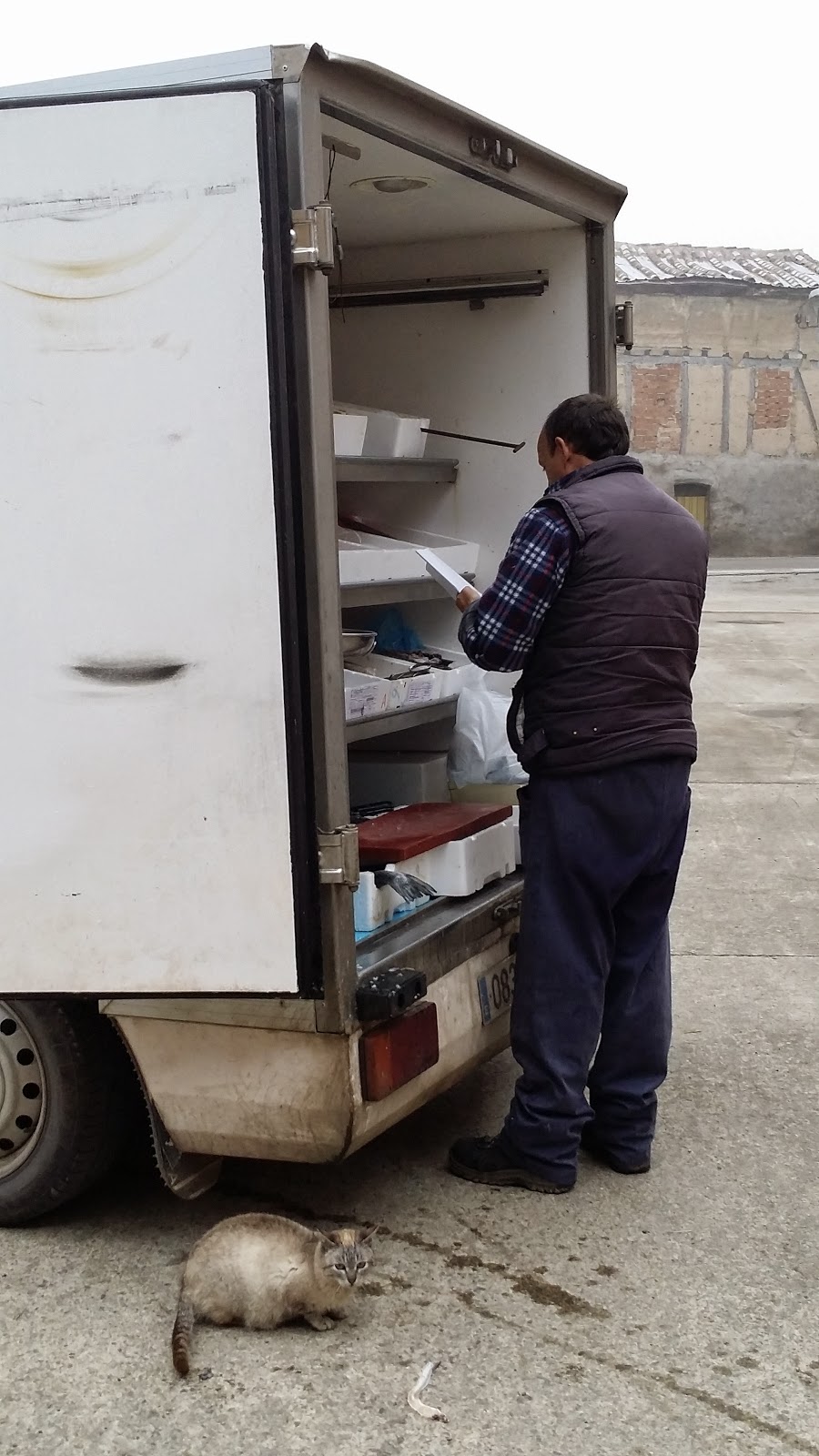
Meanwhile the fishmonger arrived in a large white van tooting furiously and several ladies gathered around to buy fresh fish (it was Friday after all). We were amused to see that the village’s local cats also eagerly appeared and the fishmonger threw them a few scraps of fish off cuts which they clearly enjoyed.
The fishmonger with feline friend
Whilst we were waiting, Alex came along again and we explained that we were waiting for the key so that I could see the font. We chatted and then Alex said “You know when you said you felt my pain earlier – where did you mean?” I said I meant the pain in his shin. “Oh” he replied, “I thought you meant the pain here” and placed his hand over his heart. I asked him gently did he have pain there and he said he did and how much of a failure he felt because he was two days ahead of the rest of his party and had been doing really well until he got shin splints. Now though, he felt he had let himself down. It turned out that Alex, who I had taken to be a very laid back kind of guy was actually a very driven person, who pushed himself too hard. David and I talked to him about going easy on himself, about not needing to prove anything to others, and about finding contentment with himself and who he has been made to be.

The Church Custodian arrived, with the key and we were let in to examine the extraordinary font, protected behind a steel gate. A large bowl carved with architectural towers, windows and carved interlaced friezes rests on a pillar consisting of eight columns with what is possibly a snake curling around it’s base. I was glad I had made the effort to hunt down the key as I wouldn’t have wanted to miss this Camino jewel.
Romanesque Font
Back outside we slowly walked up the street and continued our conversation with Alex. David explained that we were Christians and asked Alex would he mind if we prayed for the issues we had talked about and especially for his leg? Alex was happy for us to pray, so we explained that in the New Testament Christians often prayed for someone by “laying hands” on them; gently placing their hands on the person and with his permission, we stopped in the road, placed our on hands on him and prayed for Alex – that God would bless him, heal his leg and give him peace and contentment in his heart, that he would no longer feel the need to prove himself to people but be content in who he was; it was a special time for David and myself on this year’s Camino. We could see that Alex was a great guy; someone who was genuine, honest and thoughtful.

Leaving Alex to walk slowly onwards, we came to the village of Castildelgado. The fog had come down thickly again and the fishmonger had caught up with us and the local cats were appearing again on cue in hopeful lip-smacking anticipation!

By lunchtime we had reached Viloria de Rioja; the birthplace of Santo Domingo de la Calzada (although the ruins of his house have been inexplicably demolished) and found that the private albergue mentioned in John Brierley’s book run by Acacio and Orietta was open and lunch was available. The downstairs of the albergue which was clearly in an ancient timber-framed building, was open plan and rustic with a basic kitchen area and a lady, who I presume was Orietta, was available to make sandwiches. A carafe of red wine and a bowl of local hazel and walnuts were on the table for us to help ourselves. Everything in the Albergue, including the lunch, is funded by pilgrim donations and there was no official charge, so we gave a generous donativo.We enjoyed a satisfying chorizo and cheese sandwich each and discussed with our host the map of the Camino and she traced for us the route of the Camino Primitivo from Oviedo which she recommended for it’s beauty. Definitely advice to file away for a future trip!
The albergue at Viloria de Rioja
As we were leaving Viloria de Rioja I noted that the parish church had a most unusual timber framed structure over hanging the eaves of it’s buttressed apse. We also stopped to laugh at a bizarre garden ornament outside one of the houses; the leg of a shop mannequin sticking upside down out of the ground! The big question that came to my mind was WHY??
Church at Viloria de Rioja
We were laughing at this when a group of late middle aged Spanish walkers came along and stopped to see what was causing our amusement. The group turned out to be a group of professionals from Madrid in their late 50’s and 60’s who met on a different day each week to discuss a subject of interest; either something from their professional careers or some other matter that interested them. A jovial man engaged us in conversation in excellent English – he was a Fire Safety Officer at a Nuclear Power Station and this interested David a lot, as he too is a Fire Safety Officer in Cork. They compared notes on the Fire Training Centre they had both once attended in Moreton-in-Marsh in Gloucestershire, England.
Interesting garden ornament!
Our new friend said he had also been to visit the English Nuclear Power Station at Dungeness. He explained that the club included a doctor, a nurse an orthodontist, and a lawyer and the rules were that they could discuss any subject except politics and religion. Two of the members had even met and fallen in love after previous marriage breakups, so the club clearly had other uses in addition to just discussions! Every few months one of the members would organise a trip away for the weekend – on this occasion they were walking from Santo Domingo to Burgos, but they were having portage for their bags and staying in nice hotels. He himself was from Segovia and he was organising the next trip later in the year to visit Roman remains and the sites of St Theresa of Avila as it was this March was the 500th anniversary of her birth . I gently ribbed him by asking why his group weren’t carrying their bags and he said, “well I am 63 and not as fit as you”. I teased him saying that David was 59 and if he could do it on his first Camino trip, he should try it next time. Eventually after walking a couple of kilometres to Villamayor del Rio enjoying the convivial conversation, our new acquaintance excused himself “I will say goodbye friends because you are walking too fast for me and I need a pee!”
Castle ruins at Belorado
The path now had a long rather tedious stretch alongside the N-120 before it finally dipped down into the little valley where the town of Belorado is situated. We had walked 22.9 km in 6 hours and 51 minutes. And 140km since Estella. We had reached the target for our walk on this occasion. I was sorry our walk was coming to an end.
Hermit's caves, Belorado
Belorado is an interesting and historic little town with narrow streets of multi-coloured buildings, (some of them with walls leaning rather precariously!) which open onto a wide town square. It has Roman origins but was resettled in 1116 when King Alfonso I of Aragón made it into a frontier stronghold on the border with León. Sitting in the Tirón river valley it is overshadowed by a limestone outcrop which has the ruins of a castle on it’s summit, which once defended the frontier of Castille, and many hermit’s cave dwellings cut into it’s sides. Some of them seem to have been converted into modern structures with windows and doors! The origin of the name “Belorado” seems to be linked to these caves as it is said to come from the “Belfuratus” mentioned in Aymeric Picaud’s guide which comes from the Latin forare – to bore into the rock face. According to Lozano one of the caves is said to be linked to San Caprasio and an image of the saint which was once kept in the caves is now in the church of San Nicolás. This may be the same saint who was once said to have hid trembling in a cave until his faith restored by seeing a young virgin martyred (her relics are kept at Conques near Le Puy) and later became Bishop of Agen.

Church of Santa Maria
The path entered the town crossing over a small bridge in front of the 16th Century Parish Church of Santa Maria, the tower of which was bedecked with a total of four stork nests! We made our way round to Albergue Quatro Cantones which was situated just off the main square because we liked the sound of it in John Brierley’s guidebook. Walking inside to register we were delighted to be greeted by our old friend Vira the Buddhist Nun. It was wonderful to see a familiar face and we greeted each other like long lost friends – although we had only met for first time at Estella, it’s amazing how quick you build up a bond with fellow pilgrims and we already felt we had so much shared experience. Vira expressed surprise at seeing us as she thought we would have been a day ahead of her as she had taken it easy one day and not walked as far as usual, but we explained that we had taken a detour to San Millán de la Cogolla.
Albergue Quatro Cantones
The albergue turned out to be delightful, with a warm and cosy atmosphere. There was a homely kitchen, with a table for pilgrims to sit around, heated by a wood burning stove which the Hospitalero would replenish with fresh timber regularly. This was very welcome on such a cold and foggy day! Strings of dried garlic hung from the ceiling beams and added to the domestic atmosphere. The dormitory was comfortable and warm with blue and red striped sheets covering the mattresses and adding a welcoming note.
The albergue kitchen (Chicken Village standing at end of table)
After checking in and handing over the dirty laundry we had accumulated since Logroño we made for the showers. As there were only two and both were occupied, I let David go first when one became free whilst I waited for the other one. Whoever was in the other shower was certainly taking their time. David came out and since a German young woman was waiting too, I let her go next whilst I continued waiting for the other shower. The occupant was now cleaning his teeth in the shower and then every now and then the shower would be switched off and I would think he was finished, only to hear the shower start again for another few minutes. David by now was dressed and still I waited. Finally the occupant of the shower appeared – it was Chicken Village smiling broadly – he must have been the cleanest Korean in Northern Spain after his marathon shower session. I could only smile upon seeing he is beaming face again – who could be annoyed?
The dormitory with Michael from Arizona on left
After showering we had a wander around the town, but the temperature was near freezing and because we had so few clothes on, having put most of them in the laundry, we had to give up when I started shivering and dive into a bar under a loggia on the Plaza for coffee and pastries.
David in albergue kitchen with friend!
Returning to the Albergue, David fell into conversation with a pilgrim from Arizona called Michael. He was telling David how he had met this Brazilian called Alex who was in a bad way with his leg and how he had encouraged him to keep going and had walked with him to Belorado. David was thrilled to hear this and explained we had talked with him at Redecilla. “Oh are you the guys who prayed for Alex?” exclaimed Michael “Alex was really touched by you guys doing thatand showing him such concern!” We were delighted to hear that Alex had made it to Belorado – it was such a personal achievement for him as we had thought he would have had to stop at Viloria. Michael had obtaineds Alex’s mobile number as he was staying in the Municipal albergue and texted him to invite him to join us for dinner that night and we hatched a plan to club together to pay for his meal to bless and encourage him.
The Plaza, Belorado
The rest of the afternoon was spent pleasantly sitting by the wood burning stove chatting to Vira. She explained how she had been a successful business woman from New Jersey, but when her sister had been diagnosed with terminal cancer and had died peacefully unafraid of her impending death, it had caused Vira to reassess her life and she now lived an ascetic life in Burma after she had been ordained as a Buddhist nun. Vira also enjoyed hearing of our trip to San Millán and we showed her pictures of Suso and Yuso.


A town house in Belorado
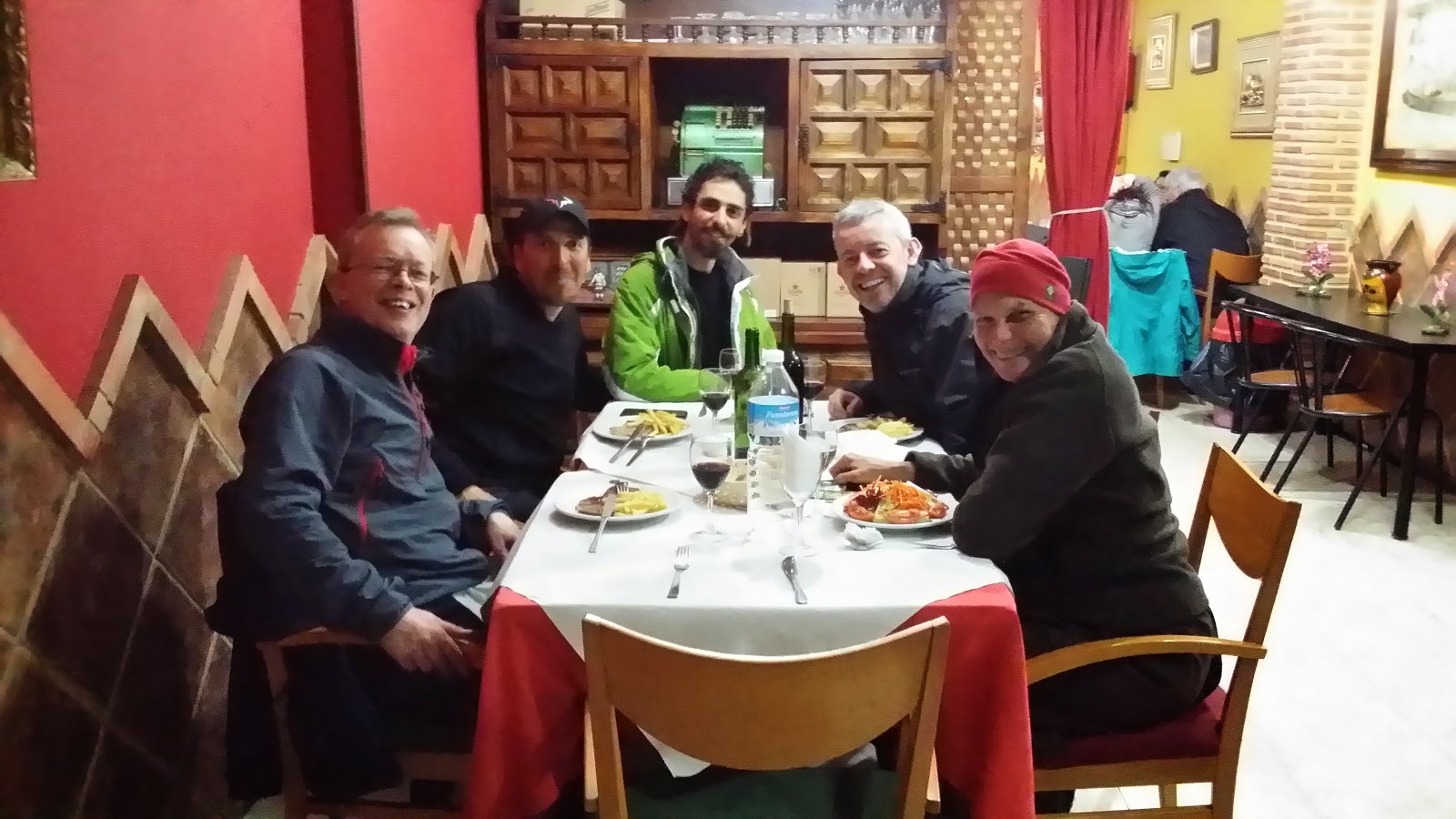
That evening David, Michael, Vira, Alex and myself had a wonderful meal together in a restaurant off the plaza. When Alex arrived we cheered and applauded him and we had a great evening chatting to each other; hearing about Michael’s wife and family in Arizona, Alex’s plans for the future and Vira’s life in Burma. It was one of those special evenings of pilgrim fellowship that is so characteristic of the Camino and it book-ended myself and David’s walk from Estella to Belorado so appropriately as we had enjoyed Heinz’s party in Los Arcos on our first night and finished our walk with another memorable meal on our last night. My only regret is that I forgot to get Alex’s mobile number as I would love to know if he made it to Santiago. Alex if you ever happen to read this back in Brazil – let me know as David and I were impressed with your courage!


Left-Right: David, Michael, Alex, me and Vira


Sunday, 24 May 2015

Camino Day 11: San Millán de la Cogolla – Santo Domingo de la Calzada (19/03/15)

It was now time to get back to the main Camino Francés route after our detour to San Millán de la Cogolla. Returning to the Yuso visitor's centre we had our credencials stamped at reception and then took a few minutes to have a coffee and a chocolate bar from the vending machines in the foyer.
The bell tower of Santo Domingo Cathedral
We walked out into the entrance courtyard of Yuso at 11.30am and were immediately met by an enthusiastic coachload of German senior citizens who were just arriving for a tour of the monasteries. There was much excitement when they saw us and they began to gather round us as one of them asked me in English where we were from and whether were real pilgrims walking to Santiago? I explained that we were Irish, and indeed walking to Santiago, but in stages and on this trip we had only walked from Estella. Would I mind posing for photographs so that they could photograph my rucksack with scallop shell? No problem, I said, but pointed out that David's large white scallop shell which I had found near Luquin was so much larger than my weedy little Ventry example. The Germans gasped with approval upon seeing David's superior scallop and fell on him like a celebrity, snapping away whilst I stood back. I was filled with covetous scallop shell envy! :-)

Bidding auf wiedersehen to our German admirers we finally set off in the light rain. I had not slept that well the night before for two reasons. Firstly my mum was having an operation on her shoulder back in Ireland that morning and I was worried about her and how she would cope. But secondly, I was still thinking of the slump that I had the previous day at the roundabout and the interminable walk downhill to Berceo in the rain and that hill had built up into a major physical and psychological barrier in my fitful dreams during the night that had to be scaled to get back to the Camino. I trudged out of San Millán with slight trepidation, steeling myself for the ordeal before me.
Halfway to Santo Domingo
However, to our amazement the walk to Cirueña turned out to be much easier than we expected. Maybe it was because we had a good breakfast with plenty of protein from the yoghurt, cheese and chorizo, maybe the chocolate bars helped, maybe we were just in good spirits after seeing the monasteries and staying in a good guesthouse, but whatever the reason, we found the road up to the roundabout which had seemed so hard the day before, now seemed much easier. Apart from a short break to have a snack back at the roundabout, we set what we consider a blistering pace of 6km an hour and walked the 12 km to Cirueña in 2 hours! Not bad for a 59 year old and a 47 year old! I was reminded how unjustified my fears had been and what can seem a hard road one day, can seem easy the next - definitely something to remember in life.
David powering towards Ciruena
When we reached Cirueña, we knew we had rejoined the Camino Frances and I was delighted to see a familiar yellow arrow and greeted it symbolically like a long lost friend while I waited for David to catch up (if anyone was watching I am sure they thought I was mad!).

We decided to celebrate with a sandwich, in what looked from the outside, a very unprepossessing cafe called Bar Jacobeo. But never judge a book by it's cover - outward appearances can be deceptive! We stepped inside and the first thing I noticed was that there were several local extended families dining - always a good sign to see locals eating in a bar I feel. The second thing I noticed was that two policemen were also eating. My dad always used to say that if you see policemen eating in a cafe it is always a good sign that the food is good!
Bar Jacobeo
We had been thinking of a sandwich as I said, but the barman suggested the menu. Sure, why not we thought? It was 1.30pm and we could treat ourselves after the success of our San Millán detour! This turned out to be the best meal I have so far eaten! It was stupendous! It would have been served in a fancy restaurant and cost a fortune had it been in Ireland!
The superlative paella!
A terracotta jar of red wine came first - wine always gladdens my heart - so far so good, then a fabulous seafood paella for primo, full of scallops and prawns. Segundo was calamari and salad for David and for me the most wonderful squid in squid ink sauce - maybe not the most aesthetically pleasing dish, but rich, savoury and very filling. Dessert was what the Spanish call "flan" - creme caramel, and one of the delights of walking the Camino from a culinary point of view, is trying out the different homemade flans, often quite different from each other. Usually there are small cup sized affairs, but we were staggered after the first two courses when enormous cake-sized wedges of flan were brought out. It was solid, it was creamy and it was heaven! I needed an espresso to close the stomach! It cost E11 - nothing in my opinion for such a feast!
Squid in ink sauce
We literally waddled out of Bar Jacobeo wondering how on earth we could walk the remaining approximately 7km to Santo Domingo de la Calzada, but somehow we did, be passed by our two fellow police diners cruising slowly down the Camino trackway in a squad car - the first time we had seen the police patrol the Camino. In the end it took us 3 hours and 50 minutes to walk the 19 km from San Millán de la Cogolla to Santo Domingo de la Calzada.
Flan
We entered Santo Domingo past a potato packing warehouse. I had hoped to stay in the Cistercian Convent and hear the nuns sing Vespers, but when we rang the doorbell nothing happened and we found out at the information centre that the nuns go away on holiday in the winter and were not at home. No matter, we made our way down the street to Albergue Casa del Santo which is run by a Spanish Confraternity. Checking in with us at the same time was a very tall young German man (built like a barn door) called Aaron who was complaining about his legs - he had the ubiquitous shin splints. Also milling around in the foyer were several Koreans who we came to like and provided colour for the last part of walk.
David walking towards Santo Domingo
The albergue was interesting - a strange eclectic mix of original Medieval and Renaissance elements – the façade of the old Bishop’s Palace, with it’s arched gateway and courtyard, and original rooms with period furniture behind a glass door, combined with a very cold yellow - glass 1970's style chapel and modern extensions. The dormitory was up two flights of stairs and for so large a building seemed fairly cramped, but comfortable enough.

Because we were some of the last to arrive there were few beds left so I let the elderly David (!) have the only remaining ground floor bunk and I had a second level bunk beneath a plywood slanted ceiling. I made note to self, not to sit up suddenly during the night or I would smack my head on same!

The bathroom was also cramped and the floor was flooded as other pilgrims had already done their ablutions and as there was nowhere to hang clothes whilst showering it was hard to keep things dry. I had been spoilt by the albergue at Logroño and our guesthouse at San Millán and I could feel myself getting irritated, but I reminded myself that this was not the right attitude and that on the Camino I should accept each day as it comes and try not to complain.

David and I were particularly keen to wash some clothes but checking around in the back garden we found that there were no washing machines and tumble driers and as it was too cold to dry clothes on a line, I decided to reluctantly shelve the idea until I got to Belorado.
Palace of  the Marquis of Fuerte Hijar
Time was getting on and we wanted to see Santo Domingo before the sun set, so we made our way into town. This ancient town is full of character and we saw Spanish tourists wandering around with their families as well as pilgrims. Some of the heritage buildings seemed dilapidated like the 18th Century Baroque Palace of the Marquis of Fuerte Hijar, with it's broken shutters and collapsing roof, but most of the town was well kept and shone in the evening sunlight as the morning’s rain had long since cleared.
Dog in Plaza Santo
The town is named after it's founder; Santo Domingo de la Calzada - St Dominic of the Roadside. Santo Domingo is one of the most interesting historical figures linked with the development of the Camino. Born in 1019 in the nearby village of Viloria as Domingo Garcia, he studied at the Abbey of Valvanera and then San Millán before being rejected by the authorities there for not being of a sufficient intellectual standard. Not to be thwarted in his call to serve God, Santo Domingo retired to live as a hermit on the site of the present town and decided to dedicate his life to serving  pilgrims on their way to Santiago. In 1044 he built a bridge over the rio Oja as well as a pilgrim hospital (which is now a Parador) and a church which later developed into the cathedral.
Artist's impression of the early development of Santo Domingo de la Calzada
Aymeric Picaud, who wrote a medieval account of the Camino says that Santo Domingo also "built the stretch of the road between Najera and Redecilla del Camino". In 1076 Alfonso VI extended his rule over La Rioja and gave his unconditional support to the work of the saint. He died in 1109 and around his tomb the "Burgo de Santo Domingo" grew up into the town we see today.
Portal of Cathedral
We made our way first to Plaza Santo. Opposite the Cathedral was the baroque facade of the small Hermitage Chapel and we decided to step inside it first and found a delightful 16th Century vaulted interior. The sense of peace compared with the hustle and bustle of the Plaza outside was palpable and we sat for a while enjoying the opportunity to reflect and seek God after a busy day.
Inside the Hermitage Chapel
Returning outside we next climbed the 18th century cathedral bell tower and this afforded fine views of the narrow streets below; the remaining stretches of the town's ramparts; the surprising proximity of the modern road, busy with lorries on the flat plain to the north of the town, and also a close up of the bells themselves. I also was also interested in the graffiti on the stonework around the bells - including some cross pattees - an ancient symbol of pilgrimage that I have also encountered in Ireland at pligrims sites such on the Saint's Road in Dingle, Co. Kerry.
David on top of the bell tower
View up inside of bell tower

Looking towards Belorado from Bell tower

Bell tower graffiti
Descending, we then went into the cathedral - the gothic church of San Salvador.  The original church was consecrated in the 12th century and had quite a dark interior. It was built over Santo Domingo's original Romanesque church and has Latin Cross ground plan with three aisles, a ribbed vault and a Romanesque ambulatory behind the high altar which had carvings in fine relief which were uplit, and therefore easy to see and which I enjoyed a lot. Floral motifs are interspersed with human figures including my favourite; King David playing a lute - a fitting theme for a house of worship considering that David organised the Levitical choirs for the Biblical Temple in Jerusalem.

A fine renaissance gilded retable by Damian Forment dating from 1537 - 40, with an impressive silver altar has been moved into a chapel on the north side so as not to obscure the ambulatory.
Apse
Apse carving detail
King David
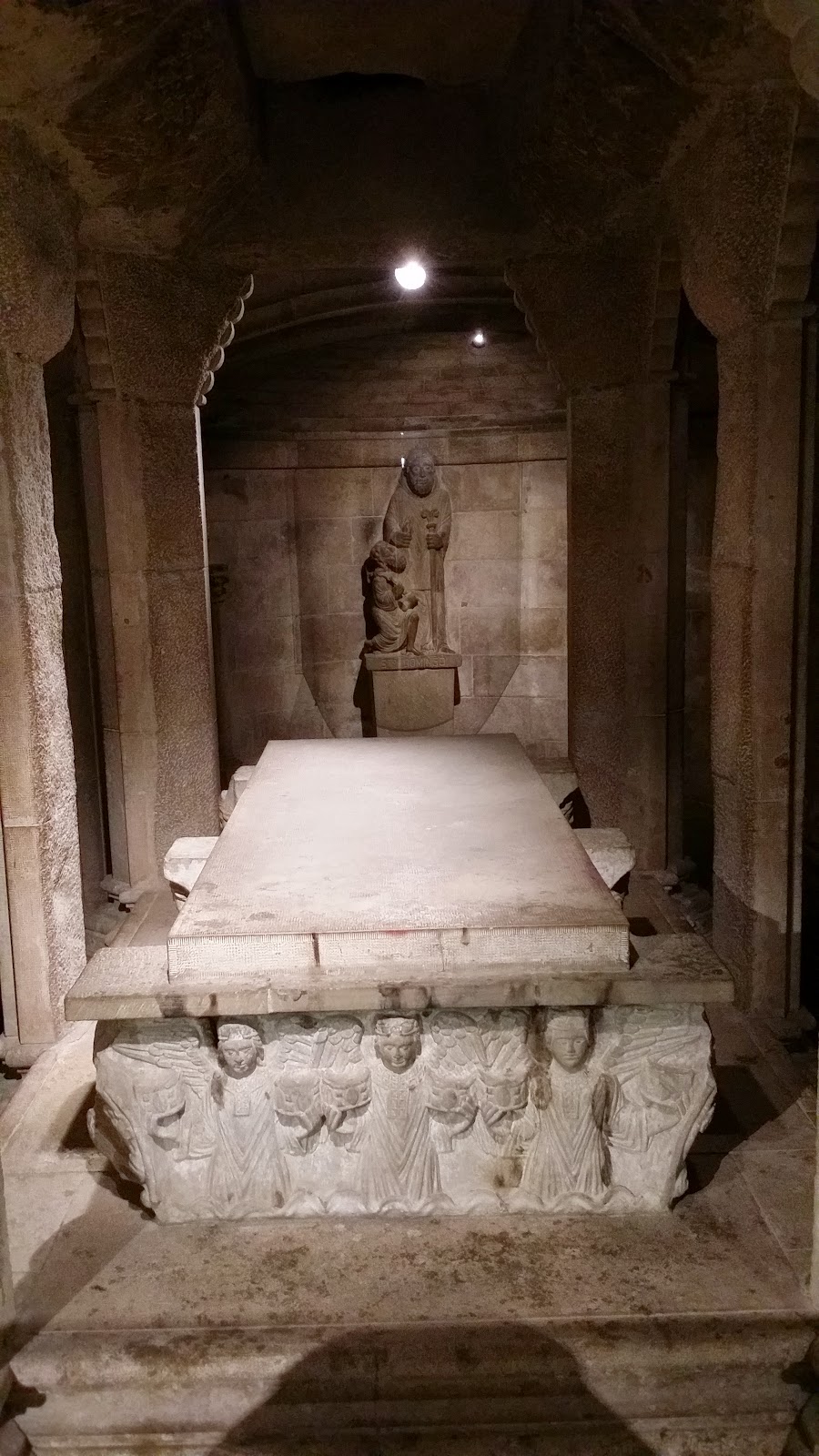
Nearby in the south transept is the impressive mausoleum of Santo Domingo himself. The saint originally requested to be buried in the middle of the road he had done so much to develop, outside the church he had built, however with the construction of the later cathedral, his tomb became incorporated within it’s walls. The Romanesque tomb is still at the old street level – I descended down some steps below the floor level of the cathedral to view it in a fairly austere stone chapel adorned with a statue of Santo Domingo himself with a kneeling follower at his feet and with some scenes of the passion and resurrection of Christ on the walls.
Tomb of Santo Domingo
Detail of Scenes from the Passion of Christ on wall of Santo Domingo's tomb
Over the sepulchre soars a gothic canopy with a recumbent statue of the saint at the floor level of the cathedral. At one end of this is an altar featuring another, presumably Baroque, statue of the saint, complete with staff, Gandalf-like beard and brown cloak, within a niche and standing on a silver plinth within a silver arch decorated with florid scallop shell and floral motifs. At his feet stand two cockerels which brings us to the most bizarre sight in the cathedral.

Gothic canopy over Santo Domingo's tomb

Near the mausoleum on the west wall of the south transept is a late gothic carved niche with a renaissance grille behind which is a cage containing a pair of live white chickens – a cockerel and a hen! This structure is called the Gallinero or Chicken Coop of Santo Domingo. The tradition of keeping chickens in the cathedral is linked to the most famous miracle associated with Santo Domingo. There are as usual, various versions of the story but basically, it is said that in the 14th Century an 18 year old German pilgrim called Hugonell from the Diocese of Cologne was on pilgrimage with his parents and stayed in an inn in Santo Domingo. The innkeeper’s daughter made sexual advances to Hugonell, who refused them. The spurned girl was filled with anger and hid a silver cup in Hugonell’s bag to get revenge and then informed the town authorities that Hugonell had taken it. Hugonell was sentenced to death and hanged. As his grief stricken parents were preparing to leave they heard their son’s voice telling them that he was still alive as Santo Domingo himself was holding him up by the feet. They rushed to the house of the town judge who was just sitting down to a dinner of two roast chickens, a cock and a hen, and told him their story. The judge scoffed at them and replied that their son was no more alive than the chickens on his plate whereupon they jumped up miraculously from his plate complete with feathers and began to flutter around proving the boy’s innocence!
Altar of Santo Domingo
This miraculous story in fact has elements that occurred again and again across Medieval Europe – versions appeared in places like Utrecht, Toulouse and Barcelos on the Camino Português. In 1307 for example, the Welsh rebel William ap Rhys was hanged at Swansea Castle and was claimed to have been raised from the dead when Lady Mary de Briouze had prayed to St Thomas de Cantilupe, the deceased Bishop of Hereford. Upon his recovery ap Rhys had claimed that de Cantilupe had held him up by his feet when he was on the gallows. The story of roasted chickens being resurrected is more unusual, although a version involving resurrected geese does appear in an old English carol.
The Gallinero
The chickens kept in the cathedral today are supposedly the descendants of the roasted ones and the Religious Order that runs the albergue keeps a spare pair in a chicken coop in the garden, which I saw and swaps them over every two weeks. The tradition of keeping chickens continually in the cathedral only dates from 1965 (which was a Catholic Holy Year) as prior to this they were only seen between the 15th April and 13th October. Supposedly it is good luck if a pilgrim hears the cockerel crow – I was reminded of something Heinz had said a couple of days earlier in the café in Azofra “I will sit there all day if I have to, to hear the b*@~#$ bird crow!!”
The holy chickens!
Also within the cathedral was an interesting museum. However alongside the usual ecclesiastical items, engravings and manuscripts was a Playmobile Holy Week exhibition! This consisted of elaborate dioramas of scenes from the arrest, trial and crucifixion of Christ and also one of an Easter Sunday parade in a Spanish town. At first David and I were a bit dubious of the whole concept, but after watching fascinated children interacting with the story of Easter Week as they examined the dioramas with their parents, we decided it was a great way to portray the gospel message in an accessible way to small children.
Playmobile Advert
The museum also included an interesting exhibition of Chinese porcelain from different dynastic periods. I have no idea why it was being displayed, but I enjoyed seeing the Tang Dynasty Horse and the incredible smooth glaze of Song Dynasty ware – so far in advance of anything Europe could produce in the same period.
Playmobile flagellation of Christ
Back outside, David and I enjoyed wandering through the streets soaking up the atmosphere of the evening passiagata. We were still stuffed from our meal in Cirueña but felt we should have a light supper and also buy a few things for breakfast, so we called into a small supermarket and bought provisions.
Playmobile Via Dolorosa
Returning to the albergue we were dismayed to see a laundrette directly across the street from the front door – we could have done some much needed laundry after all but had somehow missed noticing it!
Tang Dynasty artefacts
In the albergue kitchen Aaron the German was frying up vast amounts of food and explaining to another pilgrim how he had been to see a GP for a steroid injection to reduce his shin splint pain. The Korean party suddenly returned. They consisted of an older very quiet gentleman, probably in his 60’s who always looked very serious, accompanied by a group of two young men, one very boisterous and one quiet and reserved, and about four young women who walked everywhere in flip flops. Upon entering the kitchen the boisterous Korean announced in an excited very loud voice “Santo Domingo - it is a Chicken Village!!” and proceeded to produce several souvenir pottery cockerels from a bag. The Koreans also produced several bottles of red wine to accompany their supper and the party went on in the kitchen long after we had retired to bed!
Song Dynasty Porcelain
I was tired, so I climbed up into my bunk to read a Henri Nouwen book I had brought. In the bed next to me was a Brazilian young man with dreadlocks and earrings called Alex, who was also suffering from severe shin splints. He spoke in a quiet hippy sort of manner and whilst reading I was amused to observe Aaron walk into the dormitory, his 6ft 5” bulk dressed in bedtime attire – a vest with nipples printed on the chest and psychedelic striped pants. Alex was limping out the door to the bathroom and stopped to slowly drawl “No way man! Like, what are you wearing? That is the most disgusting outfit I have ever seen anyone wear!” Aaron looked at him, smiled and replied in his heavily German accented English “Do not vorry Alex – you take life far too seriously – go to bed and relax and you feel much better in the morning!” The amusement, respect, tolerance and even affection that pilgrims show each other in the albergues summed up in one little exchange of banter!
Tomb in Cathedral