Showing posts with label #Plateresque. Show all posts

Sunday, 27 August 2017

León Part II – The Cathedral & Monastery of San Marcos (02/04/17)

We left San Isidoro and made our over to the cathedral. The Spanish journalist Carlos Herrera has described León Cathedral in these poetic terms: “It stands before the tired gaze of the pilgrim a blazing light which fills everything and takes over the dark shadows inflicted by the fatigues of the penitent…rising in the middle of the path [the Camino] like a lighthouse…which serves as a guide, refuge and consolation”.
It certainly makes an impressive sight. Built over the Roman baths within the old Castro, there was an earlier Visigothic church and the royal palace of Ordoño II on this site, which was followed by a Romanesque Cathedral in the 11th Century. However, the present structure dates largely from the 13th Century, when Alfonso X, The Wise and Bishop Martín Fernández promoted the construction of a new and highly innovative cathedral in the French Gothic style. Unusually, for a medieval cathedral, the main church (excluding the later towers and cloister) was completed in only 50 years and this gives the cathedral a great architectural harmony. In the shape of a Latin cross, it has a three-aisled nave and a pentagonal apse with ambulatory and five radiating chapels.
The main achievement of the builders was to give the building great verticality and to support the walls through stone rib vaults in the roof which rest on the internal pillars and tie the whole building together, allowing for very large areas of stained glass, for which the cathedral is famous. There are 1,765 square metres of stained glass, and these include 31 windows in the nave and transepts, three rose windows and the windows in the chapels around the ambulatory. It must have been a revelation to medieval pilgrims entering the cathedral’s light - filled soaring spaces, full of coloured glass, after being used to the architectural vocabulary of the Romanesque with it’s bulky pillars, heavy semi-circular arches and smaller windows and consequently darker internal atmosphere. The cathedral is basically, a coloured glass box, or as close to it as medieval architects dared, which evokes the colours of the New Jerusalem as described in Revelation 21:11 “It shone with the glory of God, and its brilliance was like that of a very precious jewel, like jasper, clear as crystal”. It is not a surprise that the cathedral is also called the Pulchra Leonina – the beauty or jewel of León.
And it was beautiful; very beautiful and yet, for all that, shocking as it may be to admit it, I think we all agreed that we still preferred San Isidoro! Maybe it was getting near lunch and we were tired and hungry; maybe the audio guide was just too detailed and even I was suffering from a surfeit of side chapels and medieval architects; maybe we missed the mini radiators to warm our legs when sat down for some contemplation or maybe we felt it was just too soaring, vast, and full of tourists so that it lacked the intimacy of San Isidoro. Who can say? Certainly, Matthew and Heather were under-awed!
Time for tapas!
It was time to step out and find some tapas! Outside the cathedral in the plaza, an animal rights organisation was staging a good- natured rally and members had brought their pet dogs; a wide variety of interesting and unusual breeds, and Heather enjoyed watching them for a few minutes as she is a dog trainer. Hunger pangs soon drove us onwards however and nearby, in the warren of streets and lanes of the Santa Maria Quarter, we found a large selection of interesting tapas bars. The choice and variety of tapas was mouth-watering! We made our way into a nice one.
Matthew & Heather
with Casa Botines behind
The idea in a tapas bar, for the uninitiated, is that you buy a drink and then the tapas comes free with the drink. And so, you wander around different tapas bars having a drink here and a drink there and lots of interesting and artistic snacks to go with them, chatting to your friends and enjoying the atmosphere. I recently read, as an aside, that the word tapas comes from the Spanish for lid or top and originally referred to the plate of snacks that covered your drink. I don’t know if this is true, but it makes sense to me.
City walls
We ordered our drinks and tapas, then sat outside to eat them in the Spring sunshine. Then we moved onto another bar to sample more wine and more tapas; what a great way to spend a Sunday afternoon! It was a bit chilly, but still pleasant sitting in the sun to eat and the Santa Maria quarter was buzzing with friends and families circulating around the tapas bars and cafes, socialising and enjoying themselves. I said in my last post that to begin with, I was quite ambivalent about León; feeling that it seemed scruffy and down at heel, but now I began to see the city in a different light; that there was vibrancy and beauty too. Overall, though I still think I like Burgos better, but shhh…I don’t think we should tell the Leónese that!
Plateresque entrance to San Marcos
After eating, we wandered over to the Parque de El Cid, where there is a surviving section of city wall and ascending the ramparts, we had nice views: in front of us, the Palacio de los Guzmanes, which houses the City Council offices and Gaudi’s extraordinary 19th century neo-gothic Casa Botines and behind us, back along the wall to San Isidoro.
Matthew & Heather's suite
At 15.30 we checked into the Parador Hotel at San Marcos. To stay in a luxury Parador Hotel may not seem quite in the spirit of pilgrimage, and some of my friends have mocked me for staying there when I should be living frugally in an albergue! However, in my defence I would say three things. The first is that the Monastery and Hostal of San Marcos is the third of the three historic architectural treasures of León, along with San Isidoro and the Cathedral, and I wanted to see it properly, so what could be better a way of seeing it than to stay there? Secondly, it was after all, built as the main pilgrim hospital for pilgrims passing through the city, so I was still following in the footsteps of medieval pilgrims! Thirdly, I had booked the twin room for David and myself months earlier and it only worked out at €45 each – great value for a luxury hotel – we had paid as much for some other cheap hotels that we had stayed in on other Camino trips.

San Marcos Cloister
In addition to our twin room, I also booked a suite as a surprise treat for Matthew and Heather for their final night in León before they returned home. San Marcos surpassed our expectations –it really was quite spectacular inside! Not only were the rooms themselves excellent, but we had free reign to wander around the complex admiring the historic fabric of the old monastery.  A grand staircase near the reception impresses on arrival, and a beautiful two storey cloister and garden is fully accessible. On the second floor of the cloister, tables and chairs were arranged for guests to sit in the sunshine and there were adjoining rooms very tastefully fitted out with period furniture, while a balcony led through to the monastery church, where we could look down into the nave. Perhaps most astonishing, was the Chapter House of the monastery, also situated off the cloister with a second door beside the main entrance. This large room has a magnificent 16th Century Mudéjar coffered larch ceiling, decorated with pineapples and rosettes and a frieze of cherubs.
Lord & Lady Roxboro graciously
welcoming guests on the Grand Staircase
San Marcos dates to the 12th Century when Alfonso VII and his sister Sancha of Castille made a donation for the construction of a modest church and hospital for the shelter of pilgrims; “the poor of Christ” outside the city walls beside the Bernesga river. The building was also the headquarters in the kingdom of León of the Order of Santiago; an order of military monks similar to the Knights Templar and the Knights of St. John.
Church of San Marcos
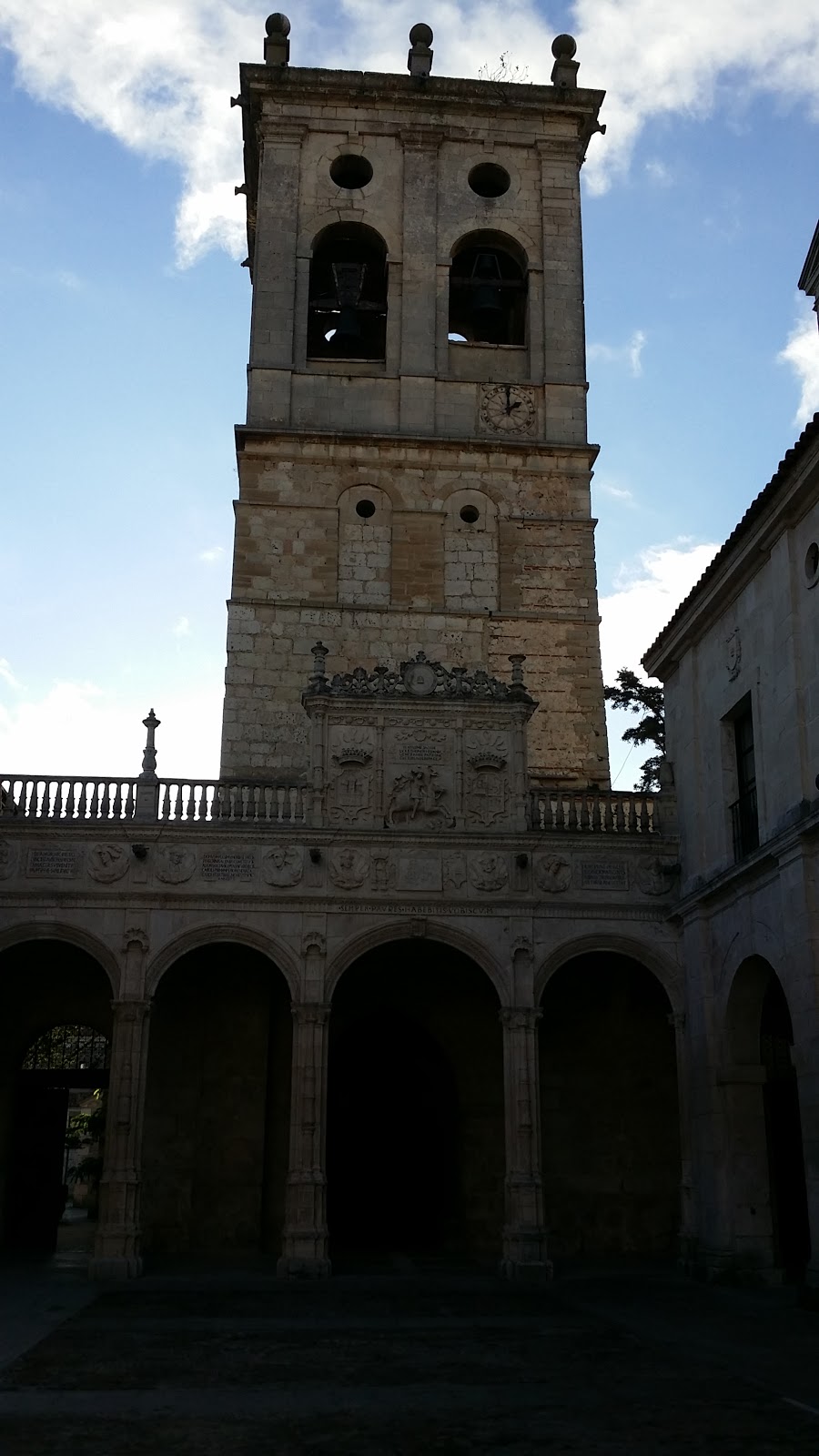
The present building however, dates from the 16th Century, when Ferdinand The Catholic made a grant in 1514 to replace the dilapidated medieval building with the vast complex we see today. Work continued through the 16th Century, with additions added in the 17th and 18th centuries. The result is an architectural creation that is considered one of the most important Renaissance buildings in Spain, especially due to it’s highly ornamented Plateresque façade.
Matthew examining the Mudejar ceiling
San Marcos unfortunately, also has a very dark recent history, which a lot of guests staying at the Parador do not realise. During the Spanish Civil War, between July 1936 and the end of 1940, the complex was turned into a concentration camp for Republican Militia members and political prisoners. Every conceivable room, including the church itself were turned into impromptu prison cells and at any one time approximately 7.000 men and 300 women were incarcerated. It is estimated that 20,000 prisoners passed through the cells and of the 3.000 deaths from political oppression recorded in León during this period, a good many of these occurred in San Marcos. Wandering around the Parador in the warm sunshine, it was hard to imagine the terrible deeds that had occurred around us and it was best not to think in too much detail what might have happened in the very room in which we were staying. The only mention of this grim past that we came across, was a plaque in the cloister explaining that damage to a religious monument had occurred when San Marcos was used as a political prison, and a passing comment on the sign regarding the Chapter House Mudéjar ceiling, stating that the room had been used a guard room for the prison guards. It may seem discordant to turn a former concentration camp into a luxury hotel and I read some criticism online about it, but I suppose what else could be done with such a landmark building that couldn’t be demolished due to it’s historic and architectural significance and had to be somehow rehabilitated?
We retired to our rooms to rest for a while and then David and I were cordially invited by text to attend a late afternoon soiree at the sumptuous apartment of Mr and Mrs Watson! We were given a grand tour of their suite and remarked on its generous size and on their balcony, which looked down on a peaceful garden of box parterres (unlike ours which, (this is just a tiny gripe) rather than looking out onto the Plaza de San Marcos, provided a view across a wide concrete area to the modernist building of the Junta of Castille and León), Then David and Matthew nipped out to the shops (well. You didn’t think we were paying for room service, did you?!) and bought some drinks and snacks and we spent an enjoyable time chatting and relaxing before taking an exploratory tour around the building itself.
Junta of Castille & Leon
There was a rather bizarre moment when we asked at Reception how we could visit the parterre garden that we could see from Matthew and Heather’s balcony and were directed into a nearby conference room where we were told we could climb out one of the large windows. Later we discovered that it could have been easily be accessed through the café / restaurant beside the front door!

The garden however. gave us a nice view of the Puente San Marcos crossing the rio Bernesga and to finish off the evening we walked along the riverside and then up into the San Claudio quarter for some dinner. Unfortunately, on the way back to San Marcos, my usually excellent sense of direction escaped me and as the new EU regulations on roaming data charges didn’t come in for another fortnight, we wandered aimlessly around for quite some time before we made it back – I suitably humbled!
Puente San Marcos
David and I said a fond farewell to Matthew and Heather and returned to our room to have showers and relax before bed. David commented on how quickly we had succumbed to luxury living in the hotel and how distant the rigours of walking the Camino already seemed. I had to agree with him -it was definitely time to enjoy a good night’s sleep in our very comfortable beds, but then in the morning cast soft living aside and get back on the road!

Saturday, 30 January 2016

Camino Day 15: Burgos - Hornillos (07/10/15)

A much easier day’s walking after the hard slog the previous day. We woke up at 6.30 am in the wonderful Emaús albergue and at 6.45 beautiful children’s choral music began from speakers set into the walls beside our bunk beds, which gradually rose in volume. I felt encouraged to rise above the problems and issues of life that can drag me down and instead, lift up our eyes and focus on God. The opening line of morning liturgy in the Book of Common Prayer for Ordinary Radicals says:

“O Lord, let my soul rise up to meet you

As the day rises to meet the sun”

The ethereal choral music certainly helped me rise physically and spiritually to face the day’s walking ahead!
Matthew & David outside the Emaus albergue
We had a communal breakfast together and said our goodbyes – we hoped to see some of our fellow pilgrims again, but David and the Polish brother and sister were walking faster and further than us, so we knew it was unlikely we would see them again as they planned to walk to Hontanas, whilst we were only going as far as Hornillos (21.0km). We slipped out quietly so as not to disturb those praying in the chapel and said our final goodbyes to Marie – Noelle, promising to pray for her as she requested.
Plaza Mayor
We cut down to the river and we could have followed the south bank westwards towards Santa Maria de Las Huelgas, but David wanted to find an ATM and anyway, I was keen to re-join the traditional Camino route in the medieval city centre. We had entered the old city through Arco San Juan and I wanted to symbolically exit the city through Arco San Martin. To do this we therefore crossed the rio Arlanzón on the Puente San Pablo, passed the statue of El Cid and walked across Plaza Mayor. It was lovely to see children walking to school, satchels on their backs, with their parents. This is one of the things I love about the Spanish cities I have seen; unlike British historic city centres, that seem to have lost their souls as families have moved out to the suburbs, families in Spain still seem to live their lives in the centres of cities like Burgos.
Arco San Martin
We found an ATM and then climbed up onto calle Fernán Gonzales, passing the rear of the cathedral where street sweepers were already at work, before exiting the old city through the 13th century Arco San Martin with it’s horseshoe shaped Mozarab gateway flanked by two towers. A descent down the hill on which the medieval city is built, brought us again across the Puente Malatos over the Arlanzón that we had crossed three days earlier when visiting Santa Maria de las Huelgas.
I was keen to see the 12th century gateway of the Hospital del Rey on the way out of the city, but I didn’t trust the John Brierley guidebook map of Burgos after our previous experiences of trying to find Las Huelgas and the Emaús albergue, so I asked a passing pedestrian. I was right to be sceptical; the map showed the Hospital del Rey as being just across the bridge behind the Hospital Miliatar. In fact it was on the other side of Parque El Parral. (It was however correctly located on the Burgos – Hornillos map). We reached the hospital passing another small hermitage gateway on the way.
Plateresque gateway of Hospital del Rey
The Hospital del Rey was one of the most important pilgrim hospitals on the Camino route and was founded in 1195 by King Alfonso VIII at the same time that he founded the convent of Santa Maria de las Huelgas. A few Romanesque ruins of the hospital survive, but most of what we see today dates from the 16th century and has now been incorporated into the Law Faculty of Burgos University. A fine Plateresque Puerto de Romeros (Pilgrim’s Gate) pierces the wall of the hospital and leads through to a courtyard with the equally fine Pórtico de la iglesia. According to A Practical Guide for Pilgrims by Lozano, the Renaissance wooden church door has exceptional wood carvings featuring three generations of a family making a pilgrimage to Santiago but I missed that detail!
The rising sun was setting alight the pinnacles of the Puerto de Romeros and making it look very special indeed, but I was aware that Matthew and David were not keen to loiter and were waiting impatiently, so I quickly took some photographs of the gateways and hospital ruins, nipped into the reception desk of the Law Faculty to get a stamp on my credencial and then we moved on!

We walked on through the suburbs of Burgos before finally entering open countryside. The weather was warm and sunny and the rain had gone. I was feeling a little weary and Matthew said his legs felt very tired. However we pressed on and we again found the fields full of dead sunflowers; many of them starting to fall over or rot. This mystified me – why plant field after field of sunflowers if they are not going to be harvested and left to start decaying? Were they harvested after we had departed? I saw hundreds of such fields of unharvested sunflowers on our walk. Maybe someone reading this blog can explain why?
Ruins of Hospital del Rey
In a picnic area near Villalbilla we stopped for a snack and together said Morning Prayer before passing under a railway line and negotiating the muddy and confusing building site where the intersection of the A-231 and N-120 was being re-designed. The extensive construction site was hard to negotiate and temporary Camino signs were confusing and hard to follow.
Fields of Dead Sunflowers
At Tarjados we bumped into the Polish brother and sister again who were just leaving a café as we arrived. We stopped for second breakfast; potato tortilla with chicken washed down with vino tinto and a café con leche for a caffeine boost.
Puente de Arzobispo
Just after Tarjados is the impressive Puente de Arzobispo (the Bridge of the Archbishop) across the rio Urbel. The Archbishop of Burgos used to have his palace at Tarjados (now the Vincentian Convent). Presumably he funded the building of the bridge? Apparently this valley between Tarjados and Rabé de Las Calzadas was once notoriously swampy and gave rise to a popular rhyme:

De Rabé a Tarjados,

no te faltarán trabajos;

de Tarjados a Rabé,

¡libera nos, Domine!”


“From Rabé to Tarjados,

you’ll have your work cut out for you;

from Tarjados to Rabé,

spare us Lord!”

With the bridge and a chat with some pilgrims from New Zealand along the way, the walk to Rabé seemed more pleasant for us!
Rabe de las Calzadas
We reached Rabé de Las Calzadas, where I hoped to see the church, however it was locked and three local women were scrubbing graffiti off the church wall outside the gate – clearly even small Spanish villages are plagued with the universal scourge of graffiti “artists” who in a similar way to stray dogs like to mark their territory!
Matthew looking intrepid before the Meseta escarpment!
After Rabé, the Meseta began – it’s initial escarpment rising up in a line before us after leaving the village. In some ways it reminded me of similar escarpments in the English South Downs. The Meseta itself is a high (610 -760m) plateau that covers about 50% of the Iberia Peninsula. As I said earlier in this blog, I was concerned about walking across it as I had heard such mixed reports about it; some people said it was wonderful with expansive horizons and wide vistas, but a lot of people seemed to find it mind numbingly boring and empty. I wondered what I would think myself as we began to ascend the 950m Alto Meseta?
Hermitage at Rabe with detail of doorway carvings

The initial ascent onto the escarpment was pleasant and Matthew and I took the opportunity to do Midday Prayer together as we climbed. At the summit of Cuesta de Matamulos (another mule killer slope!) however, we were surprised to suddenly come upon Matt who was sitting admiring the view with a few pilgrims he had met including Annika from Birmingham.
Meeting Matt surprised us as we were not expecting to meet up with him until we reached Hornillos. Matt of course was delighted to meet us and being the highly gregarious and talkative person that he is, immediately began to pepper us with conversation, questions and anecdotes about his pilgrimage thus far! As I lay on the grass resting I felt a sense of culture shock come over me; Matthew, David and I had spent five days travelling together and three days walking on the Camino and had fallen into a comfortable rhythm of talking interspersed with periods of silence quiet reflection. As often seems to happen when I walk on the Camino, I find that the longer I walk, the less I feel the need to talk and enjoy the periods of solitude and silence. Now suddenly, I felt bombarded by Matt’s conversation and almost unable to cope with it! My silence began to draw Matt’s attention, which only made me feel worse as he began to ask questions like “What’s wrong with you Michael?”, “Why are you so quiet?”, “Are you in a bad mood?”
Over the next few days I would struggle with Matt’s constant stream of conversation as we walked and I began to feel guilty for wanting to wander off by myself or just tell him to shut up for a few minutes! Matt is a lovely guy and his chatter was friendly and well-meaning. So why was I having trouble coping with it? Was I being selfish for wanting peace and quiet and the Camino? These were inner questions I struggled with as I walked.
The answer however came to me as I read Henri Nouwen’s The Way of the Heart – The Spirituality of the Desert Fathers and Mothers (www.harperone.com). I usually bring a small devotional book on the Camino to read at bedtime as I lie in my albergue bunk and this is the book I had brought this time. However, I didn’t get to read it until near the end of the trip and was therefore surprised to find that it was divided into three sections: Solitude, Silence and Prayer. As I read the chapter on silence, I was startled to hear Nouwen say that “First silence makes us pilgrims. Secondly silence guards the fire within. Thirdly, silence teaches us to speak” Nouwen then went on to quote Abba Tithoes who said that “Pilgrimage means that a man should control his tongue” and said that “To be on pilgrimage is to be silent (pergrinato est tacere)” In short, says Nouwen “words can give us the feeling of having stopped too long at one of the little villages that we pass on our journey, of having been motivated more by curiosity than service”.
The other positive feature of silence that Nouwen discussed was that Silence is the discipline by which the inner fire of God is tended and kept alive”. To illustrate this Nouwen quoted Diadochus of Photiki who said that “When the door of the steambath is continually left open, the heat inside rapidly escapes through it: likewise the soul, in it’s desire to say many things, dissipates it’s remembrance of God through the door of speech, even though everything it says may be good”.
From reading Nouwen’s book, I came to realise that God was actually speaking to me through Matt’s constant chatter. When I had started walking the Camino in September 2014, I had gradually realised that God was drawing me to the value of solitude; I had spent more and more time walking and sitting by myself, just enjoying the peace of God’s presence. This time I realised that God was speaking to me about the value of silence. It wasn’t about Matt talking too much or about me feeling selfish, it was about me learning to talk less and build up the steam of God’s presence and love in my heart, so that I have something to offer people when God brings them to me and to help me realise that silence, as Nouwen said, can become “a portable cell taken with us from the solitary place into the midst of our ministry”. This is countercultural stuff in a verbose world that never shuts up and is full of a constant stream of chatter (much of it inane) on radio, television and social media, but something I need to learn if I am to have anything to offer of value to those around me.
Descending Cuesta Matamulas with
Hornillos in distance
Nevertheless, as the four of us set off down the mule killer slope towards Hornillos, I deliberately hung back and let Matt go on ahead with Matthew and David so I could enjoy the peace of the Meseta!
Calle Real, Hornillos
At Hornillos we checked into the Meeting Place Albergue. The other albergues were filling up fast and we were unable to get into the albergue with the swimming pool! The Meeting Place was however pleasant and modern and we had no complaints about the facilities.
Medieval jettied buildings
After showering and resting David, Matthew and myself had a walk around the small town (more of a large village actually) which had clearly seen more prosperous days, but still had an attractive down-at-heel ambience. The main street was lined with medieval buildings – some of them dilapidated timber-framed structures with jettied protruding second storeys. There was once a Benedictine Monastery in the village and I wondered if one of the buildings on the Main Street was part of this or had been a Pilgrim Hospital as it had carvings of a chalice and St. Peter’s Keys and a Cross of Santiago over it’s doorways? Nearby, I was startled to see a more modern house with a stone medieval sarcophagus acting as the lintel over the front door!

Beyond the edge of town, David, Matthew and I also stumbled upon some medieval ruins which may have been the remains of the Hospital of San Lázaro – one of many leprosaria that were once strung along the Camino? The surrounding area seemed to full of storerooms built into the hillside and presumably used by the locals to keep produce cool in summer before the days of refrigeration?
Sarcophagus doorway
In the centre of the village was a small plaza with a Parish Church and the picturesque Hen Fountain or Fuente del Gallo. Annika was sitting on the steps of the municipal albergue doctoring her feet, which looked in a very sorry state with numerous blisters.
Fuente del Gallo
It didn’t take long to look around town and then Matt joined us and we had some lunch in a nearby café and shared communion together with some of the left over bread and wine. Afterwards Matt and David returned to the albergue and Matthew and I walked over to the beautiful parish church and sat for a long time. We enjoyed the soaring gothic architecture (surprisingly grand for such a small place and clearly hinting at a more important past) and enjoyed the peace; reading the Psalms of Ascents together and meditating on them.
We returned to the albergue in time for the communal meal of chicken paella and got talking to an American from California who works in an Emergency Control Room despatching the police, fire and ambulances in response to 911 calls. As David has spent a career working for the Fire Service in Cork, there was much comparing of notes between the way things are done in California and Ireland!


We finished the evening by sitting on the bench outside the albergue under a starry meseta sky saying Evening Prayer together before the chill got too much and we scuttled back inside.
Paella