Showing posts with label #Belorado. Show all posts

Thursday, 31 December 2015

Camino Day 13: Belorado - San Juan De Ortega (05/10/15)


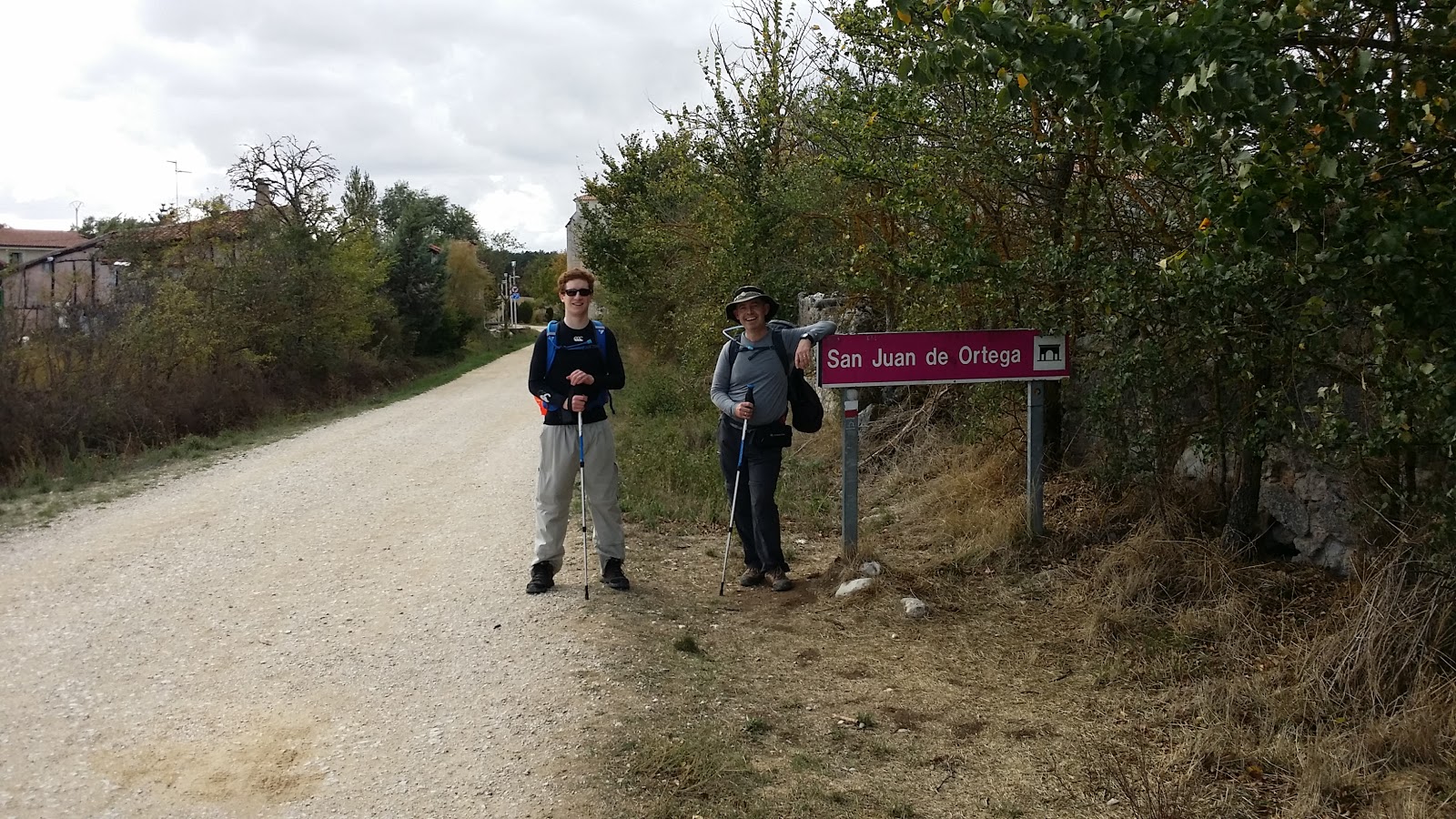
After a good breakfast in the albergue, the three of us headed out into a very grey and drizzly dawn. The distant storm in France was making itself felt with very breezy conditions and a mix of sunshine and showers. David and Matthew put rain covers over their rucksacks and I opted to wait and see how things went and only get out my poncho if necessary. Although the rain gradually subsided as we walked, the strong wind lasted the entire day. This was significant moment for Matthew; his first day walking on the Camino!
Matthew preparing for his first day on the Camino
The day’s walk was really in two parts; the first half consisted of walking across wide expansive farmland and the second half through mountain pine forest.
Leaving Belorado
We quickly passed through the small modern suburbs of Belorado, crossed the rio Tirón on a pedestrian bridge and onto the Camino track which runs raised above the N-120 along which we had come by bus the previous day. The sun came out and illuminated a vibrant rainbow against the dark sky and our early morning shadows lengthened in front of us.
Very soon over to our right, lit up by the sunshine near Tosantos, small cliffs came into view. These contain more hermit’s caves, like those below Belorado Castle and the 12th Century hermitage of Our Lady of the Rock Ermita de Nuestra Señora de la Peña, which apparently contains a Romanesque statue of the Virgin which is venerated locally.
Ermita de Nuestra Señora de la Peña
At Villambistia, we stopped in the grounds of Iglesia San Roque for Morning Prayer; which the three of us did sitting on a bench in the church grounds.
Doorway at San Roque
Our reading from Psalms was from Psalm 25: 6-10 and verse 10 struck us as highly appropriate for our first day walking again on the Camino:

“the paths of the Lord are love and faithfulness to those who keep his covenant and testimonies”
At San Roque
Just after the church we saw a sign to the right advertising a café and so we enthusiastically took the detour as it was definitely time for Second breakfast and enjoyed chocolate caliente and cakes!
Villambistia
Beyond Villambistia the expansive farmland continued and Matthew soon produced his binoculars to look at Griffon Vultures soaring in the distance and soon several Red Kites were also seen at closer quarters. Indeed Matthew’s inexhaustible enthusiasm each time we saw Red Kites (and we saw plenty during our walk!) quickly became a source of good natured banter between us as I pretended to yawn each time Matthew whipped out his bins to look at another one and he in response made exaggeratedly bored remarks about Romanesque baptismal fonts!
Fountain in Villambistia
We crossed the N-120 at Espinosa del Camino and about half a kilometre from Villafranca we descended a small ridge and came to Ábside de San Felices (San Felice’s Apse). The apse is all that remains of a 10th Century Mozarabic monastery that was dedicated to San Millán’s mentor, San Felices.
Matthew at Ábside de San Felices
The remains are interesting because the structure still contains a horseshoe arch influenced by Arabic architecture and has a small dome inside. I also noted a reused inscribed stone built into the apse which seemed to part of a Roman (or was it Visigothic?) gravestone? San Felices is also the reputed burial place of Count Diego Rodríguez, who founded Burgos in A.D. 884 and whose statue can be seen in the city in Plaza San Juan.
Interesting stone at San Felices
Shortly after this, we rejoined the N-120 and entered the town of Villafranca Montes de Oca. On the outskirts as we crossed the rio Oca, we passed a group of of about a dozen Senior Citizens filling numerous bulging carrier bags with the large amounts of walnuts which they were collecting off the ground. As I like a bit of foraging in the hedgerows back home for Sloe Gin and Blackberry Vodka, I was most impressed!
Looking back at San Felices
We found a small shop and stocked up on picnic provisions as we knew that this was our last chance before we climbed into the forests of the Montes de Oca. Next door was a bar (with a friendly cat) so I bought a glass of Rioja and poured it into my empty water bottle so that we would have wine for communion together when we did Midday Prayer later.
Friendly Cat!
Villafranca itself seemed fairly unremarkable (although maybe we missed the interesting bits?) and walking through it one could be forgiven for thinking that it is of relatively little historical importance. However it actually has great historical and ecclesiastical importance. According to tradition, when St. James came to Hispania on his evangelistic missionary trip, he brought with him seven Apostles, one of whom was San Indalecio. He was reputedly made a Bishop and converted the Auca area to Christianity. 2.3 km from Villafranca is the remote Ermita de Nuestra Señora de Oca and behind this is a medieval bridge Puente Viejo which leads to a stone water tank, the Pozo de San Indalecio, where legend says that San Indalecio was martyred. Each year on the Feast Day of San Indalecio (11th of June) a local pilgrimage to the site takes place.

What is certain, is that Villafranca was the site of the ancient episcopal see of ‘Auca’ (Oca). It’s first recorded Bishop was Asterio, whose signature appears in A.D. 589 at the Third Council of Toledo. Alfonso VI however moved the See to Burgos in 1075 which was a common practice in the period as kings sought to centre Episcopal Sees in the centres of secular power, the Norman kings did the same in England.
In the medieval period the town was an important stop on the Camino and had a pilgrim hospital as early as the 9th century. The name ‘Villafranca’ shows that like many other towns on the Way of St. James, it was resettled with Franks who arrived as pilgrims and then returned as artisans. The second half of the name “de Oca” comes from the Spanish for wild geese but is probably a corruption of the ancient name of Auca.
Taking a turn off the main road and up a track by the church we quickly began a very hard climb up into the forested Montes de Oca. This came as a shock to the system as it was our first day of proper walking. As I have explained previously, I am walking the Camino in stages of about one week or so each, as I cannot afford to take the annual leave from work needed to walk the entire Camino in one go. There are advantages and disadvantages to doing the Camino this way. On the positive side of things it means that I have time to really take the time to absorb all that the Camino has to offer and not feel constrained to reach Santiago in a limited timeframe of a few weeks. On the negative side however, each time my body is just getting used to increased levels of fitness and settling into the rhythm of the Camino and the aches and pains are beginning to subside, it is time to come home. As we climbed breathlessly into the Montes de Oca, I was reminded of this once again!
View as we climbed the Montes de Oca
The previous day Matt had texted us to warn us that “the pine forest goes on and on” and that he found it very tedious. The three of us however liked this stretch and enjoyed the seclusion and wildness of the forest. We fell into an enjoyable rhythm of chatting interspersed with periods of comfortable silence.

Although enjoyable to us, the Montes de Oca were once considered to be one of the most feared stretches of the Camino; a remote borderland place on the edge of Castille, full of dense forest and undergrowth where bloodthirsty bandits lurked who would prey on pilgrims and rob them. In keeping with this dangerous reputation the Book of Miracles in the famous Codex Calixtinus records 22 miracles in this area.
Although the initial climb was hard, it afforded expansive views back towards Belorado. We took a welcome break at Fuente de Mojapán – Moisten Bread Fountain where there was a shelter with a bench to sit in and eat a snack, though not of stale bread needing softening like out medieval pilgrim forbears.
Monumento de los Caídos
Eventually, we reached the stark Monumento de los Caídos – Monument to the Fallen. This is the site of two mass graves of about 160 combatants from the Spanish Civil War who were buried here in 1936. The first grave site was bleak enough with it’s concrete obelisk, concrete wall (with railing), small cross and another concrete marker. But nearby we found the second mass grave site, isolated amongst the trees and demarcated by a simple wooden fence and gate. Somehow the isolated nature of this second site made the atrocities of the Spanish Civil War seem much more real. Both mass graves had be excavated in the 1990’s by archaeologists and the bodies identified and returned to living relatives.
David at the second mass grave
The grave sites had be marked out with wooden sleepers and white stones. Information boards explained how the archaeologists had done their work and archaeological multi-coloured scaled diagrams showed the jumbled positions of the skeletons when excavated. Nearby a headstone listed the names of the dead. A pot plant left as a memorial, had blown over in front of it. I have never seen a mass grave before.

I don’t know which I found more disturbing; seeing the names of the dead in their long stark columns, the vibrant colours of the mathematically measured skeleton diagrams or the Fascist swastikas and graffiti that had been daubed everywhere showing that undercurrents of pain and hatred still remain just below the surface for some in modern Spain.

David and I stood a long time in silence. I reflected on the appalling thing that had happened here in this quiet forest not really that long ago; in the year that my grandparents had married in Ireland these kinds of terrible atrocities were happening and were only a foretaste of the many more mass graves that would disfigure Europe in the days ahead as the dark cloud of World War II approached. Soberingly, they were also just like the ones that had happened during the time of my own married life in the former Yugoslavia. I silently lifted the pot plant and set it back in front of the headstone; it was as the only mark of respect I could think of offering.
Nearby were a group of picnic tables which seemed to me an incongruous site for lunch so near as they were to the graves, but we were now fairly hungry so we ate lunch and then said Midday Prayer together, before taking a little of the bread we had reserved and the wine I had bought at Villafranca and sharing Communion.
Matthew and I
Refreshed, we carefully descended the very steep track down to the footbridge over the Peroja stream, before ascending once more to reach the summit of our walk that day at 1,150M. We carried on through a long stretch of pine and oak forest. Along the way we found that the wide forest path was strewn with messages that other pilgrims had written using stones. It was fun to read them. The possible monotony of the forest also was also broken by a forest clearing where colourful totem pole sculptures of pilgrims and goofy faces had been erected.
Messages in stones!
Finally, the forest began to break up into some open clearings and in the distance we could see the buildings of San Juan de Ortega. It was a welcome sight; we were all getting tired. However there was a little life in the old dog yet – Matthew is very competitive and can’t resist a challenge, so when I saw the sign for San Juan in the distance I deliberately started to running because I knew Matthew wouldn’t be able to resist and have to go tearing past me to stop me saying that a forty year old had beaten him to San Juan! It worked of course – Matthew soon raced past whilst I chuckled and David, the only the mature member of our group, told us off for risking injuring ourselves when our bodies were tired at the end of a long walk!
Altogether the walk had taken 8 hours and 5 minutes.
David & Matthew powering towards San Juan
San Juan at last!

Sunday, 20 December 2015

Burgos - Belorado (04/10/15)


The Jimenez bus from Burgos to Belorado left at 14.00 and took exactly one hour. On the way, Matthew and I took the opportunity to do Midday Prayer together and I had time to look out the window and reflect how different the landscape looked compared with back in March when all had been covered in snow and David and I had been travelling in the opposite direction.

Matt had texted us earlier to say that although he had reached Belorado the previous day, he had decided to continue on and not wait for us as there “wasn’t much to see” in Belorado and was staying that night in Agés. He had arrived there after sharing a taxi from San Juan de Ortega with some English pilgrims he had met.

David and I thought it would be good for Matthew to stay in a slightly nicer private albergue on his first night in a Camino hostel, so we booked back into Albergue Quatro Cantones and it was interesting to note what a different feel the Albergue had compared with back in March. Back then only the ground floor with the cosey kitchen and one dormitory had been open for the winter months. Now however, we found that there were an additional three floors above us and a restaurant for dinner and breakfast – all accessed by an impressive traditional staircase that wound up the middle of the building in a similar fashion to the staircase I had seen back in the very first albergue I stayed in at St. Jean Pied de Port.

We chose a smaller dormitory of 6 beds for a small additional cost, instead of the larger ground floor dormitory and were allocated beds on the top floor. Matthew commented afterwards however that he thought it was a little expensive and not as basic as he had expected, and hoped we would be staying in cheaper albergues for the rest of the trip – so much for breaking him into albergues gently! I should have known; he likes budgeting and saving money!!

Once we had checked in, we decided to have a wander around Belorado. The last time I had been here it had been very cold and most of my clothes had gone to the laundry, so I felt that I hadn’t been able to get a proper look around the town before retreating back inside a warm bar. I had also discovered since my last visit that there was a path to the ruins of the castle up the side of the Santa Maria parish albergue and I was keen to explore it!
Close up of Santa Maria Belfry
When we walked over to the Church of Santa Maria, I was pleased to find that it was open, as it had been locked in March and we went inside. Situated at the foot of the hill on which stands the ruins of Castle, the church was originally the chapel for the fortress. It was remodelled in the 16th century, but because it wasn’t in a very secure position compared with the rest of the castle, it was eventually closed and it was only reopened in 1910 when it was rebuilt in a neo-gothic style with a slender traditional belfry.
Inside, the church has three naves, a small dome letting in light at the crossing and an impressive 17th century high altar. To the right, when facing the altar, is a side chapel which I went and sat in for a while so I could examine the notable stone retable dedicated to St. James. Someone had placed a vase of red and pink gladioli in front of the retable adding a splash of colour in the dim light. St. James appears in both his Camino guises in the centre of the retable, inside a two storeyed structure of classical pillars. Below, he appears as St. James the pilgrim, with his hat, staff and water gourd and above as St. James Matamoros – the Moor Slayer. A rather comical sculpture of God the Father bizarrely seemed to be squeezing out of the pediment at the top to bless those below, as if almost added as an afterthought.
St. James Retable
I was also fascinated by the strange (Baroque?) wooden carvings of faun-like mythical semi-human & semi beast creatures that were supporting a coat of arms on top of the screen between the chapel and the high altar. There was a strange manic ferocity about the way they had been portrayed with windswept hair, apparently playing tug of war over the coat of arms.

I rejoined Matthew and David and as there was no one else in the church, we took some time to sing some worship songs together and enjoy the acoustics before we left.
Castle Ruins
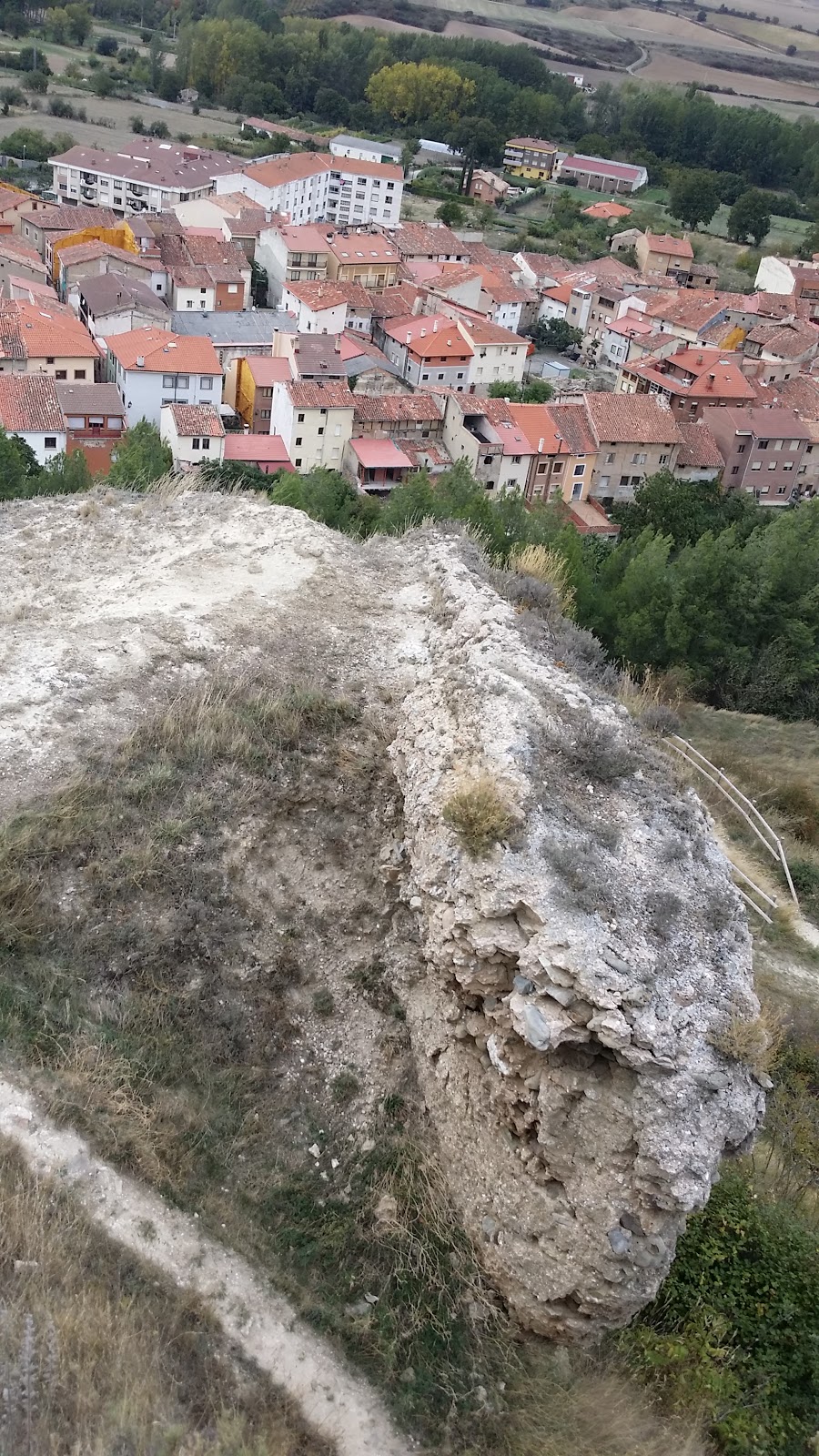
We then walked up to the castle. Very little remains of this once important Aragonese fortress that once guarded the frontier with Castille, except some bulky fragments of shattered stone and brick walls on top of natural rock outcrops and what looked to be like the possible base of a tower. Basically though, it was impossible to get an idea of the original layout or size of the castle and it was only afterwards on the internet that I found the Francisco Coello map dating from 1868 which suggests that the castle (far left middle of map) was a square courtyard with towers at the four corners
The castle mound was covered with wild roses bedecked with rose hips and a few autumn crocuses were making valiant efforts to peep through the tussocky grass. A wild wind was adding to the general air of bleakness around the ruins and at times the gusts were so strong that it was hard to stand and walking around the paths below the walls was rather precarious at times. What we didn’t know at the time was that the wind was a forerunner of the edge of a storm which at that moment was battering the French Riviera; 17cm / 6.7in of rain had fallen in two hours, causing serious floods in Antibes, Cannes and Nice, killing at least 19 people. We would feel the edge of this storm over the next two days as we walked to Burgos.

The view from the castle ruins over the rooftops of Belorado was good however, and looked small and tucked into it’s river valley. Apparently the town was once much larger and more prosperous with additional quarters that have now entierley disappeared. It had a vibrant and important Jewish quarter, but when the Jews were finally expelled from Spain in the 17th century, the town began to go into serious economic decline and by the 18th century was already much reduced in size and has never really recovered. It certainly has the feel of a place that the tide of history has passed by.
We were grateful to descend the hill out of the ferocious wind and made our way to the town plaza. As I explained in my last post, Matthew is a rugby fan; he played it at school and is an avid follower and as the Rugby World Cup was taking place in England and Wales during some of the time we were walking, he was desperate to see the Ireland vs. Italy match which was starting at 17.30 Spanish time.
Base of Castle tower?
Personally, rugby does not have any pleasant connotations in my mind but reminds me of freezing cold November mornings at Gransha Boy’s High School in Bangor, County Down, in the early 1980’s when boys twice my size were given license in the name of Sport, to jump on me and press my face into the mud whilst taking the opportunity to surreptitiously stick the boot in somewhere soft! However, as Matthew is a valued friend and as I knew seeing the Ireland/Italy game meant a lot to him and as I had subjected him to hours of Spanish history earlier in the day at Las Huelgas , I agreed to watch it with him if he could find a bar that would show it. Needless to say however, although we tried three bars around the Plaza with Satellite TV, we either got blank looks when rugby was mentioned or else were told that it wasn’t possible as some Spanish soccer match was on instead.
 Matthew returned to the albergue looking rather forlorn, but then I had the bright idea that if we could’nt see the match at least we could tune into Radio Ulster online using my mobile on the albergue wifi and at least listen to the commentary. And so it was that we sat on a bunk bed (as my mobile needed charging and had to plugged into the wall) in a Spanish albergue and listened to the Northern Irish tones of the commentator describing the second half, whilst two American lady pilgrims looked on politely.
View over roof of Santa Maria

Matthew really does have an impressive and compendious knowledge of Rugby and it’s rules and valiantly tried to explain the game to me and what was going on as the second half of the game proceeded. I almost felt that I was beginning to actually understand what was going on (as rugby usually makes no sense to me whatsoever!) and even slightly enjoy the experience. But don’t tell Matthew that or he might suggest that I join him to watch a match back in Ireland!
Plaza Mayor

We rounded off the day with a pilgrim menu meal in the albergue restaurant and then reorganised our bags and made ready for getting back on the pilgrim trail the following morning.