As
I mentioned in the previous entry, Matt and Matthew were keen to see the stars
over the Meseta, so we got up early at 5.55am. The scowling French lady in the
bunk below, who had been so unfriendly the day before, obviously saw me as some
sort of leader of our group (due to my grey hair!?) and came into the bathroom
at 6.10am (presumably as a reprimand) to show me the time on her wrist watch
before shuffling off scowling again.
 |
The misty pre-dawn summit of
Alto Mostalares
|
We
quietly made our way through the silent streets of Castrojeriz, past San Juan
and down towards the rio Odrilla. It turned out to be very misty, so there were
no stars, but it was wonderfully atmospheric as we crossed the marshy area by
the river, full of the noise of waking birds and began to ascend the Alto
Mostalares. Mind you, the sense of misty seclusion was somewhat interrupted by
Matt who kept bursting into loud exuberant worship songs, causing Matthew to
comment something along the lines that the silence peppered by the occasional
bird noise could be very lovely and
evocative if only we were able to enjoy it!

It
was still foggy at the summit of the Alto, but the sun rose suddenly over the
Meseta as we descended the far side revealing a spectacularly beautiful scene
as the track stretched before us and banners of mist lingered. The landscape
was bejewelled with spider’s webs encrusted with sparkling dew drops and an all-encompassing
silence hung over all; this was the Meseta at its most beguiling.
At
Fuente del Piojo we stopped for a small picnic breakfast and Morning Prayer. Matt
was eating some chorizo and bread and I was pulling his leg about his
pronunciation of chorizo, to which he took offence as he was tired and stomped
off after telling me that “the trouble with you Michael is that you never know
when to stop” which may indeed be true!
 |
| Sloes |
We
came to the wonderfully evocative 13th C pilgrim’s hospital of San
Nicholas, which after being derelict for several centuries, has fairly recently
been restored and opened as an albergue by the Italian Confraternity of St.
James of Perugia. Inside there is space for only 12 pilgrims who can stay in
fairly basic conditions, but enjoy a communal meal lit only by candles. I would
dearly have loved to stay there and hope I can return someday and do just that.
We enjoyed an espresso coffee, gave a small donation and had our credencials
stamped.
 |
| Hospital San Nicolas |
A
little beyond the hospital we crossed the rio Piseurga on the majestic eleven
arched Puente de Itero, built in the
11th C by Alfonso VI, whose development of the Camino we have seen
examples of since Najera. Upon crossing the river, we were leaving the province
of Burgos and entering Palencia. The river was in the past the border between
the Kingdoms of Castille and León and indeed the name Itero comes from the
Spanish word “hito” which means
boundary stone and indeed, a modern boundary stone welcomed us to Palencia.
 |
| Puente de Itero |
The
river is also the point where the area called the Tierra de Campos or Land of
Fields starts and continues to the rio Cea at Sahagún. This is a rich and
extensive agricultural area that is well irrigated by canals and specialises in
wheat, vegetable and wine production. In Medieval times it was also known as
the Campi Gothorum or Fields of the Goths and much admired for
its rich agriculture but also noted for its unvarying landscape. The Poitou
priest Aymeric Picaud who wrote the Liber
Peregrinatos in about 1130; the first European Guidebook to the Way of St.
James comments about the Tierra de Campos that:
“It is a land
full of treasures, of gold and silver, rich in wool and strong horses, and
abounding in bread, wine, meat, fish, milk and honey. However, there are few
trees…”
 |
| Irrigated fields on the Tierra de Campos |
We
stopped at Itero de la Vega for second breakfast in a rock music themed café as
we admired the proprietor’s business acumen who had sent out a woman to meet
hungry pilgrims and distribute flyers to them advertising the cafe about 500 m
before the village was reached. The bacon and eggs (accompanied by the
obligatory medicinal Rioja) was excellent and lived up to the billing on the
flyer! By the time we left Itero Matt and I had walked together and had a chat
and our recent disagreement was soon forgiven and forgotten.
 |
| Itero de la Vega |
We
walked on, crossing under the Canal Piseurga and stopped for Midday Prayer on
the summit of a small hill crowned by pine trees, however we didn’t linger as the
pines in addition to providing shade, also sheltered a density of midges worthy
of Scotland in August!
Just before Boadilla del Camino we met a shepherd leading his flock of sheep which reminded me of the words of Jesus in John 10:27:
"My sheep listen to my voice; I know them, and they follow me"
We stopped for lunch at the En El Camino Albergue, which has extensive gardens and a swimming
pool and this allowed us to have a very pleasant outdoor dining experience.
Outside the albergue is the wonderful 15th C village cross or Rollo, which is a stone column that
functioned as a symbol of judicial authority and was the place where trials and
executions would have taken place. The rollo was richly decorated pilgrim
scallop shells and other motifs. I was also keen to visit the 16th C
Parish Church of the Assumption as it apparently contains a beautiful 14th
C gothic baptismal font, but David made me laugh by remarking about my deep
interest in such things that “I need this church to be closed” and indeed he
got his wish as it was and so we trekked onwards!
 |
| Boadilla Rollo |
After
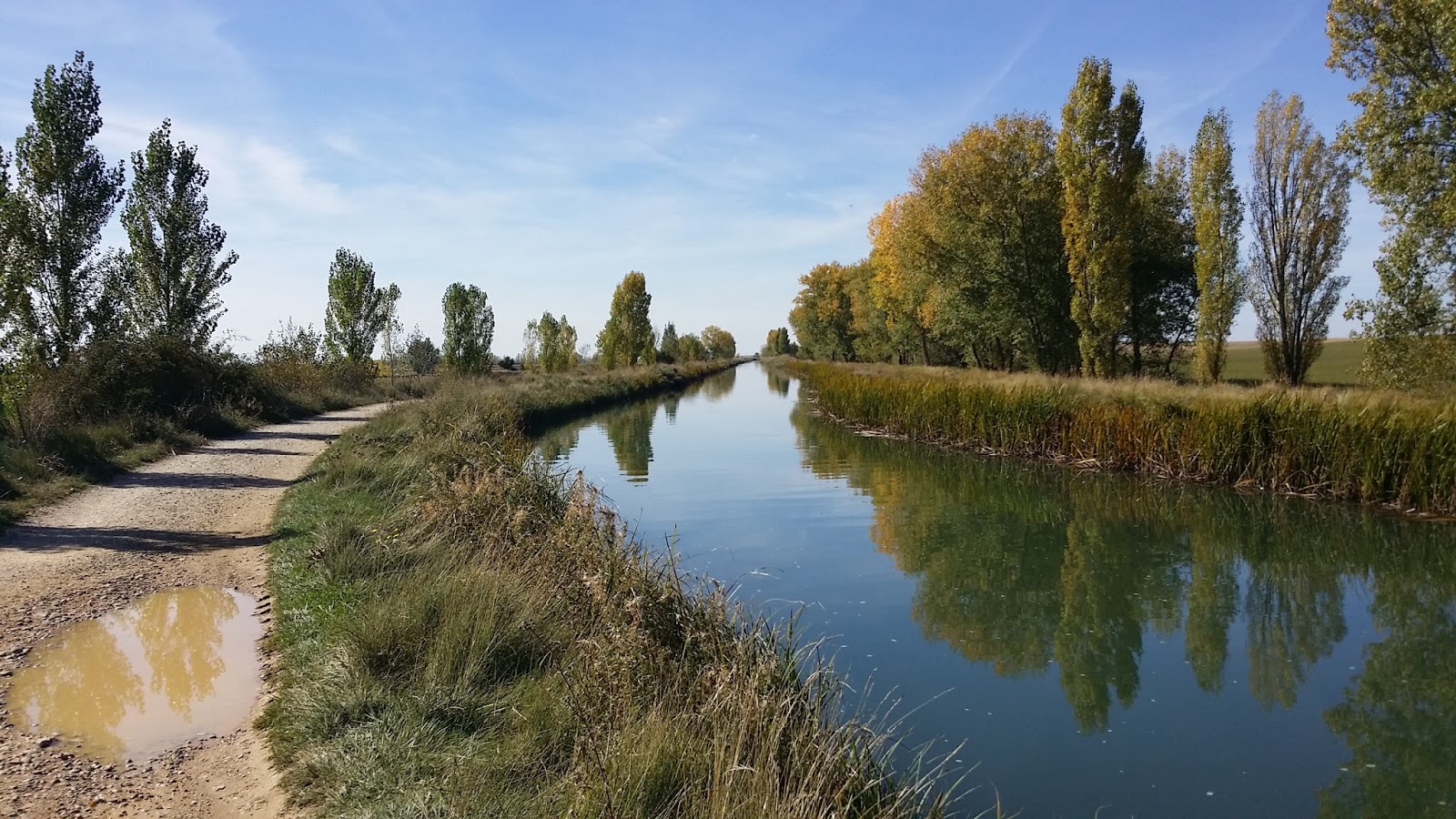
Boadilla we had a little trouble finding our way onto the tow path of the Canal
de Castilla, but once we did, we enjoyed a very pleasant tree-lined walk
alongside the canal all the way to Frómista, noting how at regular intervals,
irrigation channels ran off the main canal to water the surrounding fields. The
modern Canal Piseurga that we passed under before Boadilla was created for
irrigation purposes only, however the Canal de Castilla was created in the 18th
C and according to the Lozano guidebook (see bibliography) it was “an important feat of 18th-century
engineering…the fruit of the enlightened policies of the Marqués de la Enselada,
and had a triple function: the transport of cereals, irrigation and grinding
corn” the latter being because it provided water to power mills. The canal
locks which we saw are now all defunct with no gates and it seemed to me that
if they are restored, the canal could become one of the great canal journeys of
Europe and attract tourism to the region with the accompanying narrowboats and
marinas. Apparently, there is indeed such a plan and to see the large locks
functioning again would be an impressive sight.
 |
| Canal de Castilla |
 |
| Matthew, David & Matt on the canal locks at Fromista |
Arriving
at Frómista, we checked into the Estrella
del Camino albergue which had a pleasant ambience, nice gardens and an
ancient dog belonging to the owners which could barely walk due to its
antiquity! We were pleased to meet up again with the Danish lady from Sweden
who we had met at the Emaús albergue in Burgos and David enjoyed a long chat
with her about the Camino.
 |
| Hospital de Palmeros |
After
a rest and a shower, I was keen to see the famous 11th century
Romanesque church of San Martín. On
the way and fairly close to the albergue, we stopped to take a look at the
exterior of the medieval Hospital de
Palmeros, which is now a restaurant serving authentic (but rather expensive)
Castillian cuisine. The name palmeros is
rather interesting as it refers to Palmers
– pilgrims travelling to Jerusalem who had the palm leaf as their symbol.
It may be that it refers to pilgrims passing through the area on their way to
Jerusalem, but the term also later came to apply to pilgrims in general.
 |
| San Pedro |
Close
by is the gothic church of San Pedro with its vaulted ceiling which was
delightfully out of alignment (subsidence? A dodgy architect?). In the shop I
bought a pin for my hat of the rollo at Boadilla.
 |
| San Pedro Vaulting |
San
Martín itself for me, lived up to it’s billing, though of course, Matthew was decidedly
under awed by the Romanesque as usual! Consecrated in 1066, it was founded by
the widow of Sancho III of Navarre and is considered one of the greatest
examples of the climax of Romanesque architecture in Spain.
 |
| San Martin |
Constructed from a
warm yellow stone the church has two drum towers on the west front, three apses
at the east end and an octagonal tower rising over the crossing. Two bands of
chequered stonework lighten severity of the walls, however the main feature of note
on the exterior are the 309 corbels that run around the eaves and are decorated
with a profusion of animal, vegetable, geometric, monstrous and human
representations.
 |
| Exterior of apses showing corbels |
The
interior of the church reveals a basilica plan with three naves; the largest
and highest leading to the central apse where a 14th century
crucifixion hangs behind the altar and two lower side aisles leading to the
smaller side apses.
The beginnings of the development of churches with a Latin
cross design is also in evidence as there is a transverse aisle running across
beneath the octagonal tower. The majority of the aisle pillar capitals are richly
carved with biblical scenes such as Adam and Eve and the Adoration of the Magi,
but some have ornamental plant and animal motifs and I enjoyed examining them.
 |
| Adoration of Magi capital |
As
I sat in the main aisle I had to admit that there is perhaps something more
appealing about the lighter frivolity of gothic architecture with its fluted
columns and soaring vaulting compared with the austere plain-ness of the
Romanesque stonework as displayed at San Martín, and yet there was something awesome,
something stately, triumphant and powerful about the church – it made the
weight of its presence felt, which is no doubt what the medieval church and
kings of Castille and León wished to convey!
 |
| Main Aisle |
Of
particular interest inside was a model showing how the church looked in the 19th
C, with its semi derelict timber framed extensions (similar to the church we
saw in Itero de la Vega) before it was heavily restored back to its original
Romanesque state.
 |
| Crossing beneath octagonal tower |
If
there was a downside to the church it was that it now seems rather marooned in
a sterile wide plaza, covered with modern flagstones. It gave the impression of
the 11th century having been incongruously dropped into a 21st
century square – the kind of feeling you get when you visit some ugly British
cities that were bombed in WWII or subjected to “improvements” in the 1970s and
where you come across some medieval church surrounded by a shopping mall and with
a concrete office block in the background. This is perhaps no surprise as Frómista
was apparently a centre of the rail industry in the 19th C and industrialisation
never improves a town in my experience. I am sure a few trees and flower beds
could have made the surrounding area look less sterile, but perhaps trees would
damage any surviving archaeology of the monastic complex that must have once
surrounded the church?
Sitting
outside in the sun contemplating this, various bells began to ring around Frómista
calling the faithful to Mass and an American pilgrim standing nearby enquired
if there was an emergency? I squinted at him in the sun and at first thought he
must be joking, but then realised that no, he really did think the bells were ringing
for the emergency services. I suppose living in Ireland where the Angelus bell
rings on the national radio station at 12.00pm and 6.00pm before the News, I
have come to imagine everyone knows about these things, even if like me, you
are not a Catholic!
I
was all for trying the authentic Castillian cuisine at the Hospital de
Palmeros, but the others, probably rightly, felt it was too expensive and so we
went to a rather generic café nearby for pizza. Afterwards we headed back to
the albergue where Matthew and I said Evening Prayer together before bed.
We
had come to the end of my third section on the Camino and it was time to travel
home the next day. Anyone for Castillian cuisine to celebrate when we next
return….?